Thank you! We will get back to you soon
Oops! Something went wrong while submitting the form.
From multi-leg shipments to fluctuating rates and constant coordination, generic tools often fall short.
Choosing a CRM for logistics isn’t just about picking what’s popular — it’s about finding one that can actually handle the complexity of freight operations.
In this guide, we compare 10 CRM platforms for 2026 to help you find the right fit and see where freight-specific solutions truly stand out.


A logistics CRM (Customer Relationship Management system) is a platform designed to manage customer relationships alongside shipment data, carrier interactions, and the multi-step workflows involved in freight operations.
Unlike generic CRMs that focus mainly on contacts and communication, a logistics CRM connects sales, operations, and finance—giving teams a complete view of each customer’s activity across the entire shipment lifecycle.
The best CRMs for logistics in 2026 include:
That said, the right choice depends on your operation—whether you're running a trucking company, freight brokerage, or full-service forwarding business.
In practical terms, this means your team isn’t just tracking conversations. Instead, they can see a customer’s active shipments, preferred trade lanes, outstanding invoices, and quote history—all in one place. This level of context helps teams sell more effectively, respond faster, and deliver a better customer experience.
Generic tools like spreadsheets and basic CRMs break down in freight operations. They can't handle multi-leg shipments, fluctuating carrier rates, or the constant coordination between sales, operations, and finance teams.
Here’s why:
When your sales team uses one tool, operations uses another, and finance lives in spreadsheets, customer context gets lost between handoffs. Your ops team can't see what sales promised. Your sales team doesn't know which shipments are delayed. And finance is chasing down information from both sides.
Beyond operational inefficiencies, the lack of a unified CRM directly impacts your bottom line. Without clear visibility into shipment-level costs and revenue, margins become difficult to track and protect.
Missed or delayed charges often lead to revenue leakage, while slow or disconnected processes can delay invoicing and disrupt cash flow. Over time, these gaps compound—quietly eroding profitability across your operations.
Standard CRMs weren't built for logistics companies. They lack the ability to link sales opportunities directly to shipments, track multi-leg journeys, or connect quoting with invoicing. Without freight-specific workflows, forwarders end up building clunky workarounds—or reverting to email and spreadsheets entirely.
Consider a common scenario: an RFQ arrives, and your team spends hours hunting through carrier rate sheets, building a quote in Excel, and emailing it back. Meanwhile, a competitor with automated quoting responds in minutes. In freight, speed often determines who wins the business.
As your business grows, manual processes don't scale—they just require more people. A unified CRM allows you to handle more volume without proportionally increasing headcount. That's the difference between sustainable growth and growing pains.
With these challenges in mind, here’s how to choose the right freight CRM.
Before evaluating specific tools, it helps to understand what separates a freight CRM from a generic one. The following criteria will guide your assessment.
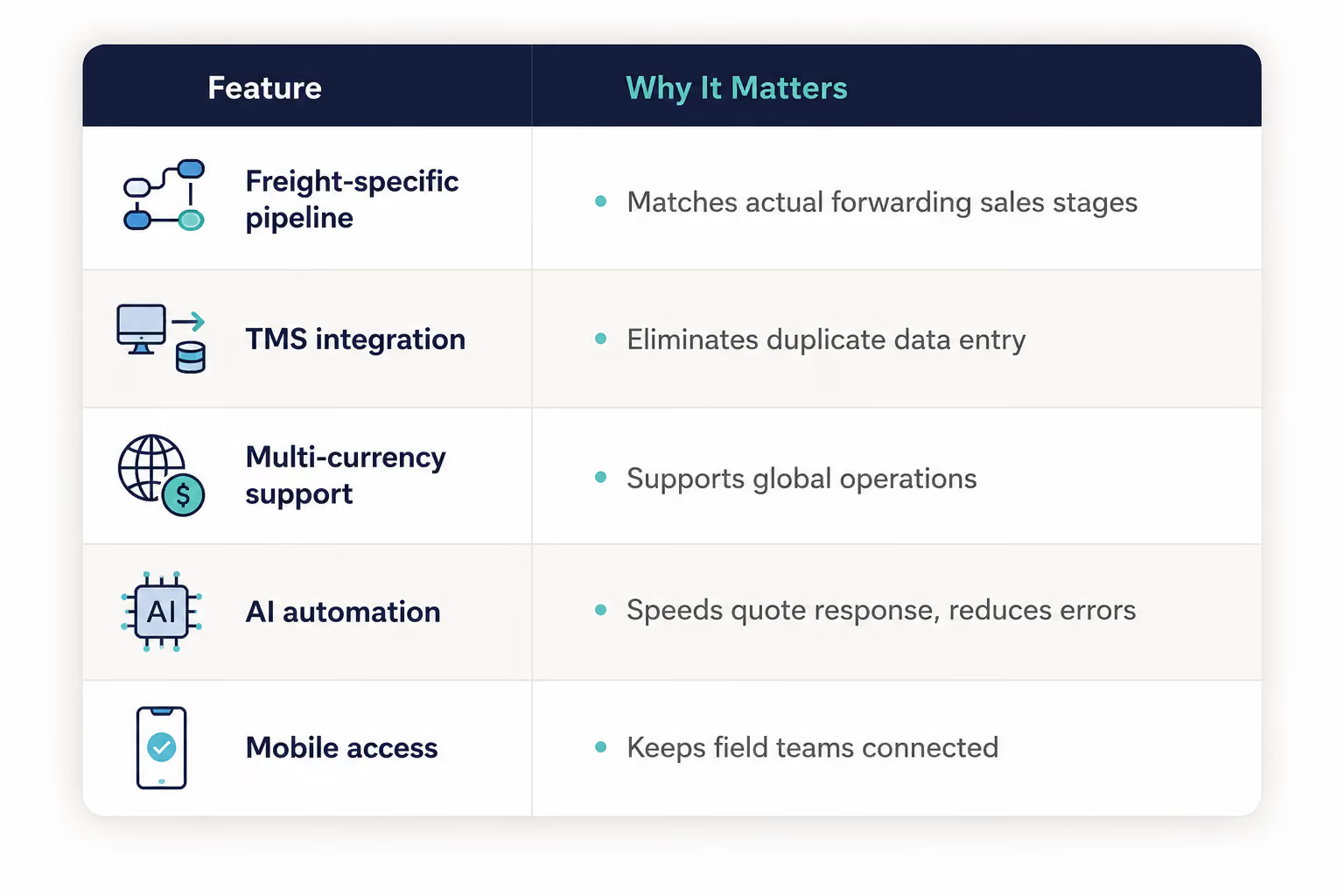
Your CRM pipeline stages ought to reflect your actual sales process. Look for configurable stages like RFQ Received, Quotation Sent, Booking Confirmed, and Shipment Executed — not just "Lead" and "Won."
To avoid data silos, your CRM connects best when it links to your Transportation Management System (TMS) and accounting software. The goal is single-entry execution: enter data once, use it everywhere.
For global forwarders, handling multiple currencies and managing different legal entities within one platform is essential for accurate reporting. Without this capability, teams end up maintaining parallel systems for each region.
Modern CRMs use AI-driven automation to parse unstructured data from emails, rate sheets, and RFQs. This reduces manual data entry significantly and accelerates quote response times—turning hours of work into minutes.
Your sales and operations teams often work outside the office. A CRM with robust mobile capabilities and real-time shipment visibility keeps everyone aligned, whether they're at headquarters or visiting a client site.
With so many options out there, it’s easy to get lost in the noise — but don’t worry, we’ll help you cut through it.
Here are some of the top CRM systems to consider:
Best for: Freight forwarders seeking a unified platform
Shipthis offers a freight-native CRM fully integrated with operations, quoting, and accounting. AI-powered automation parses emails and documents automatically, while single-entry execution flows data from quote to final invoice without re-keying. The branded customer portal gives shippers real-time visibility without email back-and-forth.
Best for: Sales-focused transportation companies
Pipeline CRM provides highly visual pipeline management designed for sales team productivity. It's straightforward to set up and particularly effective for teams that prioritize deal tracking over deep operational integration.
Best for: Freight forwarders with warehousing operations
Magaya focuses on the end-to-end supply chain, with integrated quoting workflows and a direct connection to their Warehouse Management System (WMS). For forwarders who also manage inventory, this integration eliminates a common gap between sales and warehouse operations.
Best for: Freight brokers and carriers
Pipedrive excels at deal tracking and pipeline visualization. Its communication automation features make it popular among brokers managing high volumes of carrier and shipper relationships. The interface is clean and the learning curve is gentle.
Best for: AI-powered lead management
Freshsales includes "Freddy AI" for lead scoring and task automation. The 360-degree customer view and strong mobile capabilities make it useful for field sales teams who spend more time on the road than at a desk.
Best for: Enterprise logistics operations
Salesforce offers unmatched scalability and customization for large, global organizations. However, that flexibility comes with complexity and premium pricing. Implementation typically requires dedicated resources or external consultants.
Best for: Small to mid-sized logistics companies
HubSpot's generous free tier and user-friendly interface make it accessible for smaller teams just getting started with CRM. The integrated marketing and service hubs add value as your operation grows and your requirements expand.
Best for: Customization and omnichannel communication
Zoho provides a highly flexible platform with a powerful workflow builder. It supports communication across email, phone, social media, and customer portals—useful for teams that engage customers through multiple channels.
Best for: Logistics companies requiring ERP integration
NetSuite combines CRM and ERP functionalities in a unified platform. This provides complete financial visibility from lead to payment, though it's priced for enterprise budgets and typically involves longer implementation timelines.
Best for: Low-code process automation
Creatio's no-code workflow builder allows you to design custom processes without developers. It's well-suited for companies wanting to build unique logistics workflows that don't fit standard templates.
So, what do you actually gain from using a logistics CRM?
Read on to find out.
When your systems are built for freight and actually work together, the difference is immediate:
When sales and operations share a single system, you eliminate the re-keying of shipment details, customer information, and pricing. Data entered during quoting flows through to booking and execution automatically. This single-entry approach reduces errors and frees your team to focus on higher-value work.
Centralized rate management and automated quote generation compress response times from days to hours—or even minutes. When your team can pull rates, apply margins, and send quotes without switching between systems, the entire revenue cycle accelerates.
With automated reminders and complete customer history visible in one place, leads no longer fall through the cracks. Your sales team can follow up with context, knowing exactly where each opportunity stands and what the customer has shipped before.
Linking CRM data with live shipment information allows your team to provide proactive updates. When a customer calls, your team sees their entire history—including active shipments and any exceptions—enabling a more informed conversation.
CRM dashboards provide real-time visibility into pipeline value, win/loss rates by trade lane, and sales team performance. Rather than compiling reports manually at month-end, you can see where your business stands at any moment.
However, the real value of a CRM comes from how well it integrates with your supply chain.
A modern freight CRM acts as the central nervous system for your commercial operations. It connects customer-facing activities with back-end supply chain systems, ensuring data flows smoothly between carriers, customers, and internal teams.
This connectivity eliminates the fragmented, email-heavy processes that slow down most forwarding operations. When your systems talk to each other, your team spends less time copying data and more time serving customers.
Still got questions?
We’ve got you covered.
Here are some of the most common questions about logistics CRM software answered:
A logistics CRM includes freight-specific features like shipment linking, multi-leg tracking, and rate management. Generic CRMs lack these capabilities, which forces forwarders to build custom workarounds or rely on disconnected spreadsheets to fill the gaps.
Pricing ranges from free tiers for basic contact management to enterprise subscriptions costing hundreds per user monthly. Most logistics CRMs offer tiered pricing based on user count and feature access, so costs scale with your team size and requirements.
Cloud-based platforms with guided onboarding can be operational within days. Complex enterprise systems requiring custom integrations and extensive data migration may take several months to fully deploy.
Most CRMs complement a TMS by adding sales and customer management capabilities on top of operational workflows. However, some unified platforms combine CRM, TMS, and accounting functionalities into a single system, potentially replacing separate tools entirely.
Pipedrive and Pipeline CRM are popular choices for freight brokers focused primarily on sales pipeline management. For freight forwarders who require deeper operational integration beyond sales tracking, a unified platform like Shipthis typically provides better alignment with day-to-day workflows.
The right CRM can be the solution to many of the challenges freight forwarders face today. Built specifically for the complexity of freight operations, it streamlines workflows across sales, operations, and finance—eliminating the need for disconnected tools and manual workarounds.
Looking for a unified CRM designed for freight forwarding?
Shipthis brings everything together in one platform—from quoting and customer management to operations and accounting—giving you complete visibility and control.
Get in touch with our team to schedule a free demo and see how you can streamline your freight operations.
