Thank you! We will get back to you soon
Oops! Something went wrong while submitting the form.
Behind every shipment is a complex web of vendor costs, invoices, currencies, and late charges. Without clear accounting, these moving parts create blind spots that quietly eat into your margins — that’s where freight forwarding accounting comes in.
This guide covers the core concepts of freight forwarding accounting, key challenges, and practical strategies to help you gain full control over shipment-level profitability


Freight forwarding accounting is the process of managing all financial transactions tied to a shipment, including vendor costs, customer billing, duties, taxes, and multi-currency payments.
Unlike traditional accounting, freight forwarding operates on a job-based model.
Every movement of cargo creates both a cost (what you pay vendors) and revenue (what you charge your customer). The goal is to track both clearly so you know the profitability of every shipment.
Here’s how:
When a shipment moves, multiple vendors are involved — airlines, shipping lines, trucking companies, customs brokers, and warehouses. These vendors send invoices for their services.
For the forwarder, these invoices become costs and are recorded under Accounts Payable (AP) against that specific job.
At the same time, the forwarder invoices the customer for the services provided — freight charges, handling, documentation, customs clearance, and other fees. This invoice becomes revenue and is recorded under Accounts Receivable (AR) for that shipment.
Because freight forwarding operates on a job-based model, each cost and revenue line is linked to the shipment file or job number. This allows forwarders to see exactly how much margin they earned after paying carriers and vendors.
In simple terms, the structure looks like this:
Here’s an example of a shipment accounting workflow:
In practice, freight forwarding accounting is about ensuring that every vendor bill and every customer invoice is correctly linked to the same shipment, so the forwarder always has a clear view of margins, cash flow, and operational performance.
Wondering if your business needs freight forwarding accounting?
Read on to find out.
Accurate freight accounting affects profitability, cash flow, and customer relationships. When costs slip through the cracks or invoices go out late, revenue leaks and margins erode quietly. Often, no one notices until month-end reports reveal the damage.
Freight forwarding and logistics companies often operate across multiple branches and countries. Without centralized accounting visibility, costs and revenues remain fragmented across locations. A unified accounting system ensures branch operations feed into one financial structure, giving leadership accurate profitability insights across regions, trade lanes, and customers.
Billing disputes, compliance issues, and revenue leakage all trace back to accounting gaps. On the other hand, tight financial controls give you confidence in your numbers and the ability to act on real-time data rather than guesswork.
Now, let’s take a deep dive into freight forwarding accounting.
Before getting into challenges and solutions, it helps to understand a few core concepts that appear throughout freight forwarding accounting workflows.
In freight forwarding, each shipment involves vendor costs and customer revenue.
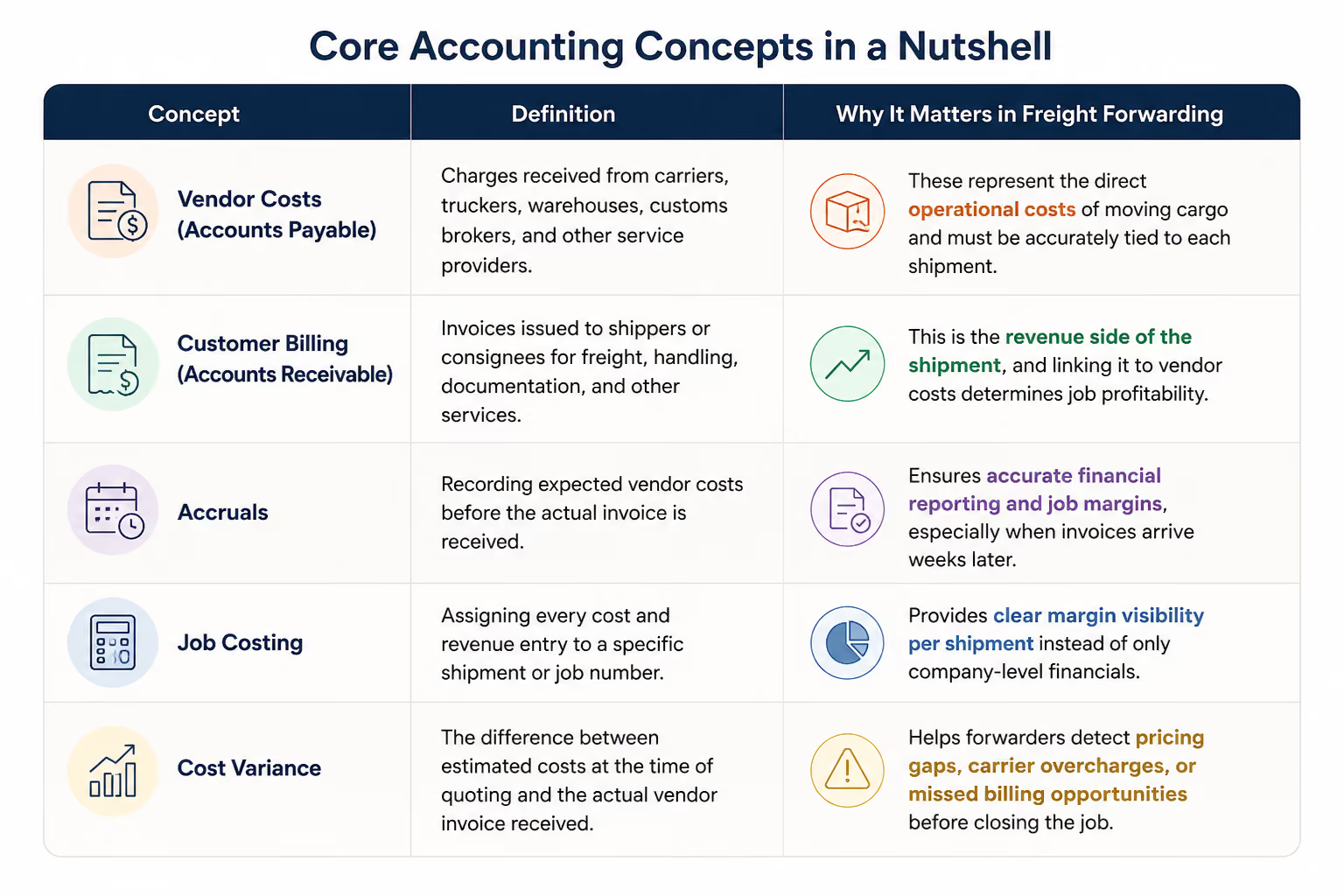
Supplier invoices (carriers, truckers, warehouses) are recorded as Accounts Payable (AP) against the job. Meanwhile, customer invoices for freight and services are recorded as Accounts Receivable (AR). Accurately matching both ensures correct job profitability.
In freight forwarding, costs are often estimated at the time of quoting to calculate expected shipment margins. However, the actual vendor invoices may arrive days or weeks later, sometimes with adjustments such as fuel surcharges, port fees, or operational changes.
Accounting systems must therefore track both estimated and actual costs while highlighting the variance between them. This helps forwarders maintain accurate shipment profitability and avoid unexpected margin erosion.
International shipments involve multiple currencies, sometimes three or four in a single job. You might quote in USD, pay a carrier in EUR, and invoice a customer in GBP. Exchange rates fluctuate between quoting, invoicing, and payment collection, which creates reconciliation complexity.
Configurable exchange rate controls help maintain invoicing accuracy. Without them, small rate shifts can cascade into significant discrepancies at month-end.
Accruals record costs or revenue before cash actually changes hands. In freight forwarding, shipments can span weeks, with vendor invoices arriving long after cargo delivers.
If you close a job without accruing expected costs, the margin looks better than reality. Then the invoice arrives next month, and that profitable shipment suddenly isn't. Proper accrual management prevents this kind of surprise.
In freight forwarding, every shipment is treated as a job file, and all financial activity is tied to that job. This is known as job costing.
When vendors such as carriers, truckers, warehouses, or customs brokers send invoices, those charges are recorded as costs under Accounts Payable (AP) and linked to the shipment. The forwarder then invoices the customer for freight and services, which is recorded as revenue under Accounts Receivable (AR).
By connecting vendor costs and customer invoices to the same job number, forwarders gain clear margin visibility for every shipment, rather than relying only on overall monthly financial reports.
Cost variance tracking adds another layer of control. Forwarders usually estimate carrier and vendor costs when quoting a shipment. When the actual vendor invoice arrives, the system compares it against the estimated cost. If the carrier charges more than expected, the variance is flagged while the job is still open, allowing teams to investigate or recover the difference before the shipment is closed.
Here are some core accounting concepts in a nutshell:
Finance teams across freight forwarding operations face these recurring issues:
Using separate systems for transportation management, accounting, and spreadsheets forces teams to re-key the same data multiple times. Each manual entry introduces error risk.
Reconciling across systems eats hours every week, and discrepancies become harder to trace as data moves between platforms.
Forwarders receive invoices from carriers, customs brokers, truckers, and warehouses. These arrive in different formats: PDF, Excel, email attachments, sometimes even faxes.
Processing this volume manually creates bottlenecks, and invoices pile up waiting for review.
Matching payments and invoices across currencies while handling exchange rate fluctuations is tedious work. A small rate discrepancy on one transaction might not matter much, but across hundreds of shipments, the cumulative effect creates reconciliation headaches at month-end.
Vendor invoices often arrive weeks after a shipment is completed, particularly for ocean freight where charges like demurrage, port fees, or adjustments appear later. Without proper accrual tracking, these late invoices distort profitability and complicate month-end reconciliation.
In manual accounting environments, small vendor charges such as handling fees, documentation charges, or port surcharges are sometimes missed. Individually these costs may appear minor, but across hundreds of shipments they create significant margin leakage.
When costs arrive after job closure, they often go unbilled. A carrier invoice that shows up two weeks late might get absorbed as an expense rather than passed through to the customer. This revenue leakage compounds over time, quietly eroding margins across hundreds of shipments.
That said, there are ways to solve these issues.
Here are practical steps to improve freight accounting operations, ordered by impact.
A single source of truth for rates, tariffs, and costs eliminates hunting through spreadsheets and disconnected systems. When operational data flows directly into finance, you avoid duplicate entry and reduce reconciliation time.
Platforms that embed accounting into freight operations make this possible without bolting together separate tools. Shipthis takes this approach, connecting quoting, booking, documentation, and invoicing in one workflow so data enters once and flows through the entire shipment lifecycle.
Modern freight platforms like Shipthis combine freight operations and accounting in a single system, ensuring shipment data flows directly into financial records without duplicate entry.
Modern freight forwarding operations receive vendor invoices in many formats, like PDFs, Excel sheets, scanned documents, or email attachments. Converting these documents into usable accounting data manually is one of the most time-consuming tasks for finance teams.
AI-powered document processing removes this bottleneck. The system reads vendor invoices automatically, extracts key fields such as vendor name, job number, charges, and currency, and converts them into structured data that can be recorded directly in the system.
Instead of manually reformatting documents, finance teams simply upload or receive invoices while the platform captures the relevant costs, links them to the correct shipment, and routes them into the Accounts Payable (AP) workflow.
Platforms like Shipthis extend this by matching extracted charges to the correct jobs and flagging inconsistencies, helping maintain clean and accurate financial records
After invoice data is captured, it must be properly matched and reconciled. AI-powered accounting tools can automatically assign vendor expenses to the correct accounts, match them with the relevant shipments, and reconcile them against estimated or quoted costs.
If a carrier invoice differs from the expected rate, the system flags the variance immediately. This allows teams to review discrepancies while the job is still active instead of discovering them weeks later during reconciliation.
The result is faster financial processing, fewer write-offs, and better control over shipment-level profitability.
Real-time variance detection compares actual costs against quoted or expected costs while the job is still open. This prevents the common scenario where a job closes looking profitable, only to have late-arriving costs flip it negative.
The goal is catching discrepancies when you can still do something about them, whether that means billing the customer for the difference or negotiating with the vendor.
Organizing accounts by the due date improves cash flow management. You collect faster, avoid late payment penalties, and capture early-payment discounts from vendors when available.
This sounds simple, but many forwarders still work from aging reports that don't surface the most urgent items first. A due-date-driven workflow keeps cash moving in the right direction.
But when you get freight accounting right, the benefits go far beyond just clean books.
What changes when you move from manual processes to automated workflows?
Automation accelerates the invoice-to-payment cycle. Invoices go out faster, payments come in sooner, and you can pay vendors on time to capture discounts. The time between completing a shipment and collecting payment shrinks.
Automated matching and variance detection catch missed charges and billing mistakes before they become losses. The system flags exceptions rather than letting them slip through, which means fewer write-offs and fewer awkward conversations with customers about corrected invoices.
When shipment costs, invoices, and accruals are tracked in real time, finance teams no longer need to chase missing data at the end of the month. Automated reconciliation and job-based financial reporting allow companies to close their books faster and with greater confidence.
Dashboard-driven visibility into margins, costs, and revenue at the shipment level enables proactive decision-making. You see problems as they develop, not weeks later in a monthly report.
This visibility also helps with customer conversations. When a shipper asks about profitability on a particular lane, you can answer immediately rather than digging through spreadsheets.
Automation allows teams to handle growing volume without proportionally increasing staff. Systems handle repetitive work while people focus on exceptions and relationships. This is how modern forwarders scale without letting overhead grow faster than revenue.
Now, there’s only one way to ensure you get the most out of the software — by choosing the right software.
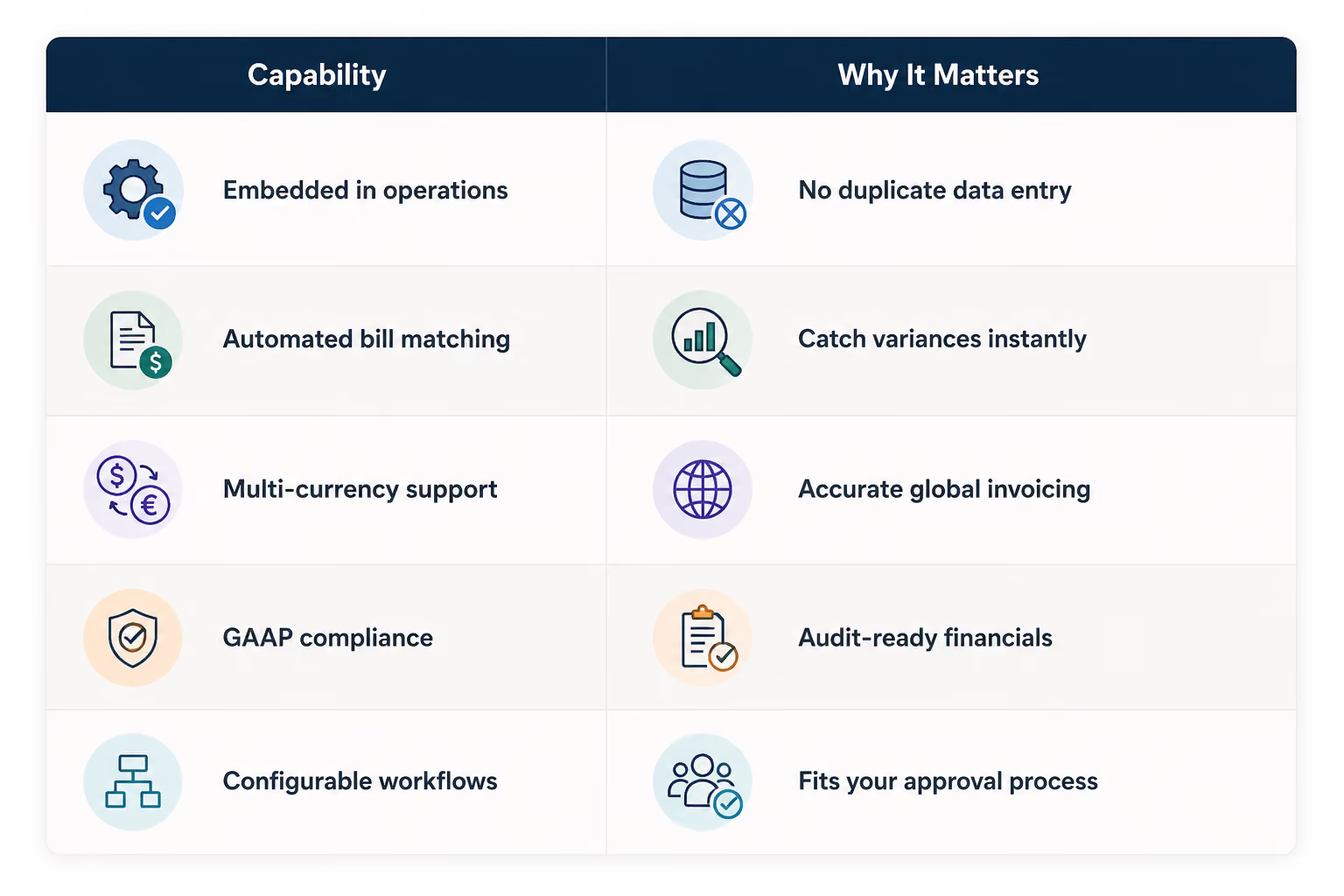
Not all accounting software fits freight forwarding. Here's what matters when evaluating options:
Accounting built into the operational workflow beats separate systems requiring manual data transfer. Single-entry execution, where you enter data once and use it everywhere, eliminates duplicate work and keeps records consistent.
When your TMS and accounting live in the same platform, shipment details flow directly into invoices without re-keying. This is the approach Shipthis takes with its embedded finance engine.
AI-driven bill matching and automatic accrual posting ensure accurate, timely financials. Look for systems that catch variances instantly rather than waiting for manual review. The best platforms flag discrepancies while jobs are still open, giving you time to resolve them.
Multi-currency invoicing, exchange rate management, and support for regulations like GST, ZATCA, Brazilian NFS-e, Egyptian E-invoicing and other e-invoicing mandates are non-negotiable for international operations. The software handles currency conversions and tax calculations automatically, reducing manual work and compliance risk.
Customizable approval workflows and dashboards provide instant visibility into financial health. The system adapts to your process rather than forcing you into a rigid structure.
You can set up approval chains, payment thresholds, and reporting views that match how your team actually works.
The shift from reactive, fragmented processes to proactive, unified operations changes how finance teams work. Instead of chasing down invoices and reconciling spreadsheets, they focus on exceptions, analysis, and strategic decisions.
Modern freight accounting means one platform where operational data flows directly into finance, where costs are visible in real time, and where automation handles the repetitive work.
Explore how Shipthis embedshttps://www.shipthis.co/ accounting into freight operations to see this approach in action.
Got more questions?
Don’t worry, we’ve got you covered.
1. How Do Freight Forwarders Calculate Shipment Profitability?
Shipment profitability is calculated by matching all vendor costs associated with a shipment against the revenue billed to the customer. By assigning these costs and revenues to the same job file, forwarders can clearly see the exact margin generated by each shipment.
They are recorded as expenses and impact shipment margin directly. Tracking variance early helps reduce these cases.
Debit the Inventory or Freight-In account and credit Accounts Payable or Cash. This adds the freight cost to the value of goods received, which then flows into the cost of goods sold when the inventory is sold.
Multi-branch forwarders use centralized accounting platforms that consolidate data from all locations while allowing local autonomy for currency, tax, and compliance requirements. The central office sees the full picture while each branch operates within its own regulatory context.
Freight forwarders comply with regional mandates like GST in India, ZATCA in Saudi Arabia, and various e-invoicing requirements depending on operating jurisdictions. The specific requirements vary by country, and software that supports localization handles these automatically.
Freight forwarding accounting is key to maintaining control over costs, cash flow, and shipment-level profitability.
With the right processes and systems in place, you can reduce errors, prevent revenue leakage, and make more confident financial decisions.
Freight forwarding accounting is key to maintaining control over costs, cash flow, and shipment-level profitability.
With the right processes and systems in place, you can reduce errors, prevent revenue leakage, and make more confident financial decisions.
That’s where Shipthis comes in.
Book a demo to see how you can take control of your freight accounting and scale with confidence.
