Thank you! We will get back to you soon
Oops! Something went wrong while submitting the form.
Last updated: 11 September 2026 (revision 4).
First published: 18 August 2026.
Reviewed by: Sartaj Beary, Shipthis.
This guide is reviewed and revised as carriers announce new rates — see the changelog at the bottom for what's changed.


If you're quoting Asia–US East Coast or Gulf freight right now, you've probably already felt it: a rate sheet that was accurate three weeks ago is wrong today. Since July 2026, four major ocean carriers have published Panama Canal surcharges with confirmed figures — CMA CGM, MSC, Hapag-Lloyd and ONE — with a fifth, Seaboard Marine, joining on 2 September. The Panama Canal Authority (ACP) cut the maximum authorized draft four times between late July and early September, then changed instrument: on 20 August it postponed its remaining draft cuts and reduced daily transit slots instead, and on 4 September it postponed the deeper 47.5 ft cut indefinitely. The current limit is 48.0 ft, in force since 2 September and, in the ACP's own words, holding "until further notice."
This guide exists so you don’t have to chase six separate carrier bulletins to quote a single booking. Below is a carrier-by-carrier breakdown of every confirmed 2026 Panama Canal surcharge announcement, why the ACP keeps adjusting draft limits, how the surcharges have stacked up over the year, and what to actually do about it before your next quote goes out.
This Article Covers
Every figure below is sourced from an official carrier notice or a named trade publication, with the publication date noted. Where a carrier hasn’t published a 2026 figure, we say so explicitly rather than guessing — stale or invented numbers in a rate sheet are worse than a gap.
A few things worth flagging before you copy these into a quote:
These surcharges aren't arbitrary — they're a direct pass-through of a physical constraint, though the ACP's chosen instrument has changed twice. The draft-cut sequence ran:
The cause throughout is low water in Gatun Lake, driven by an El Niño-linked dry pattern: cumulative rainfall for the hydrological year is running roughly 34% below the historical average.
The ACP has changed course twice. On 20 August (Advisory A-29-2026) it postponed both remaining draft cuts and cut daily transit slots instead — from 36 to 34 (9 Neopanamax + 25 Panamax) effective 3 September, then to 32 (9 Neopanamax + 23 Panamax) effective 15 September. Then on 4 September (Advisory A-33-2026) it postponed the 47.5 ft draft cut indefinitely, following a review of lake levels and weather projections, leaving 48.0 ft in place "until further notice."
So the binding constraint has shifted from draft to slots. This matters for how you explain the situation to a customer: vessels are not being asked to load lighter than they were on 2 September, but fewer of them get through each day, and that tightens further on 15 September. The ACP's own August operations summary (Advisory A-34-2026, 10 September) puts actual throughput at an average of 33.19 oceangoing transits per day for August, within a range of 26 to 37.
The booking system changed alongside it. From 3 September the Neopanamax auction slot splits into four cargo-type groups — LNG/LPG; Dry Bulk/General Cargo; Container/Vehicle/Reefer; Chemical/Crude Tankers — so container ships no longer bid directly against tankers and LNG carriers. A further temporary adjustment (Advisory A-30-2026, 28 August, applying to booking dates from 13 September) sets 63 weekly Neopanamax slots with per-segment minimums and allows multiple bookings per date.
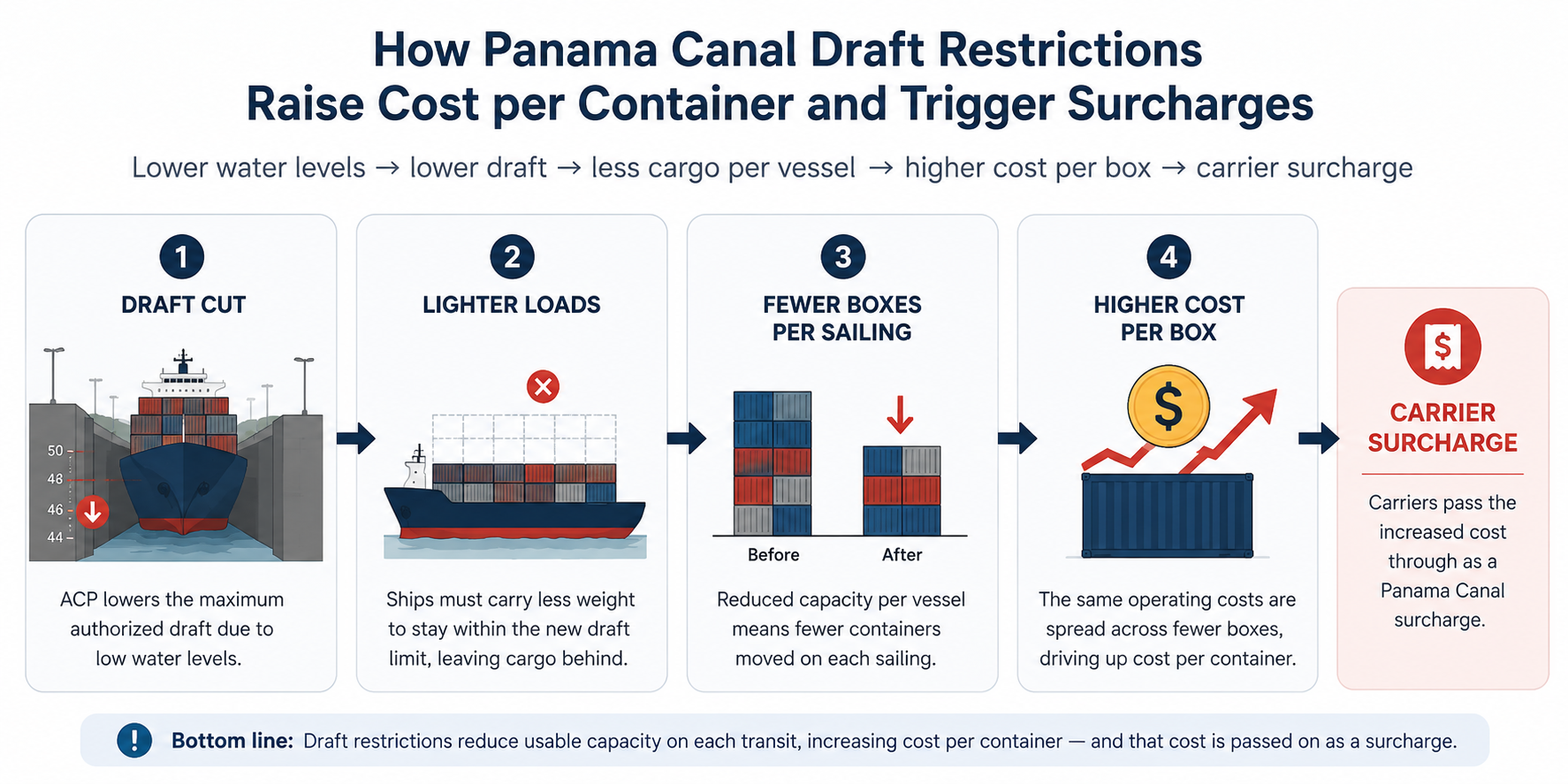
Here’s the mechanism that turns a water-level problem into a line item on your invoice:
Separately, premium slot auctions at the canal have escalated sharply. Splash247 reported a record $4 million Neopanamax slot bid in May 2026, against a pre-crisis baseline of $135–140k. That record has been broken twice since: $4.6 million on 14 August, then $5.3 million on 25 August, paid by an LPG carrier — roughly nine times the going rate, and the standing record as of 11 September. Reported averages vary by basis and period: about $1.1 million across August auctions generally, with one outlet citing $2.5 million for Neopanamax slots specifically, so quote the basis alongside the figure rather than the figure alone.
It's worth being precise about what this is. These auctions are dominated by tankers, LPG and dry-bulk vessels — cargoes that can outbid containerships for a single slot — and were initially driven by Strait of Hormuz rerouting before the drought compounded them. They are not a direct driver of the container-line per-TEU surcharges in the table above. The two pressures are related but distinct, and conflating them overstates the case to a client asking "why." What the auction prices do tell you is how scarce canal capacity has become in absolute terms, which is the context for the slot cuts.
Rather than one abstract cause, this is a story of compounding announcements. Here’s the sequence so far:
Two patterns are worth reading off this. Carrier surcharges have followed canal restrictions closely — but they have not followed them back down: the ACP postponed its 48.0 ft cut, then shelved the 47.5 ft cut entirely, and as of 11 September not one of the four carriers on this page has revised a surcharge amount or effective date in response. We checked each carrier's own notices rather than assuming. The second pattern is that the list is still widening rather than settling — Seaboard Marine joined on 2 September, and MSC opened a second trade lane the same day. Forwarders should plan for this page to keep growing through Q4 2026.
Given how fast this list has changed since July, treating any single snapshot — including this one — as permanent is the biggest risk in your workflow right now. A few concrete steps:
This guide is the hub for a full set of resources on the 2026 Panama Canal situation. For more depth on any one piece:
1. What Is the Current Panama Canal Surcharge for 2026?
There is no single "the" surcharge — each carrier publishes its own, and several carriers have more than one on different lanes. As of 11 September 2026, confirmed figures are CMA CGM at $500/TEU on Far East–USEC/Gulf (in force since 10 September), plus a separate $250/TEU Transit Surcharge on Far East–Latin America and a $150/TEU Low Water Surcharge from 1 October; MSC at $100/TEU switching to $149/$297/$376 per container on 12 September; Hapag-Lloyd at $130/TEU (since 15 August); ONE at $150/TEU (since 10 August); and Seaboard Marine at $150/TEU from 4 October. Maersk and COSCO have no confirmed public 2026 figure — we checked and could not establish one, which is not the same as confirming none exists.
2. Why Are Panama Canal Surcharges Increasing in 2026?
The Panama Canal Authority cut the maximum authorized vessel draft four times between late July and early September 2026 — to 49.0 ft, 48.5 ft and then to 48.0 ft — because of low water in Gatun Lake linked to an El Niño dry pattern, with rainfall running about 34% below the historical average. On 20 August it changed approach, postponing further draft cuts and reducing daily transit slots instead, from 36 to 34 and then to 32 on 15 September; on 4 September it postponed the deeper 47.5 ft cut indefinitely. Both mechanisms raise cost per container — less cargo per vessel, then fewer vessels per day — and carriers pass that through as a surcharge. Note that the canal easing a restriction has not so far caused any carrier to reduce or postpone a surcharge.
3. Do These Surcharges Apply to All Asia-US Routes?
No. Each carrier’s surcharge applies to specific trade lanes and often carries exclusions — for example, CMA CGM’s fee excludes Bangladesh-to-USEC cargo, and ONE’s fee excludes Puerto Rico. Always check the specific lane and routing before assuming a surcharge applies.
4. Will Panama Canal Surcharges Go Away Once Water Levels Recover?
There is no confirmed timeline, and the early evidence is not encouraging. The ACP has now eased twice — postponing the 48.0 ft cut in August and shelving the 47.5 ft cut indefinitely on 4 September — and no carrier has reduced or withdrawn a surcharge in response. Meanwhile the underlying hydrology is still deteriorating: rainfall is running roughly 34% below the historical average, and the ACP has pointed to a potentially severe 2026–27 El Niño lasting into next year. Plan for these costs to persist through at least Q4 2026, and treat any carrier reduction as upside rather than as the base case.
5. How Often Is This Guide Updated?
This guide is reviewed and updated mostly as carriers announce new rates, with a changelog tracking what’s changed since the last revision. Bookmark this page rather than a single carrier bulletin, since most surcharge coverage on other sites goes stale within weeks of a new announcement.
Sep 11, 2026 (revision 4) —
Aug 25, 2026 (revision 3)
Aug 21, 2026 (revision 2)
Aug 18, 2026
The figures on this page will change. That is the point of it. What decides whether a draft cut costs you margin is not how fast you read the announcement — it is how many open quotes carry a number that was correct a fortnight ago, and how long it takes one person to find and re-date them all. Centralised rate and surcharge management turns that from a manual sweep into a single update that flows into every live quote.
Want to see it against your own lanes? Book a demo and ask to see a mid-month surcharge change propagate into open quotations without anyone re-keying a rate sheet.
Or start with the numbers — Shipthis pricing is $89 per user per month, every module included.
