Thank you! We will get back to you soon
Oops! Something went wrong while submitting the form.
Learn how NVOCCs operate, manage ocean freight, handle carrier responsibilities, and navigate the processes and regulations that shape their business.


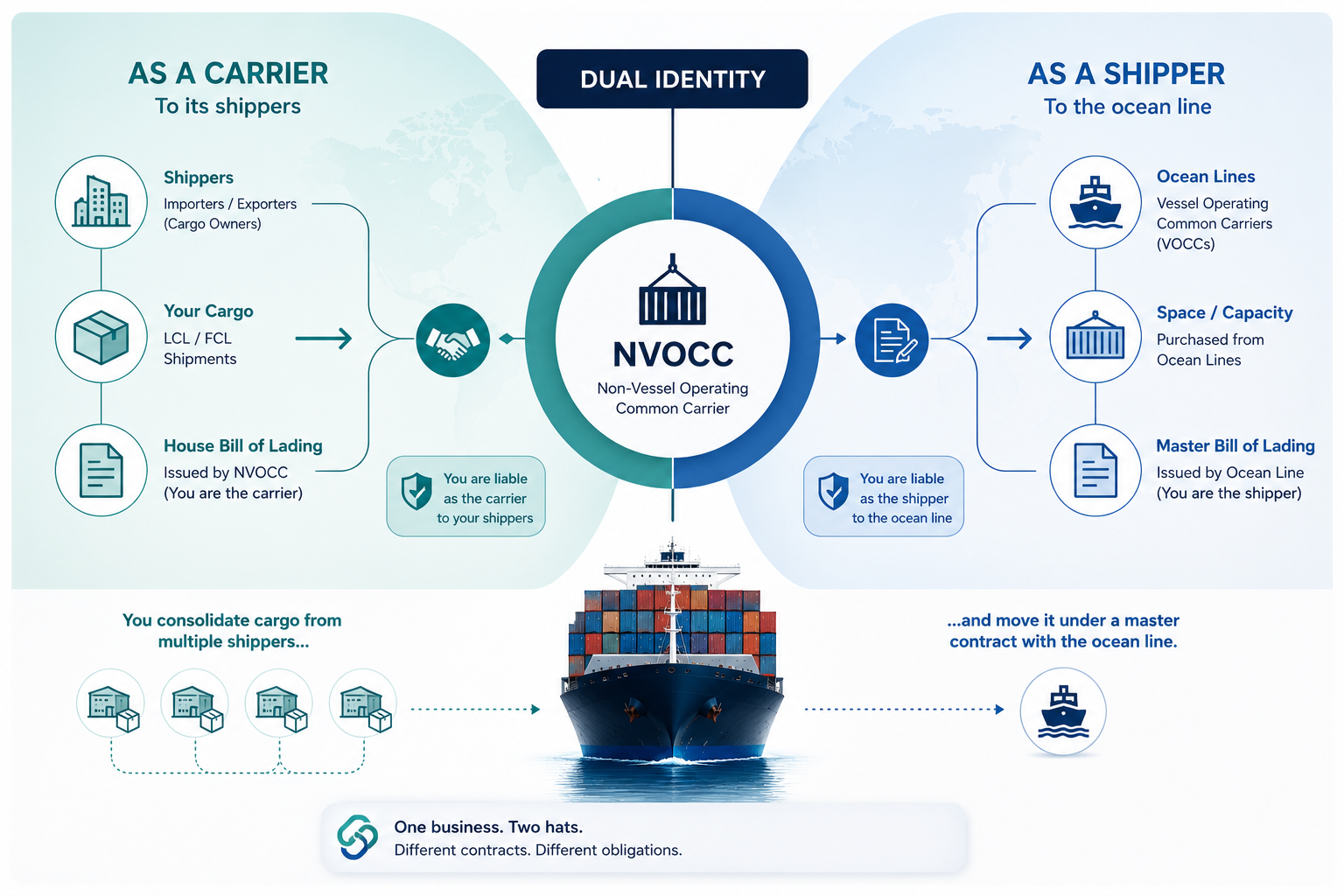
An NVOCC is an ocean carrier that moves cargo under its own bill of lading without owning or operating any vessels. Instead of running ships, a non-vessel operating common carrier buys space from the lines that do, then resells it to its own customers under its own contract of carriage.
The clearest way to hold the idea: it is a carrier to its shippers and a shipper to the ocean lines, sitting on both sides of the transaction with different obligations facing each way. Almost everything else about how these businesses operate, earn, and are regulated follows from that dual identity.
This Article Covers
What Does NVOCC Stand For?
NVOCC stands for non-vessel operating common carrier. The term is occasionally written as non-vessel owning common carrier, which describes the same thing — the operator neither owns nor runs the ships.
In the United States the definition is regulatory rather than descriptive. The Federal Maritime Commission treats an NVOCC as a common carrier that offers ocean transportation to the public, issues its own house bill of lading, and does not operate the vessels used to carry the cargo. Two related terms come up constantly alongside it. A VOCC — vessel-operating common carrier — is a line that does own and operates ships, such as Maersk, MSC or CMA CGM. An OTI, or ocean transportation intermediary, is the FMC’s umbrella category covering both NVOCCs and ocean freight forwarders.
For a short definition you can quote, see the NVOCC entry in the Shipthis freight glossary.
The distinction that matters is not size or service breadth, but whether the company acts as a principal carrier or as an agent for someone else.
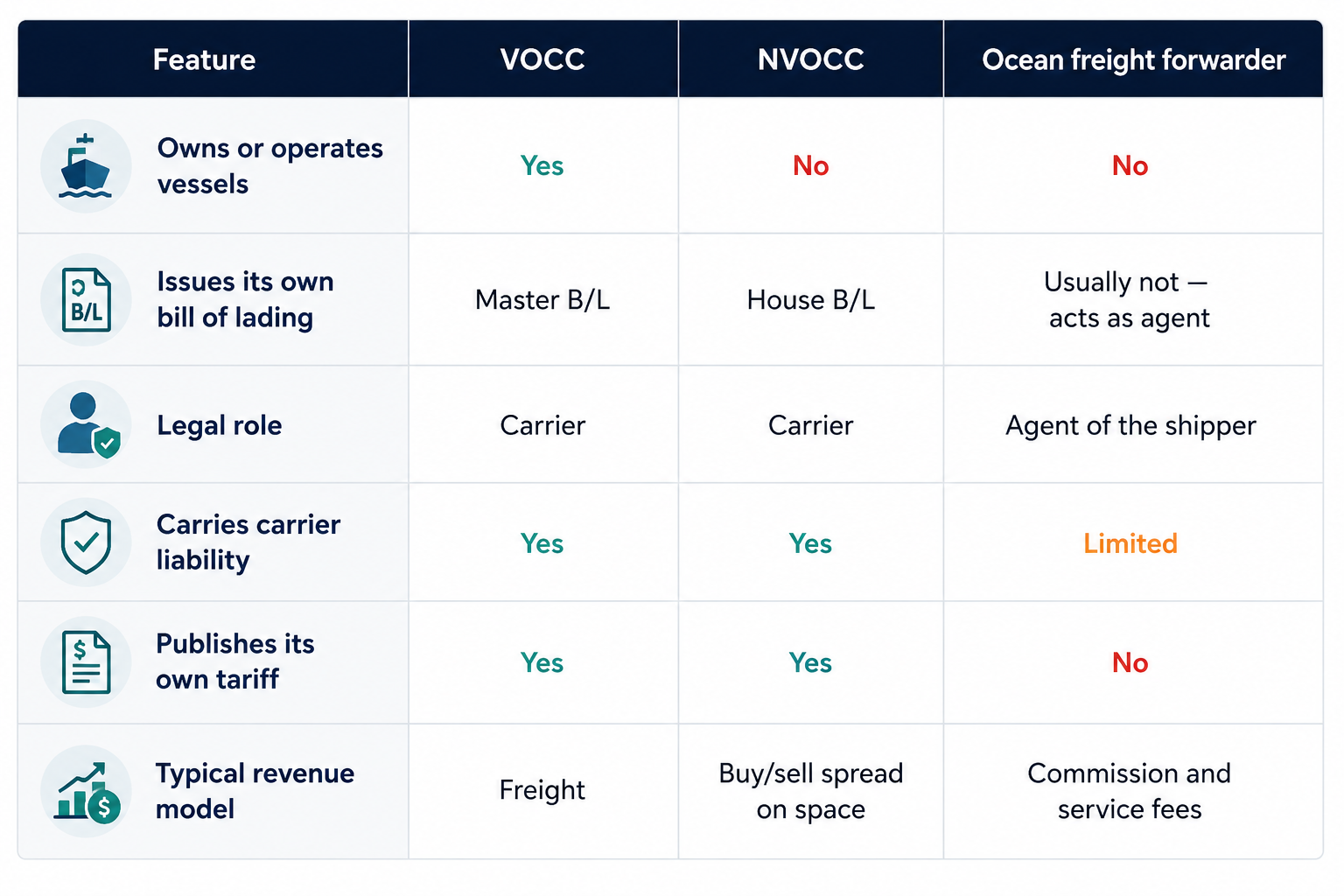
There is a nuance most explanations skip: the same company is frequently both. A mid-sized operator may act as an NVOCC on an LCL consolidation where it issues its own house bill of lading, and as a forwarder on an air shipment the following day where it simply books space as the shipper’s agent. The role changes shipment by shipment, decided by which document gets issued and who carries the liability.
The practical consequence is that the operating system has to support both modes on one record, since the same customer and trade lane will move between them. It is also why the freight forwarder versus broker distinction is worth understanding separately — agency and carriage are different legal positions, not different service levels.
Six functions define the job, and each creates an operational or documentary obligation the shipper never sees.
1. Buys Ocean Capacity in Bulk
Service contracts with the lines commit the operator to minimum annual volumes in exchange for rates and space allocations no individual shipper could negotiate alone. It manages a mix of contract and spot rates, and carries the risk when committed volume does not materialise.
2. Consolidates LCL Cargo
Cargo from several shippers, none with enough volume to fill a container, is combined into one box at a container freight station. This groupage function is the historical reason the model exists, and why the industry still calls these operators consolidators.
3. Issues Its Own House Bill of Lading
The house bill of lading is the document that turns an intermediary into a carrier. It is a contract of carriage between the NVOCC and its shipper, on the NVOCC’s own paper, with the NVOCC’s own terms and conditions on the reverse. Issuing it means accepting carrier liability for the cargo.
4. Publishes and Maintains a Tariff
An NVOCC sells at its own rates, not the line’s, which means building and maintaining a tariff of rates, rules and surcharges. In some jurisdictions that tariff must also be published, as a regulatory condition of operating rather than a commercial choice.
5. Runs an Agent Network
Issuing a bill of lading at origin requires a counterpart at destination to receive the cargo, notify the consignee, and release against the original document. Those relationships are commercial as well as operational: origin and destination split the profit, then settle between themselves, usually across currencies.
6. Carries Liability and Handles Claims
Because it is the contracting carrier, cargo claims land on the operator first, regardless of which line actually carried the box. Demurrage and detention exposure, cargo insurance, and recovery against the underlying carrier all sit with it rather than the shipper.
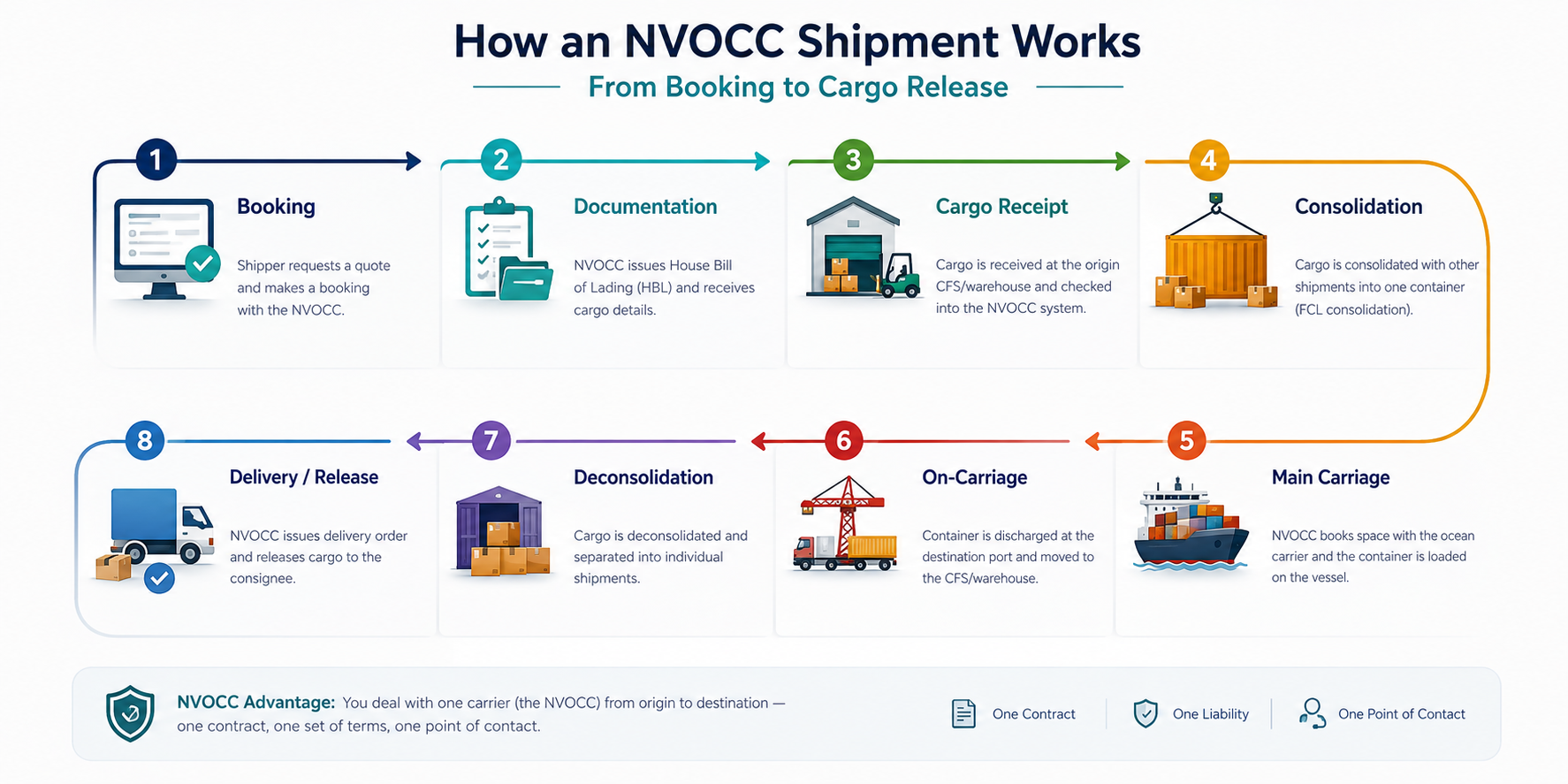
Below is a standard LCL export. The critical moment is step five, where one shipment becomes two layers of documentation.
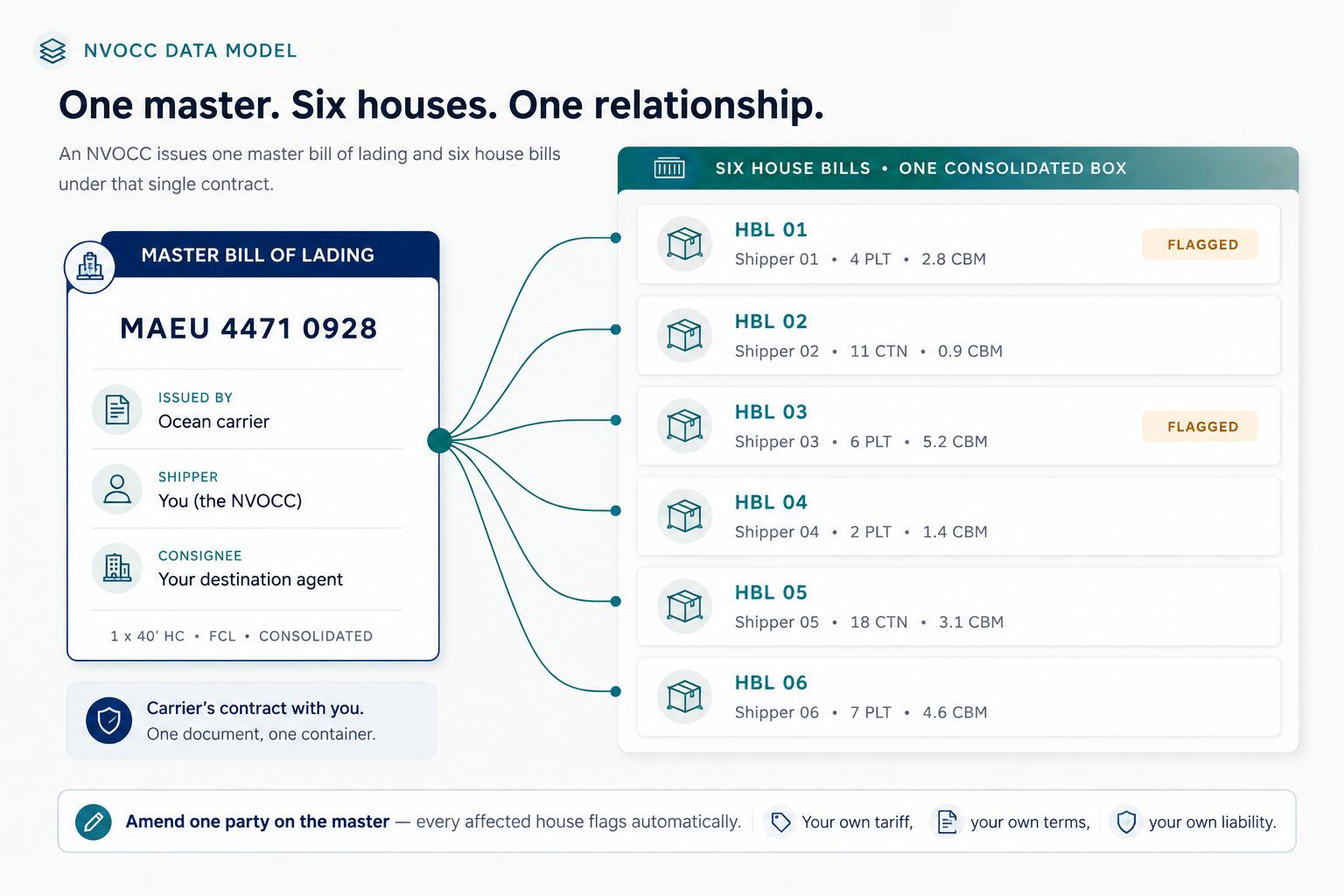
The split matters legally: the shipper holds a contract with the operator, not with the ocean line, so a damage claim follows the house bill of lading. That relationship between the two documents is the whole data model of the business — see the software section below.
Most explanations describe what an NVOCC is and stop. The business only makes sense once you see where the margin comes from.
The primary source is the spread between buy and sell space is bought at a contract rate earned through volume commitment and sold at the operator’s own tariff rate. The larger the committed volume across the lines, the better the buy rate, and the wider the spread it can hold while still undercutting what a small shipper could negotiate directly.
LCL consolidation is where the operational skill lives. Revenue arrives per cubic metre or per house bill of lading; cost arrives per container. A box sold at 80% utilization earns a materially different margin from the same box at 45%, on identical buy rates. Fill rate, not rate negotiation, separates a good consolidator from a mediocre one.
Ancillary revenue — documentation fees, CFS handling, demurrage and detention recovery — is small per shipment but reliable across volume. On any shipment with a destination leg, profit is shared with the overseas agent under an agreed split.
The structural consequence: margin is calculated per house bill of lading inside a container-level cost. An operator who can only see profitability at container level is flying blind on most of its shipments.
There is no single global NVOCC license. Requirements are national and differ from more than most guides suggest, since the majority of published material describes only the US regime.
United States
The most prescriptive regime. A US-based NVOCC must be licensed by the Federal Maritime Commission as an ocean transportation intermediary, which requires a qualifying individual with at least three years of relevant experience, a Form FMC-18 application, a published tariff, and proof of financial responsibility. Under 46 CFR § 515.21, the bond amount is $75,000 for a licensed NVOCC, against $50,000 for an ocean freight forwarder. A non-US-based NVOCC may either obtain a licence or register with the Commission instead; a registered NVOCC posts $150,000. It is also unlawful for licensed intermediaries and vessel operators to accept bookings from unlicensed ones, which makes compliance with a commercial gate rather than just a legal one.
India
India does not have a dedicated NVOCC licensing regime equivalent to the U.S. FMC framework. Operators providing multimodal transportation under the Multimodal Transportation of Goods Act, 1993 are subject to MTO registration requirements administered by the Directorate General of Shipping. Requirements depend on the services and transport structure involved.
United Kingdom, UAE, Singapore and Australia
Outside the U.S., NVOCC regulatory treatment varies by jurisdiction. Requirements may involve different combinations of carrier, freight-forwarding, customs, maritime, or multimodal transport regulations rather than a single NVOCC licensing framework. Operators should confirm applicable requirements with the relevant national authority.
The functions above translate into specific software requirements. Operators running on generic forwarding software or spreadsheets usually discover the gaps at the worst moment — during an amendment, an audit, or a claim.
Each of these deserves proper evaluation rather than a feature checkbox. We cover the nine capabilities to assess and the exact questions to put to vendors in NVOCC software: what to look for in 2026. For the wider ocean category, see ocean freight software.
1. What Does NVOCC Stand For?
NVOCC stands for non-vessel operating common carrier: an ocean carrier that offers transportation to the public and issues its own bill of lading, but does not own or operate the vessels carrying the cargo. It buys vessel space from shipping lines and resells it under its own contract.
2. What Is the Difference Between an NVOCC and a Freight Forwarder?
An NVOCC acts as a carrier: it issues its own house bill of lading, publishes its own tariff, and accepts carrier liability for the cargo. A freight forwarder acts as agent of the shipper, arranging transport and documentation without becoming the contracting carrier. One company can perform both roles on different shipments.
3. Does an NVOCC Own Ships?
No. An NVOCC owns no vessels and operates none. It purchases or leases container space from vessel-operating common carriers such as Maersk, MSC or CMA CGM, then sells that space to its own customers. Some own or lease container fleets, but never ships.
4. What Is the Difference Between a House Bill of Lading and a Master Bill of Lading?
A master bill of lading is issued by the ocean carrier to the NVOCC and covers the whole container. A house bill of lading is issued by the NVOCC to each individual shipper whose cargo sits inside that container. One master commonly sits above several houses.
5. Do You Need a License to Operate as an NVOCC?
It depends on the jurisdiction. In the United States, NVOCCs are subject to Federal Maritime Commission licensing or registration requirements and financial responsibility requirements. In India, operators providing multimodal transportation are subject to MTO registration requirements administered by the Directorate General of Shipping. Outside these frameworks, requirements vary by jurisdiction and may involve different carrier, freight-forwarding, customs, maritime, or multimodal transport regulations. Operators should confirm the applicable requirements with the relevant national authority.
6. Can a Freight Forwarder Also Be an NVOCC?
Yes. Many companies hold both roles and choose which applies per shipment, depending on whether they issue their own bill of lading. In the United States a company can be licensed as both an ocean freight forwarder and an NVOCC, but cannot act in both capacities on one shipment.
7. What Is an NVOCC Service Contract?
An NVOCC service contract commits the operator to tender a minimum cargo volume to an ocean carrier over a defined period, in exchange for agreed rates and space allocation. Equivalent arrangements are also made with the operator’s own shipper customers.
8. What Software Do NVOCCs Use?
NVOCCs use freight operations platforms that issue house and master bills of lading natively, manage LCL consolidation and per-house profitability, maintain their own tariffs, track containers, file customs documents, and settle agent accounts across multiple currencies and entities.
Understanding the NVOCC Model
An NVOCC is a carrier to its shippers and a shipper to the ocean lines. Every distinctive feature of the business — the house bill of lading, the consolidation of economics, the agent network, the liability — comes from occupying both positions at once.
If you run one, or are about to, the operational requirements are worth working through properly: start with NVOCC software: what to look for in 2026, which sets out the nine capabilities to evaluate and the questions to ask any vendor.
Want to see how house and master bill of lading automation works in practice? Book a demo and bring one of your own shipping instructions.
