Thank you! We will get back to you soon
Oops! Something went wrong while submitting the form.
Last updated: 11 September 2026 (revision 4).
Last verified: 25 August 2026.
Reviewed by: Sartaj Beary, Shipthis.
Status as of 11 September 2026 — In force: CMA CGM US$500/TEU (10 Sep), MSC US$100/TEU through 11 Sep, Hapag-Lloyd US$130/TEU (15 Aug), and ONE US$150/TEU (10 Aug).
MSC switches to US$149/20ft, US$297/40ft and US$376/45ft per container from 12 Sep.
CMA CGM also has a separate US$250/TEU Panama Canal Transit Surcharge on specified Far East–Latin America trades.


If you are booking Asia to US East Coast or Gulf right now, four carriers are charging a Panama Canal surcharge, and they are not charging the same amount, on the same basis, or from the same date. Which one is cheapest genuinely depends on the week your cargo gates in.
This page lists every carrier position we have been able to verify, says plainly where the public record is contradictory, and maps the effective dates onto a gate-in view so you can rank carriers for a specific sailing. It also covers the exclusions and the GRI, BAF and fuel-surcharge stacking that decides your landed cost. For the wider draft-restriction and transit-slot picture, see our pillar guide, Panama Canal Surcharges 2026: Full Carrier Guide.
This Article Covers
On 20 August the Panama Canal Authority postponed both remaining draft cuts and reduced daily transit slots instead. The 48.0 ft draft limit took effect on 2 September and is current. On 4 September the ACP postponed the deeper 47.5 ft cut indefinitely, leaving 48.0 ft in force until further notice.
This matters for every fee on this page, because every one of them was justified by the draft schedule that has just moved. CMA CGM’s US$500/TEU was announced, in ICIS’s reporting, because “the Panama Canal Authority is lowering draft limits at neopanamax locks beginning 26 August.” MSC cited “ongoing draft restrictions.” Hapag-Lloyd cited “latest developments concerning draft limitations.”
The 26 August cut those fees were priced against took effect on 2 September, and the deeper 47.5 ft cut was postponed indefinitely on 4 September. So the live question is whether any carrier revises its quantum or effective date in response.
As of 11 September 2026, no carrier has publicly revised a Panama Canal surcharge following the postponements. We are asking all four directly and will update this page when we have answers. If your carrier rep tells you something different, we would like to know.
Two things to hold in mind when you explain this to a customer. The draft relief has held — 48.0 ft is current and the deeper cut is off the calendar for now. And the transit-slot cuts are arguably the harder constraint to plan around, because they reduce the number of sailings available rather than the payload on each one.
Verified as at 11 September 2026. ONE and Hapag-Lloyd rows are from those carriers’ own published notices; MSC and CMA CGM rows are from trade-press reporting of carrier advisories.
Sourcing note: the ONE and Hapag-Lloyd rows come from those carriers’ own published notices — the strongest sourcing on this page. The MSC and CMA CGM rows come from trade-press reporting of carrier advisories we could not retrieve directly — accurate as far as we can establish, but one step further from the source. Maersk and COSCO are listed because we checked them and could not establish a position, not because they have none.
This conflict is now historical. From 10 September, CMA CGM’s confirmed PCAF is US$500/TEU, and that is the rate to use for any current quotation. What follows concerns only the pre-10 September period.
Two credible sources disagree on what CMA CGM charged before 10 September, and we have not been able to settle it against CMA CGM’s own tariff:
It is possible both are right and describe different tranches — CMA CGM may have moved from $100 to $320 to $500 — but we have not confirmed that, so we are not going to assert it. The tables above and below use $320 and flag it, because it is the more specific and more precisely dated of the two claims. If your CMA CGM rep confirms either figure, that resolves it.
Where this changes the answer: if the rate was $100/TEU rather than $320/TEU, CMA CGM was the cheapest option from 25 July to 18 August and tied with MSC from 19 August to 9 September. It does not change any ranking from 10 September onwards.
CMA CGM, Hapag-Lloyd, and ONE quote their fee per TEU. MSC’s US$100 charge is per TEU through 11 September; from 12 September MSC switches to fixed per-container rates of US$149/20ft, US$297/40ft and US$376/45ft.
None of their public notices states whether a 40ft box is charged once or twice. That ambiguity is real, and you should resolve it with your rep before quoting a customer.
But it affects your absolute cost far more than it affects which carrier is cheapest. Because all four use the same “per TEU” wording, whichever convention applies multiplies all of them equally — so the ranking holds either way. Worked for a 40ft box from 19 August to 9 September:
For the current comparison, a 40ft box from 12 September: Hapag-Lloyd US$130/TEU; ONE US$150/TEU; CMA CGM US$500/TEU; and MSC at a fixed US$297 per 40ft container.
Same order both ways. The one place the convention does bite is from 12 September, when MSC switches to fixed per-container rates that do not scale — but even there Hapag-Lloyd comes out cheapest on both readings ($130 or $260 against MSC’s $297).
So: use the ranking with confidence, and resolve the basis before you put a number in front of a customer.
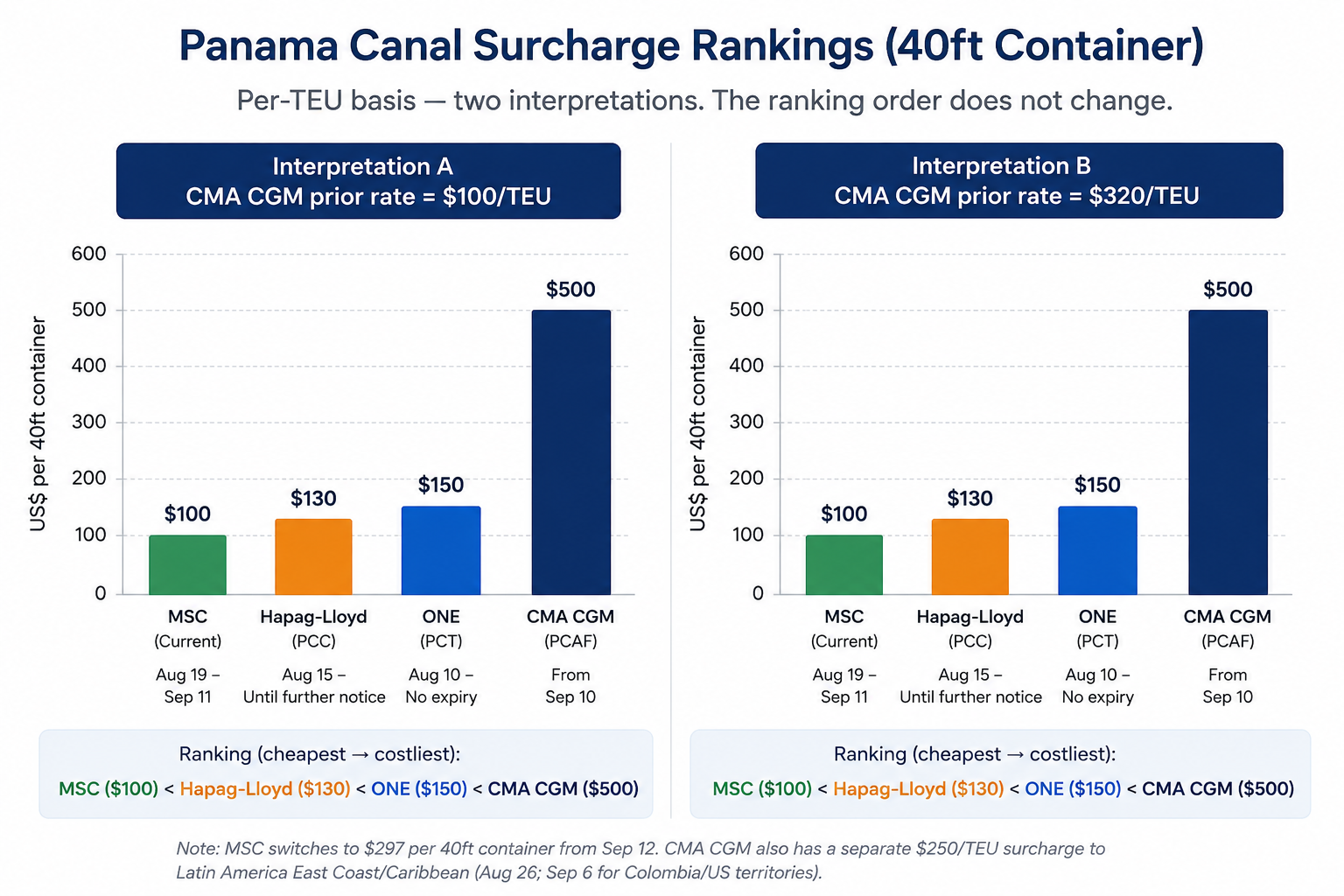
Dates below are gate-in and effective dates, not sailing dates. For the current window, MSC is cheapest through 11 September at US$100/TEU; from 12 September onward, Hapag-Lloyd is cheapest at US$130/TEU.
Two observations worth more than the ranking itself. Hapag-Lloyd is cheapest from 12 September onward and is the only carrier of the four with no announced next increase — which also makes it the one most exposed to a sudden change, since “until further notice” offers no protection. And MSC’s move on 12 September is the largest single jump on this page: from $100/TEU to $297 for a 40ft box.
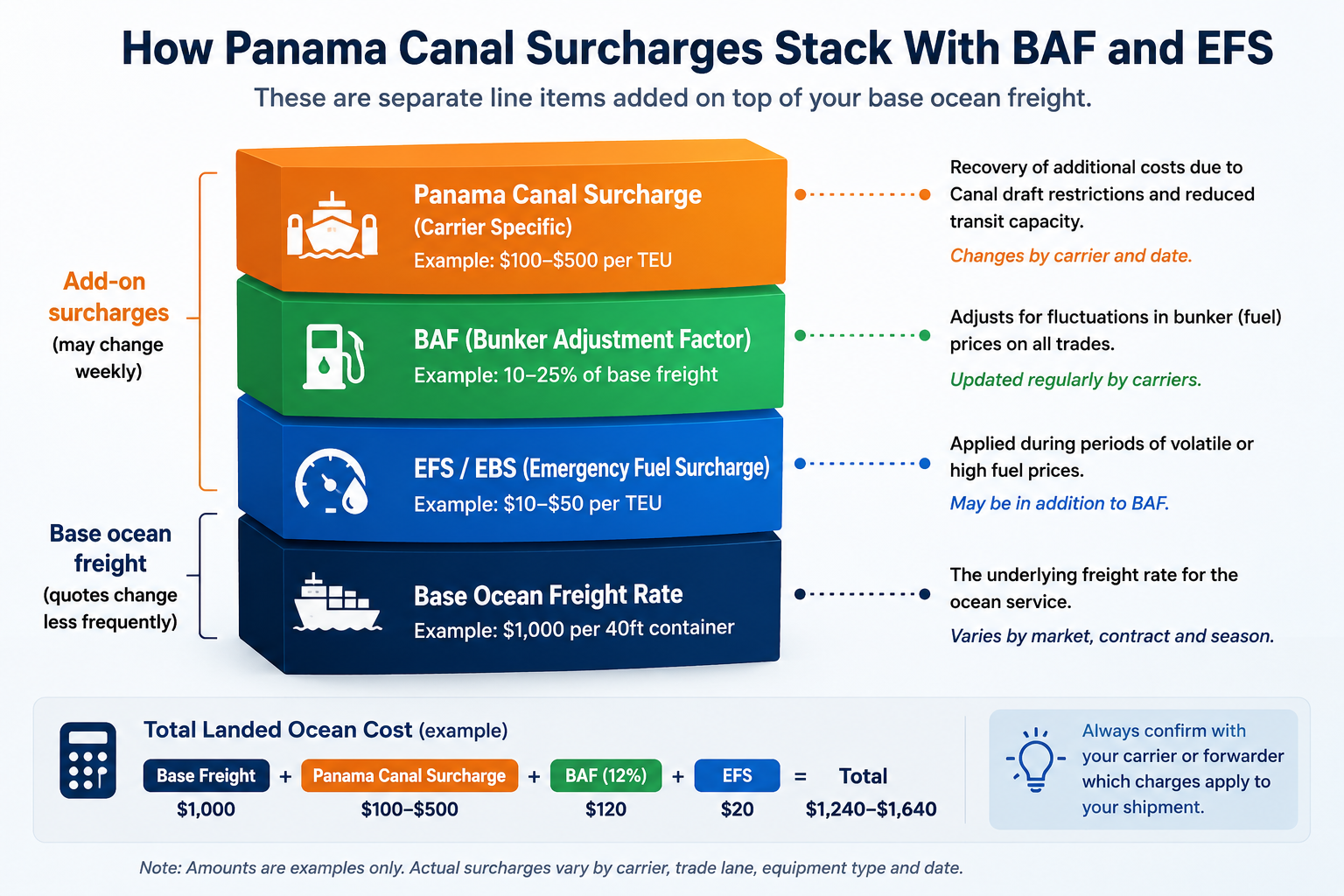
The Panama Canal surcharge does not replace other adjustment mechanisms. It sits on top of them.
General rate increases: As of 11 September 2026, none of the four carriers has published a formally dated GRI for the Asia to US East Coast and Gulf lane for September or October. Freightos reported in its 19 August update that Asia–USEC spot rates had risen 3% to a new high of $9,400/FEU on its FBX03 index, and that carriers were layering Panama-related transit surcharges of $200–$1,000/FEU into spot pricing from mid-September. That is market commentary on spot pricing, not a named carrier notice — treat it as directional pressure, not a number you can quote.
One caution on rate figures generally: three Asia–USEC benchmarks are in circulation this week and they are not interchangeable. Freightos FBX03 has $9,400/FEU (18 Aug), Drewry’s WCI has Shanghai–New York at $9,507/40ft (20 Aug), and FreightWaves has cited $10,527 (24 Aug), against $7,193 for US West Coast — a reported 42% rise since the start of the Iran war, alongside near-record ~1.9 million TEU handled at LA/Long Beach in July. Different baskets, not contradictions — but name the index when you quote one.
Bunker and fuel: All four carriers run separate bunker or fuel surcharge programs. These are a distinct line item and do not substitute for the Panama Canal fee. Freightos also flagged bunker prices up roughly 15% since the ceasefire collapse, with some carriers expected to add around $90/FEU in emergency fuel surcharge from mid-September.
When you build a landed-cost estimate, budget the Panama Canal surcharge, the standard BAF, and a possible emergency fuel surcharge as three separate stackable items, not one blended number.
1. Which carrier has the cheapest Panama Canal surcharge right now?
As of 11 September 2026, MSC at US$100/TEU is cheapest through 11 September. From 12 September, Hapag-Lloyd at US$130/TEU becomes cheapest; ONE is US$150/TEU and CMA CGM is US$500/TEU.
2. Does a “per TEU” fee mean a 40ft container pays double?
None of the carriers quoting per-TEU rates states this in its public notice. It is a genuine ambiguity in the carriers’ own communications, and it doubles your cost if you assume wrong. It does not change which carrier is cheapest, because all four use the same wording — but confirm it in writing before quoting a customer.
3. Have the ACP draft postponements changed these surcharges?
Not as of 11 September 2026. The 48.0 ft draft limit took effect on 2 September, and the ACP postponed the deeper 47.5 ft cut indefinitely on 4 September. Daily transit slots were cut to 34 on 3 September and are scheduled to fall to 32 on 15 September. As of 11 September, none of the four carriers has publicly reduced or postponed its surcharge in response.
4. Is Hapag-Lloyd’s US$130 per TEU going to increase?
There is no announced increase. But unlike CMA CGM and MSC, which have both published their next rate change, Hapag-Lloyd’s fee is listed as valid until further notice with no stated review date. It is the cheapest from 12 September and also the least predictable of the four.
5. Do Maersk or COSCO charge a Panama Canal surcharge?
We could not establish a position for either as of 11 September 2026. No Panama Canal surcharge was found on Maersk’s public advisories, and COSCO’s notice page could not be read directly. Neither is confirmation that no fee exists — confirm with your rep.
6. Do these fees include fuel costs?
No. All four carriers run separate bunker adjustment factor or fuel surcharge programs that stack on top of the Panama Canal fee. Budget them as distinct line items, and allow for an emergency fuel surcharge on top of both.
7. Should I expect a GRI on top of these surcharges?
None of the four has published a formally dated GRI for Asia–USEC/Gulf for September or October 2026. Spot-market reporting shows rates rising and informal Panama-related premiums appearing in spot pricing, but that is commentary rather than a carrier notice. Confirm with your rep rather than assuming either way.
The ranking on this page will not survive the quarter. CMA CGM moved on 10 September, MSC moves on the 12th, and the ACP has a further slot cut on 15 September. The work is not knowing which carrier is cheapest — it is making sure the number in every open quotation matches the week the cargo actually gates in. Centralised rate and surcharge management handles that in one update instead of a manual sweep.
Want to see it on your own lanes? Book a demo and ask to see a mid-month surcharge change flow into open quotes without anyone re-keying a rate sheet. Or start with the numbers — Shipthis pricing is $89 per user per month, every module included.
Related reading: Panama Canal Surcharges 2026: Full Carrier Guide · Why Panama Canal Draft Restrictions Raise Freight Costs
