Thank you! We will get back to you soon
Oops! Something went wrong while submitting the form.
This guide covers the four structural differences, the nine capabilities to evaluate, a weighted scorecard you can copy, the red flags, FAQs and some tips for Choosing the Right NVOCC Software


Your ops team keys the master bill of lading into one screen, then keys six house bills of lading into another. One consignee address is transposed. The box arrives, the release is held, demurrage starts counting, and your name is on the document that caused it — because as an NVOCC you are the carrier of record, not a broker passing paper along.
That is the gap most software has with this business. A freight forwarding TMS tracks shipments. NVOCC software has to run a legal document factory: your own house bill of lading, your own terms on the reverse, your own liability, and a master/house data model that holds together when something changes at 11pm the night before sailing.
The gap matters more this year than last. Pricing and packaging changes across several incumbent platforms have pushed a lot of operators into a software review they had not budgeted for, and a review under time pressure is where bad ten-year decisions get made.
So what separates NVOCC software from everything else on your shortlist?
This Article Covers
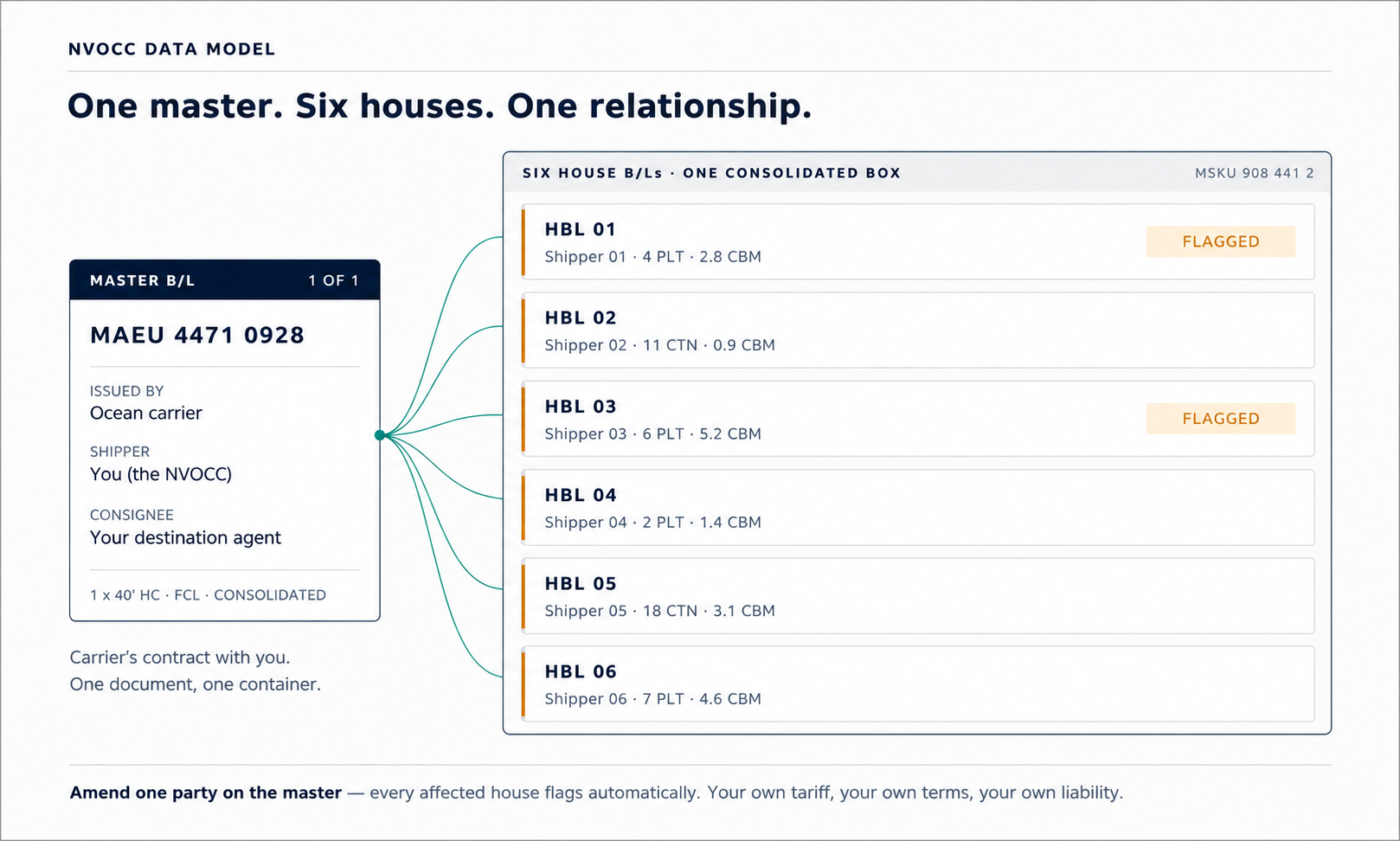
Four structural differences separate an NVOCC TMS from generic forwarding software. Every criterion later in this guide traces back to one of them.
1. You Are the Carrier of Record
You issue your own house bill of lading under your own tariff, with your own terms and conditions on the reverse. The system has to treat that document as a legal instrument with version control and an audit trail — not as a printable summary of a shipment record.
2. Master and House Are One Relationship, Not Two Records
One MBL sits over many HBLs. Either the data model represents that natively, with changes of cascading and conflicts flagged, or your team maintains the relationship by hand in a spreadsheet and hopes the two never drift apart.
3. Consolidation Economics Run Below the Container
LCL co-load, CFS handling, and per-HBL profitability sit inside a cost that arrives at container level. Allocation has to happen in the system, at booking, not in a month-end reconciliation.
4. Your Network Is Agents, Not Only Customers
Overseas agent settlement, profit share, back-to-back documentation, and multi-currency netting are core workflows for an NVOCC. In most forwarding software, they are an afterthought bolted onto accounts receivable. Shipthis handles agent collaboration through a vendor and agent portal rather than an email chain.
Now, what should you actually test in a demo?
Each capability below has the same shape: what it is, what “good” looks like, and the one question to put to the vendor. Ask all nine on their system, with your documents.
1. Native House and Master B/L Handling
The core test. A house bill of lading should be generated from the master without re-entry, and should survive splits, part-shipments, and amendments without breaking the link back to the MBL. Your own B/L template, your own terms on the reverse, your numbering series.
Good looks like: you change a notify party on the master and every affected house B/L flags automatically, with a record of who changed what and when. Bad looks like: the house B/L lives in a custom field, a Word template, or a second system.
This is also where you find out whether the vendor built for NVOCCs or adapted a forwarding product for them. Ask to see it live, not in a slide. See how Shipthis handles smart documentation and B/L generation.
Ask: “Show me you amending a master B/L with six houses under it, live, and show me what the ops team sees afterwards.”
2. eBL Readiness and Interoperability
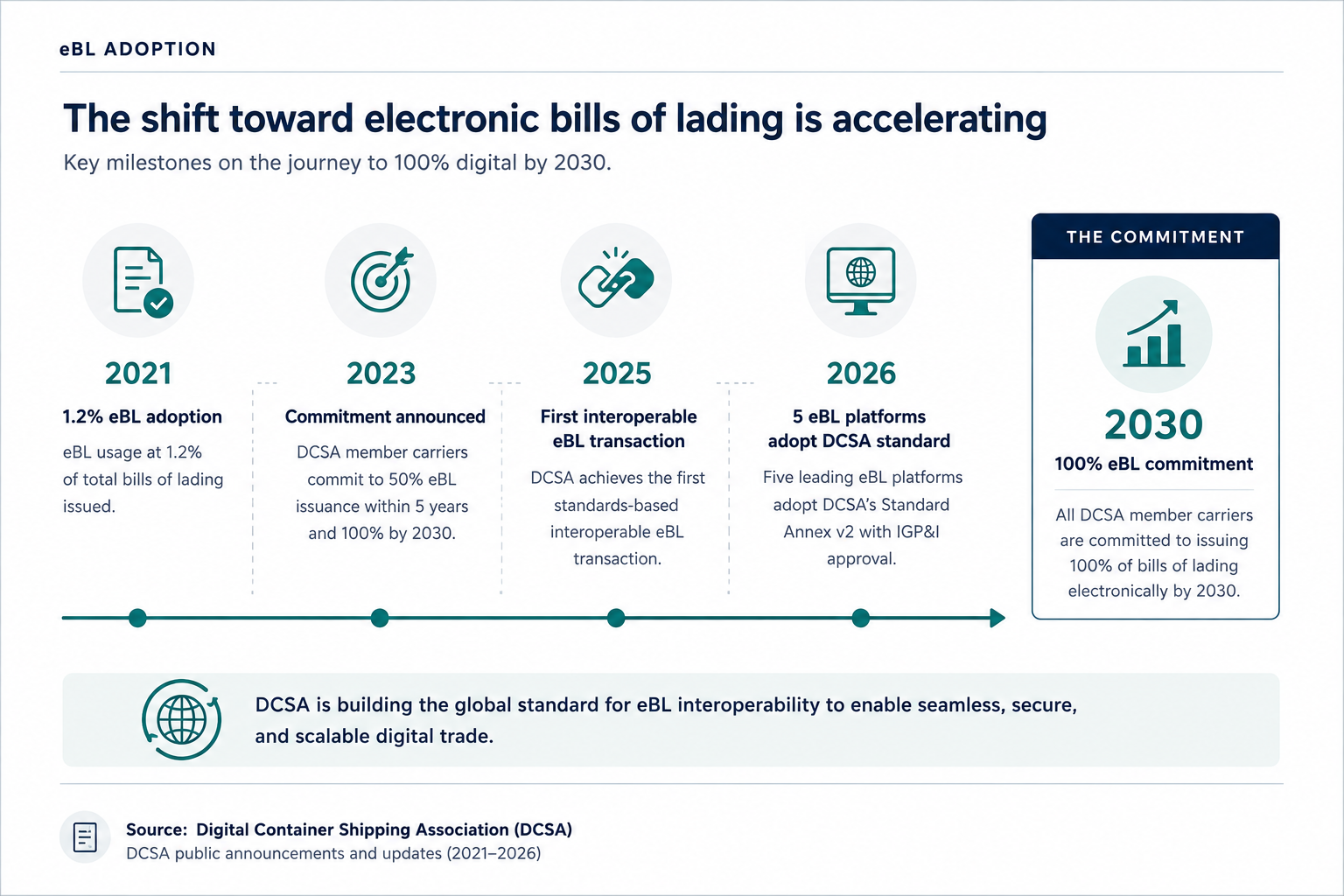
The genuinely new criterion for 2026. The nine DCSA member carriers have committed to issuing 50% of their bills of lading digitally within five years of their 2023 pledge and 100% by 2030. In June 2026, five eBL platforms — CargoX, edoxOnline, TradeGo, WaveBL and eTEU — implemented DCSA’s Standard Annex for eBL Platform Interoperability v.2, each approved by the International Group of P&I Clubs. An electronic bill of lading can now move between platforms instead of trapping every party to a shipment on the same system.
Actual adoption is still relatively early, so what you are buying is readiness, not usage today. The legal ground is settled in several major jurisdictions: the UK Electronic Trade Documents Act 2023 gives eBLs the same standing as paper under English law, and the FIT Alliance eBL declaration shows this is an industry-wide move rather than vendor spin.
Ask: “Which eBL platforms do you integrate with, and can I issue a house eBL from inside your system without logging into anything else?”
3. Consolidation and Container-Level Profitability
LCL consolidation is where an NVOCC TMS earns or loses its keep: co-load management, a working CFS or warehouse link, allocation of container-level cost across the houses in the box, and P&L visible per shipment and per HBL.
Good looks like: gross margin on a single house B/L, in the system, at any point in the shipment lifecycle. Not after an export, not at month end when the pricing decision that caused the loss is six weeks old.
Most platforms can produce container-level profitability. Far fewer attribute it correctly across houses when the co-load partner rebills, a house is short-shipped, or detention sits against one consignee out of five.
Ask: “Can I see gross margin on a single house B/L inside a co-loaded box, without exporting to Excel?”
4. Rate and Tariff Management
Your NVOCC tariff sits on top of your buy rates, and both change. The system needs contract and spot rates side by side, surcharge and D&D handling, validity windows that expire cleanly, and a path from quote to booking that does not involve retyping what the customer already agreed to.
Good looks like: a new trade lane with three surcharges built in minutes by an ops person, not days by a consultant. Watch for platforms where rate maintenance is technically possible but practically abandoned after go-live because nobody on staff can do it without help.
Ask: “How long does it take to build a quote for a new trade lane with three surcharges, and who on my team can do it?”
5. Container and Milestone Visibility
Carrier tracking breadth, event normalisation so two carriers’ milestones mean the same thing in your reporting, exception alerting that reaches a human, and a branded customer portal. Shippers treat visibility as table stakes; you are evaluated on it whether or not you sell it.
Good looks like: an ETA change at 2am generates an exception, notifies the right ops owner, and updates the customer portal without anyone touching it. For reference, Shipthis connects to 120+ carriers and tracking networks across air, sea and road.
Ask: “How many carriers do you track directly, and what exactly happens when a carrier changes an ETA at 2am?”
6. Compliance and Filings for Your Lanes
Filing requirements vary by geography and change without asking your software vendor’s permission: US ISF and AMS, EU ICS2 at house-consignment level, India’s ICEGATE filings, UAE and Singapore customs, VGM, and dangerous goods under the current IMDG Code (Amendment 42-24 became mandatory on 1 January 2026).
What matters commercially is ownership, not the list. Which filings are native, which go through a partner, and who updates them when a rule changes mid-year? Verify current requirements for your own lanes against the authority — for example US Customs and Border Protection — rather than a vendor datasheet. Shipthis maintains global trade compliance workflows configurable by country and trade lane.
Ask: “Which filings are native, which are via partner, and who maintains them when the rules change?”
7. Agent Network and Back-Office Settlement
Where NVOCC back offices actually bleed hours. Agent profit share, inter-company netting, multi-currency, multi-entity and multi-branch structures, plus either native freight accounting or a real integration with Xero, QuickBooks, Sage or Tally.
Good looks like: a 50/50 profit share with an overseas agent, across two currencies, settled from the shipment record without a parallel spreadsheet and a monthly email thread — with bank reconciliation happening from a direct feed rather than a manual statement match.
Ask for this one with your own structure. “Multi-currency” in a feature list rarely survives contact with two entities, three branches, and an agent who invoices in a third currency.
Ask: “How do you settle a 50/50 profit share with an overseas agent across two currencies and two of my legal entities?”
8. AI That Touches the Document Workflow
Draw one distinction and most vendor AI claims sort themselves out. Useful AI in this business is applied to the documents and the data: reading a booking email or a shipping instruction and drafting the house B/L, extracting line items from an agent invoice, flagging a mismatch between the SI and the MBL before it becomes a claim.
The other kind is a chat assistant on top of a screen that still requires the same manual entry it always did. That distinction usually reflects architecture. A platform designed around manual data entry can add an assistant, but it cannot easily remove the keying — which was the cost you were trying to eliminate.
For a benchmark to hold vendors to: Shipthis AI extracts 50+ fields from an MBL, HBL, AWB, invoice or packing list in under 10 seconds, and matches vendor invoices to the correct job before it closes.
Ask: “What percentage of a house B/L can your system draft from a shipping instruction, what’s the field-level accuracy, and can you run it on one of my documents in the demo?”
9. Implementation Time, Migration Path, and Pricing Model
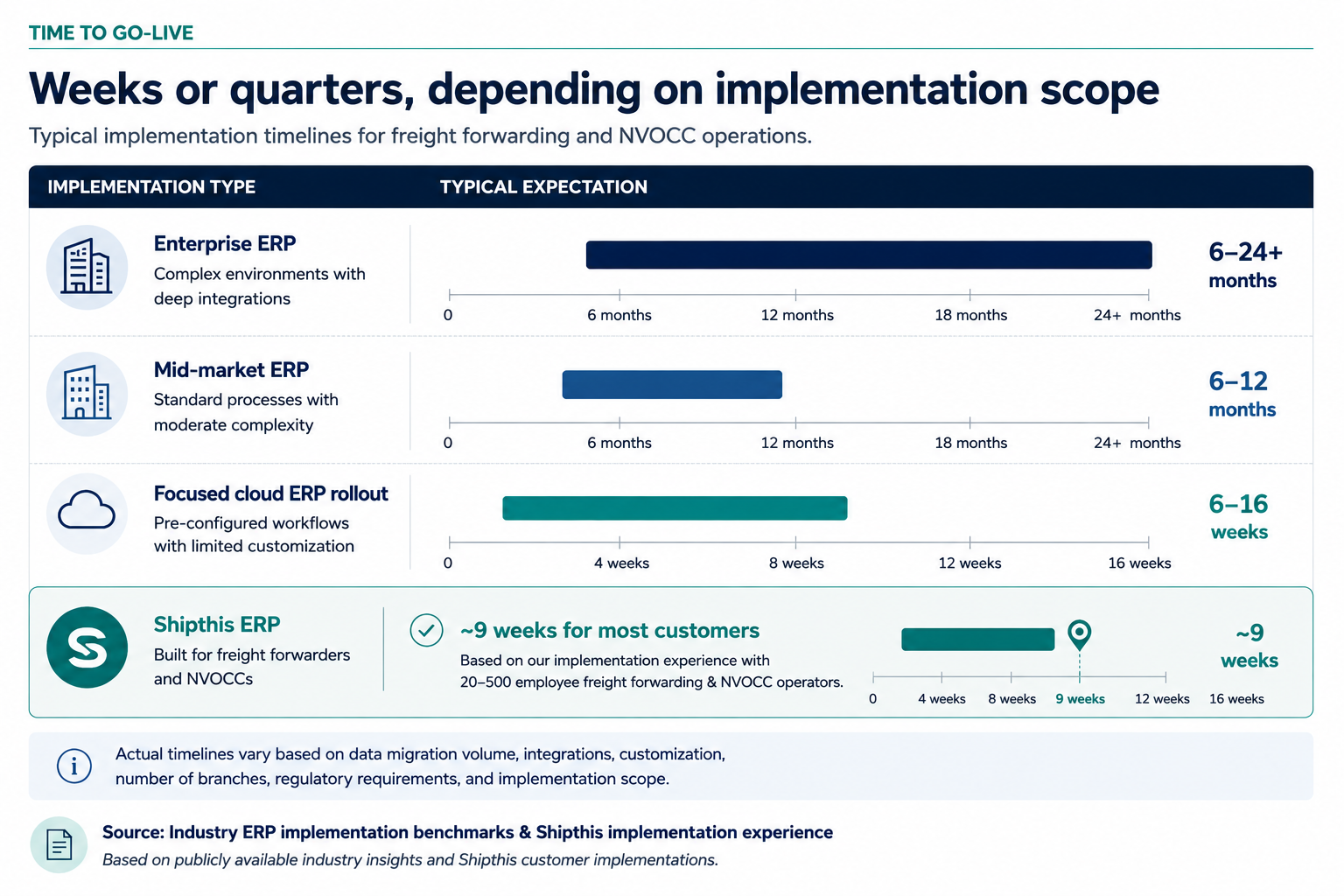
Weeks or quarters. Who performs the data migration — you, the vendor, or a partner you have not met yet. How carrier connections get re-established. How much training the ops team absorbs while still shipping. And the pricing model: per seat, per module, or per shipment, plus what the bill looks like at double your volume.
Pricing structure has become a live issue for NVOCCs this year, which is why volume-linked models deserve a hard look before signing: growth should not automatically re-price the software.
Shipthis prices at $89 per user per month with every module included and no per-shipment surcharge, and most customers go live in 9 weeks. Ask every vendor on your list to state both numbers in writing.
Ask: “What’s your median go-live time for an NVOCC our size, and what’s the contractual remedy if you miss it?”
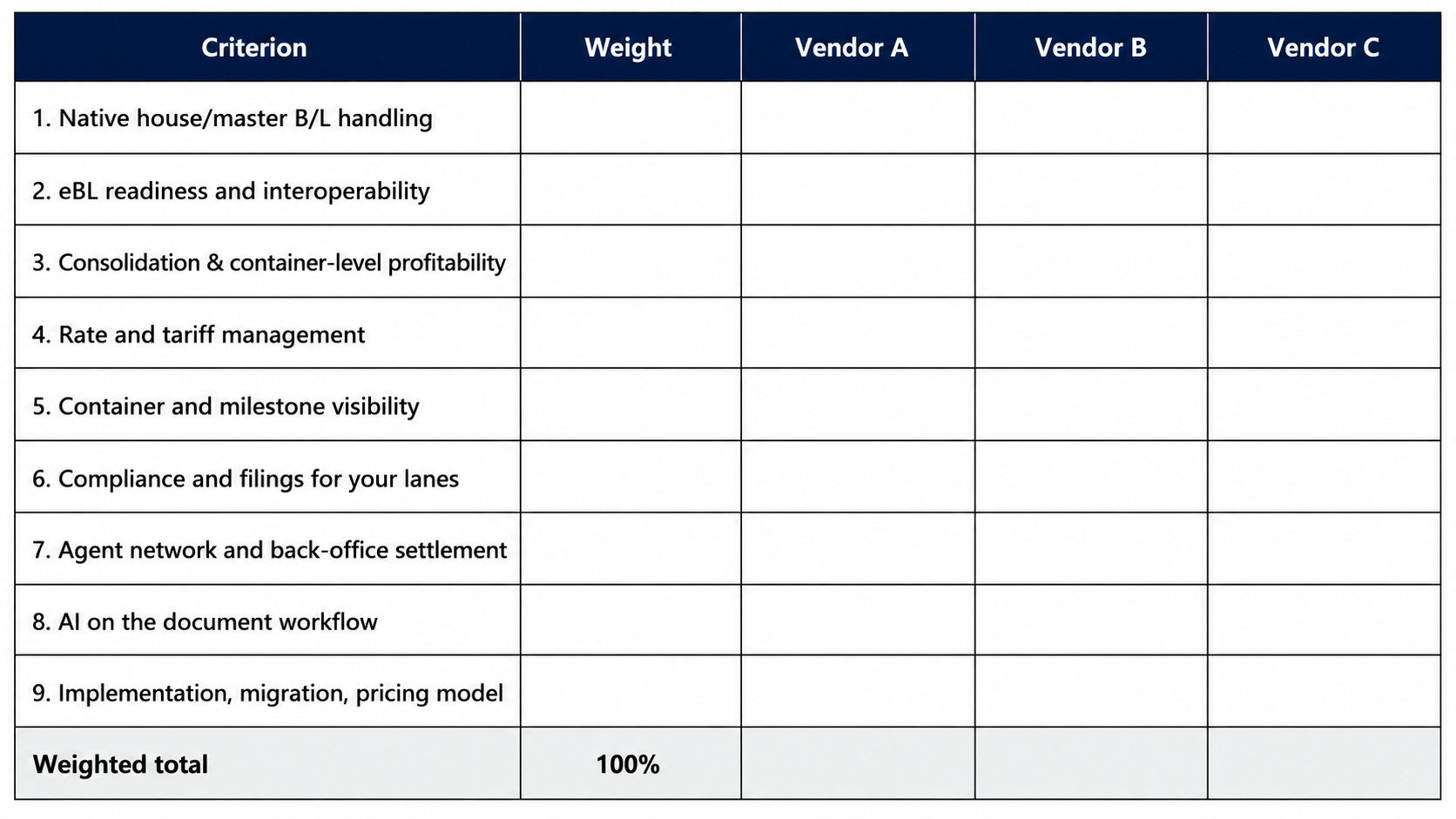
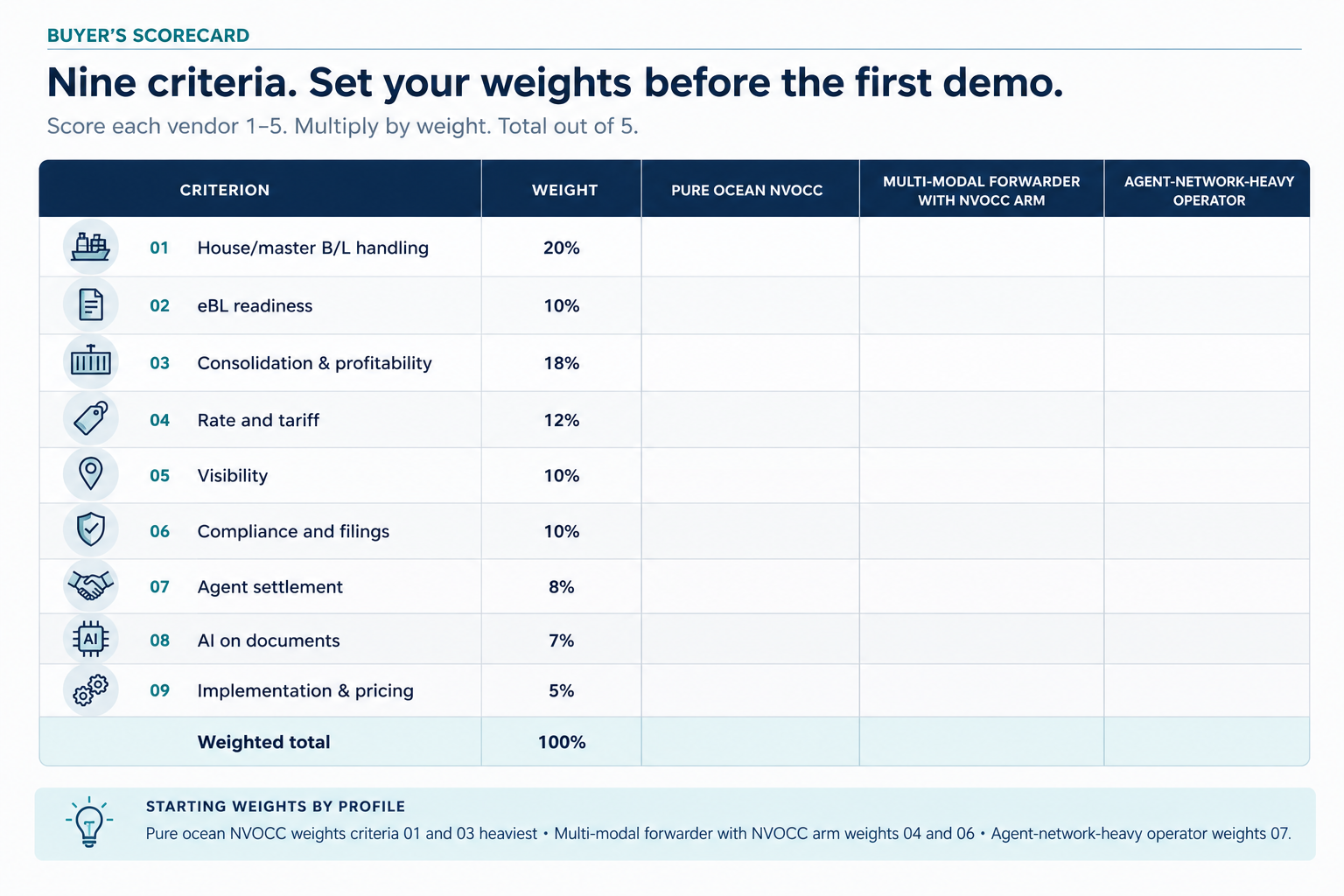
Copy this table, set your weights, and score each vendor 1–5. The discipline is agreeing the weights before the first demo, so a strong presentation cannot quietly re-rank your priorities.
Suggested starting weights by profile:
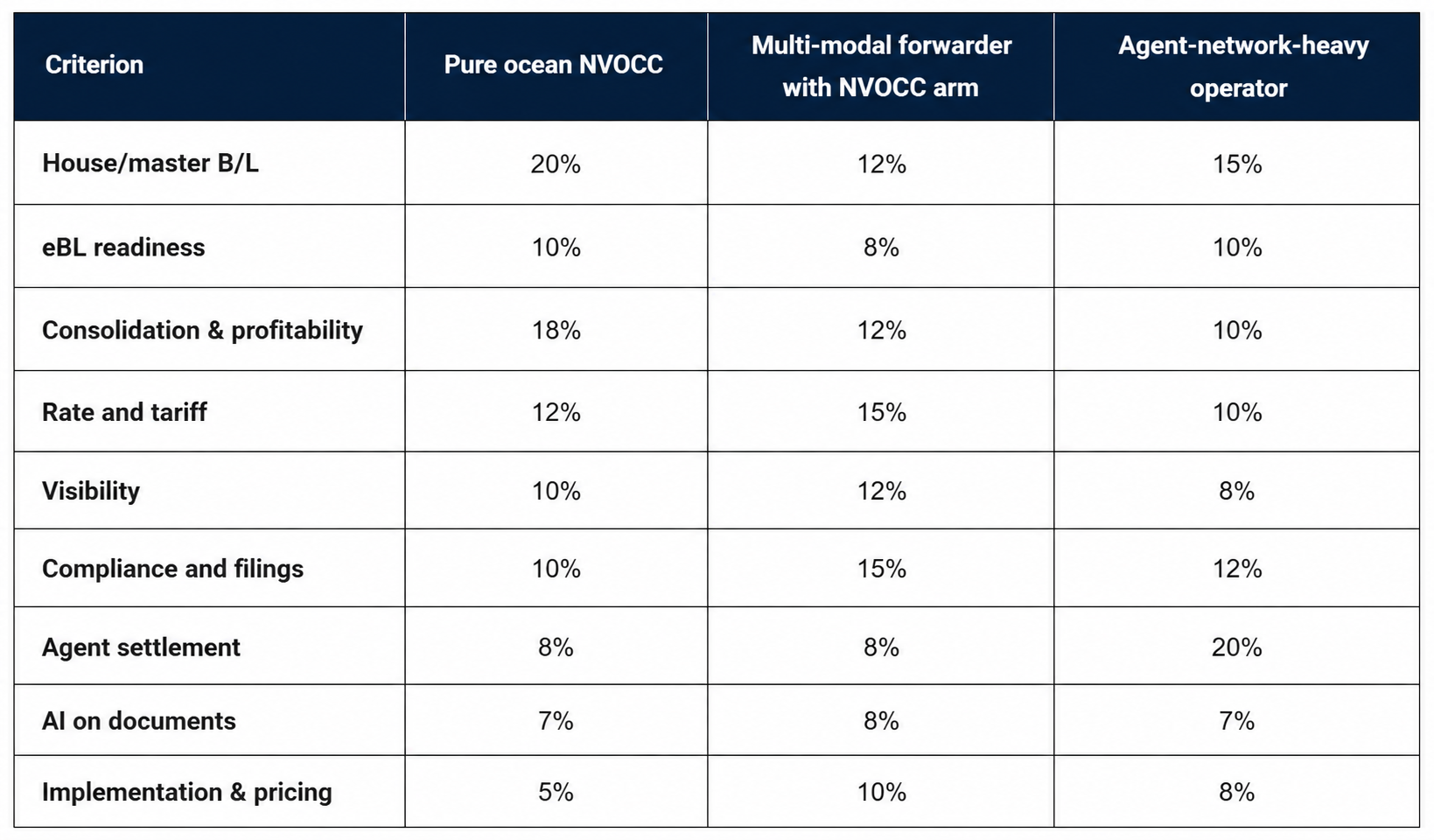
Adjust rather than adopt. The value is a number you can defend to your board, not a number we chose for you.
Vendors in this category fall into four archetypes, and the honest answer is that each one wins somewhere.
Enterprise Suites
These cover the widest functional surface and integrate deeply across customs, accounting, and carrier connectivity at global scale. If you operate across many jurisdictions with an internal IT function, that depth and brand safety are real advantages. The trade-offs are implementation measured in quarters and module or consumption-based pricing.
Established Mid-Market Platforms
Platforms with on-premise heritage bring long track records and mature core functionality. Their constraint is usually architectural rather than functional — how modern the APIs are, and how much the data model still assumes manual entry.
Regional Shipping ERPs
Often the strongest option for local compliance in a single geography, with filings and statutory reporting maintained by people who work in that market. Thinner APIs and a narrower partner ecosystem are the usual limits.
AI-Native Modern Platforms
Built around document automation and current integration standards, with faster implementations. They are younger, with shorter reference lists and less coverage of exotic edge cases.
Shipthis sits in this group: AI-native, per-seat pricing, live with 100+ forwarders across 35+ countries, and built for operators in the 20–500 employee range handling 500 to 50,000 shipments a month.
Comparing categories more broadly? See 9 best freight forwarding software in 2026 and what ocean freight software covers.
Seven signals that NVOCC operations software was not built for this business:
Still have questions? Here are the ones buyers ask most.
1. What Is NVOCC Software?
NVOCC software manages the operations of a non-vessel-operating common carrier: issuing house bills of lading under the operator’s own tariff, linking those houses to a master bill of lading, managing LCL consolidation, tracking containers, filing customs documents, and settling accounts with overseas agents.
2. How Is NVOCC Software Different from a Freight Forwarding TMS?
A freight forwarding TMS tracks shipments and manages customer billing. NVOCC software additionally treats the operator as carrier of record: it issues house bills of lading as legal documents, models master-to-house relationships natively, allocates container-level costs across houses, and settles agent profit shares.
3. Can NVOCC Software Issue House Bills of Lading?
Purpose-built NVOCC software issues house bills of lading directly from the master bill of lading, using the operator’s own template, numbering series, and terms and conditions. Generic freight forwarding software often handles house bills of lading through custom fields or external templates, which breaks the audit trail.
4. Do I Need eBL Support in 2026?
Electronic bill of lading support is a readiness requirement in 2026 rather than a daily necessity. DCSA member carriers have committed to 100% electronic bills of lading by 2030, and cross-platform eBL exchange became available in June 2026, so NVOCC software should be able to issue a house eBL when customers request one.
5. How Much Does NVOCC Software Cost?
NVOCC software is priced per user seat, per module, or per shipment volume. Shipthis is $89 per user per month with every module included and no per-transaction fees — a 25-user team pays $2,225 a month for the whole platform. Total cost of ownership depends less on the headline rate than on implementation fees, data migration cost, and how the price behaves as shipment volume grows.
6. How Long Does It Take to Implement NVOCC Software?
Implementation timelines range from a few weeks for modern cloud platforms to two or three quarters for enterprise suites requiring extensive configuration. Most Shipthis customers are fully operational within 9 weeks of signing. The main variables are data migration volume, number of carrier integrations, customs filing scope, and how much of the work the vendor performs directly.
7. Can I Migrate Historical Shipment Data from My Current System?
Historical shipment data, master and house bill of lading records, customer and agent masters, and rate tables can be migrated from most incumbent systems. Migration quality depends on export access and on who owns the mapping work. Ask any vendor for a named migration owner, a timeline, and a written definition of completion.
8. What’s the Best NVOCC Software for a 50-Person Company?
The best NVOCC software for a 50-person operator is the platform that handles house bills of lading natively, prices per seat rather than per shipment, and implements in weeks rather than quarters. Score shortlisted vendors against weighted criteria covering documentation, consolidation profitability, filings, agent settlement, and implementation risk.
NVOCC software is a five-to-ten year decision that most operators make inside a six-week window created by a renewal date. The vendors on your shortlist will change. The nine criteria will not, because they come from the structure of the business rather than from anyone’s product roadmap.
Take the scorecard, set your weights before the first demo, and make each vendor answer the nine questions on their own system with your documents. If a vendor cannot amend a master B/L with six houses under it while you watch, you have learned more in ten minutes than a month of feature comparison would tell you.
You can read our whitepaper to learn more — How to Choose the Right Freight Forwarding Software.
Or, why not get started today by booking a free demo of Shipthis and bringing one of your own shipping instructions?
