Thank you! We will get back to you soon
Oops! Something went wrong while submitting the form.
Freight forwarding has always been a coordination game, but the stakes have never been higher.
A single international shipment can touch more than 28 stakeholders and generate over 200 data interactions. Historically, managing this meant stitching together spreadsheets, email threads, and disconnected carrier portals. The result: data entered five times over, invoices that didn't match bookings, and customers calling to ask where their cargo was.
The tools have finally caught up with the complexity.


Digital freight forwarding platforms connect quoting, booking, documentation, tracking, and invoicing into a single operational system — giving freight forwarders the visibility, speed, and control that modern global trade demands.
This article covers
These terms are related, but they are not the same.
A logistics company that runs operations using technology, automation, and data-driven workflows instead of manual processes.
Focus: digital interfaces, faster quoting, real-time visibility, automated operations.
The cloud-based software that connects quoting, booking, documentation, tracking, and invoicing in one system.
Shipment data is entered once and flows across all processes, reducing errors and duplicate work.
Any traditional freight forwarder can adopt a platform to modernize operations without changing its core business.
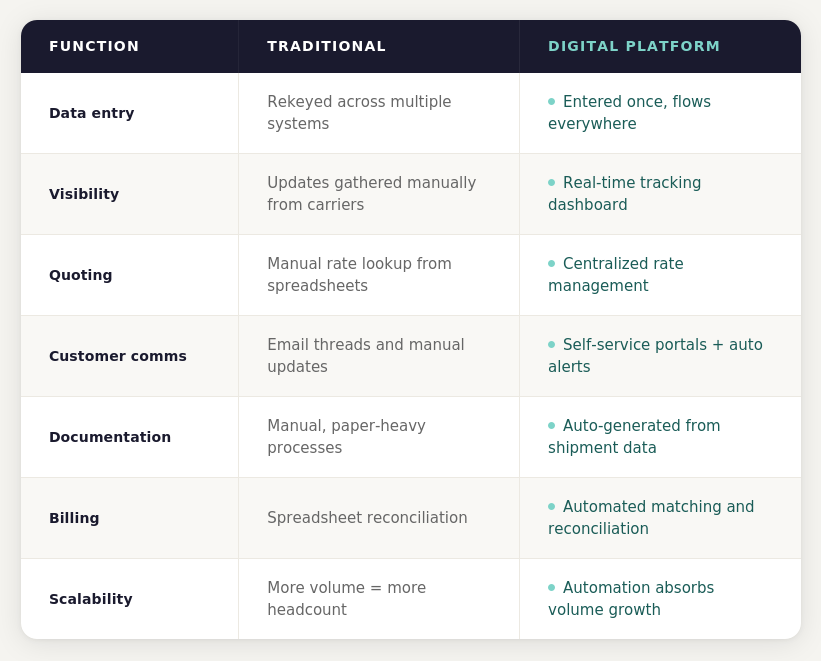
Freight forwarding teams across the industry deal with many of the same operational challenges:
• Fragmented systems – TMS, accounting, and CRM tools operate separately, leading to siloed and inconsistent data.
• Manual data re-entry – Shipment details entered during quoting are entered again for booking, documentation, and invoicing.
• Limited visibility – Teams spend time chasing carrier updates instead of receiving them automatically.
• Slow quoting – Rates spread across multiple spreadsheets delay RFQ responses and can cost business to faster competitors.
• Billing errors – Disconnected systems allow cost discrepancies to pass through to closed jobs, gradually reducing margins.
1. Eliminate Data Re-entry and Reduce Errors
A digital freight forwarding platform captures shipment data once and automatically carries it through quoting, booking, documentation, and invoicing. Your team spends less time on repetitive data entry and more time managing operational exceptions and customer needs.
2. Real-Time Shipment Visibility
With centralized tracking across air, ocean, road, and rail, your team gets automated milestone updates while customers access live tracking through a self-service portal. Instead of chasing updates, you stay ahead of them.
3. Faster Quoting and More Won Business
Centralized rate management helps sales teams respond to RFQs in minutes instead of hours. In a competitive freight market, faster quoting often means higher conversion and increased revenue.
4. Stronger Freight Cost Control
Automated invoice matching identifies cost discrepancies before jobs are closed. This reduces billing errors, protects margins, and prevents small variances from turning into larger write-offs.
5. Scale Without Adding Headcount at the Same Rate
Freight forwarders using digital platforms can manage significantly higher shipment volumes without expanding their teams proportionally. Automation shifts the workload from manual processing to exception management.
6. Improved Customer Experience
White-labeled customer portals give clients 24/7 access to shipment tracking, documents, and quotes. This reduces inbound emails and calls while delivering a more modern, transparent service experience.
When evaluating a digital freight forwarding platform, look beyond basic functionality. The right solution should combine strong operational features with built-in AI automation.
• Rate management and online quoting – Centralized tariffs and rate sheets allow fast, accurate multi-mode freight quotations from a single system. AI-powered RFQ parsing can automatically convert incoming emails into structured quote requests, helping sales teams respond faster.
• Multimodal shipment tracking – Carrier integrations deliver live milestone updates across air, ocean, road, and rail. AI-driven predictive monitoring can flag at-risk shipments before delays occur, enabling proactive customer communication.
• Automated documentation – Bills of lading, customs documents, and invoices are generated directly from shipment data. AI document intelligence can extract structured data from freight documents, reducing manual entry and improving accuracy.
• Integrated financial workflows – Vendor billing, customer invoicing, and cost reconciliation are managed within one unified platform, with automated invoice matching to detect discrepancies early.
• Customer portals – White-labeled, self-service portals provide 24/7 access to quotes, tracking, and shipment documents, improving transparency and customer experience.
• Analytics and reporting – Real-time dashboards surface shipment performance, carrier metrics, revenue trends, and overall financial health, supporting data-driven decision-making.
• API and carrier connectivity – Native integrations with airlines, ocean carriers, ERP systems, customs portals, and accounting software ensure seamless data exchange across your logistics ecosystem.
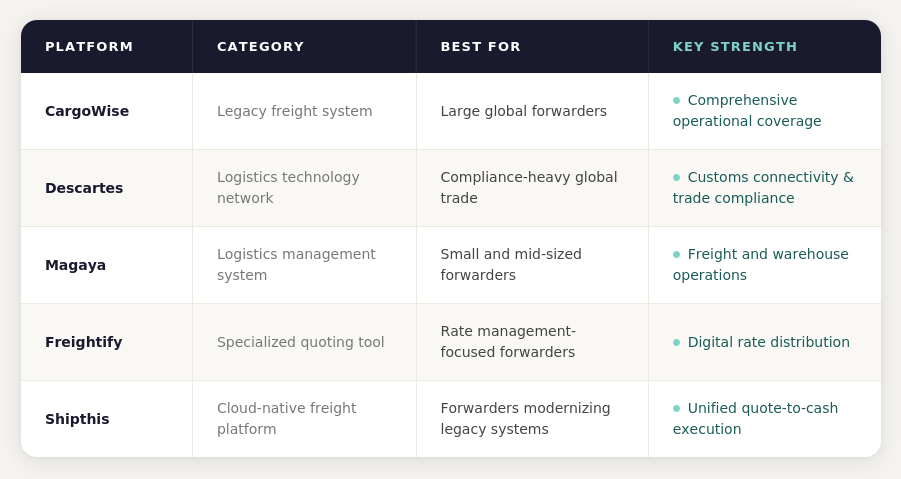
Choosing the right digital freight forwarding platform requires more than comparing feature lists. Use this structured approach to evaluate vendors properly:
Start by documenting your full shipment lifecycle, from initial quote to final payment. Identify where data gets re-entered, where delays happen, and where customers experience friction. This helps you avoid choosing software that looks impressive but does not solve your real operational bottlenecks.
Make sure the platform supports your core transport modes, whether air freight, ocean freight, road, or rail, and handles both import and export workflows. If it only supports part of your operations, you will still rely on disconnected tools.
Ask for a clear list of integrations. Do not accept vague claims. Confirm connectivity with your key carriers, ERP or accounting system, and any customs platforms you depend on. Strong integrations are essential for true end-to-end visibility.
Request live demonstrations of automation in action, such as document generation, RFQ email parsing, and invoice matching. Sales presentations show potential. Live demos show reality.
Look beyond subscription pricing. Consider implementation, integrations, data migration, training, and long-term support. Many platform projects fail during rollout, so understand what onboarding and post-go-live support actually involve.
Streamline your quoting, booking, documentation, and billing with a digital freight forwarding platform like Shipthis.
Move from manual, email-driven workflows to faster quoting, real-time visibility, and automated operations without increasing headcount.
