
An RFQ Emailed to You Becomes a Quote, Before Anyone Opens It Manually
Requests for quotes arrive however your customers prefer to send them, email, WhatsApp, your website, your customer portal, or a call someone writes up afterward. Shipthis captures all of it in one place, and for the emails that make up most of that volume, AI parses the shipment details automatically and feeds them straight into a quote, so your pricing team starts from a structured request instead of a wall of text.
No credit card required. Go live in weeks, not months. Implementation team included.


.avif)
An RFQ already contains everything a quote needs, origin, destination, cargo, weight. The delay is someone transcribing that into the system by hand.
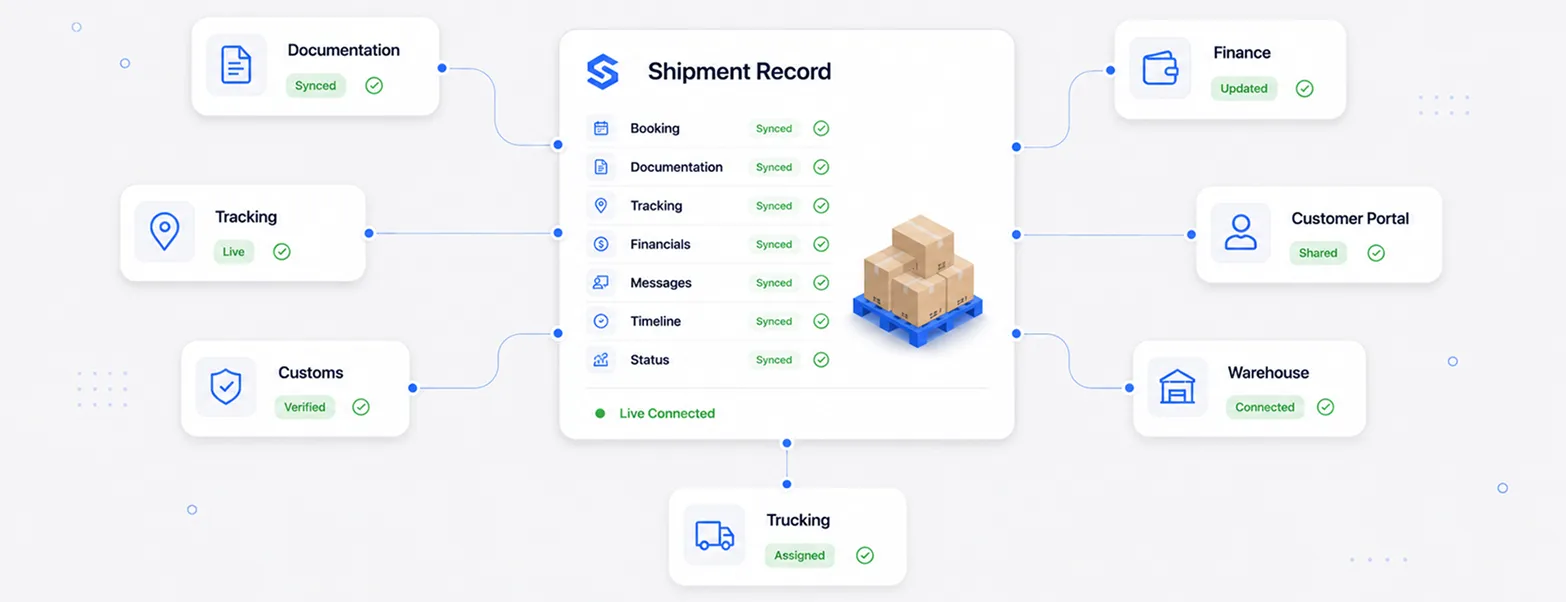
By the time an RFQ lands in an inbox or a WhatsApp thread, it already contains almost everything a quote needs, where the cargo's going, what it is, how much of it there is. The actual time cost isn't receiving that information, it's someone reading it and typing it into a quoting system before pricing can even begin. Shipthis removes that step. AI parses incoming emails directly into structured quote data, WhatsApp submissions come through a guided chatbot that captures the same fields cleanly, and website or portal requests arrive already structured because the customer entered them directly. Manual capture is still there as a clean fallback for anything that arrives by phone or in person, but it's the exception, not the default workflow.


Send the Email. Get a Structured Quote Request. No Typing Required
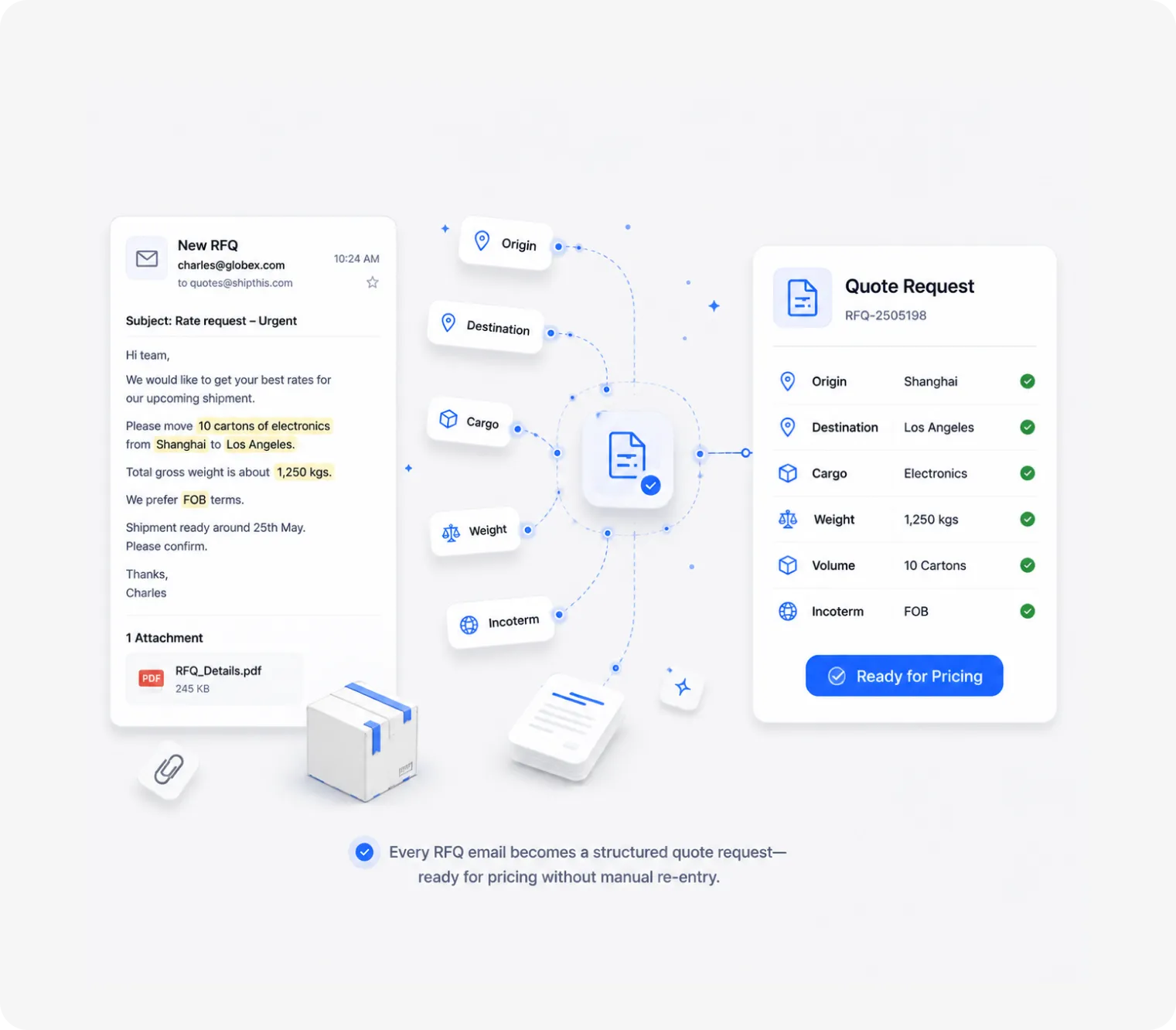
AI reads the RFQ email, extracts shipment details, and feeds them directly into the quoting system, ready for your pricing team to price, not re-enter
A customer's RFQ email usually isn't structured, it's a paragraph, sometimes with an attachment, sometimes a forwarded thread. Shipthis's AI parses that content directly, extracting origin, destination, cargo type, weight, dimensions, and shipper or consignee details, and feeds it straight into the quoting workflow as a structured request. Your pricing team opens a quote that's already populated, not an email they have to read and transcribe first, which is where most of the delay between "customer asks for a price" and "customer gets a price" actually comes from
If Your Customers Live on WhatsApp, So Does Your RFQ Intake
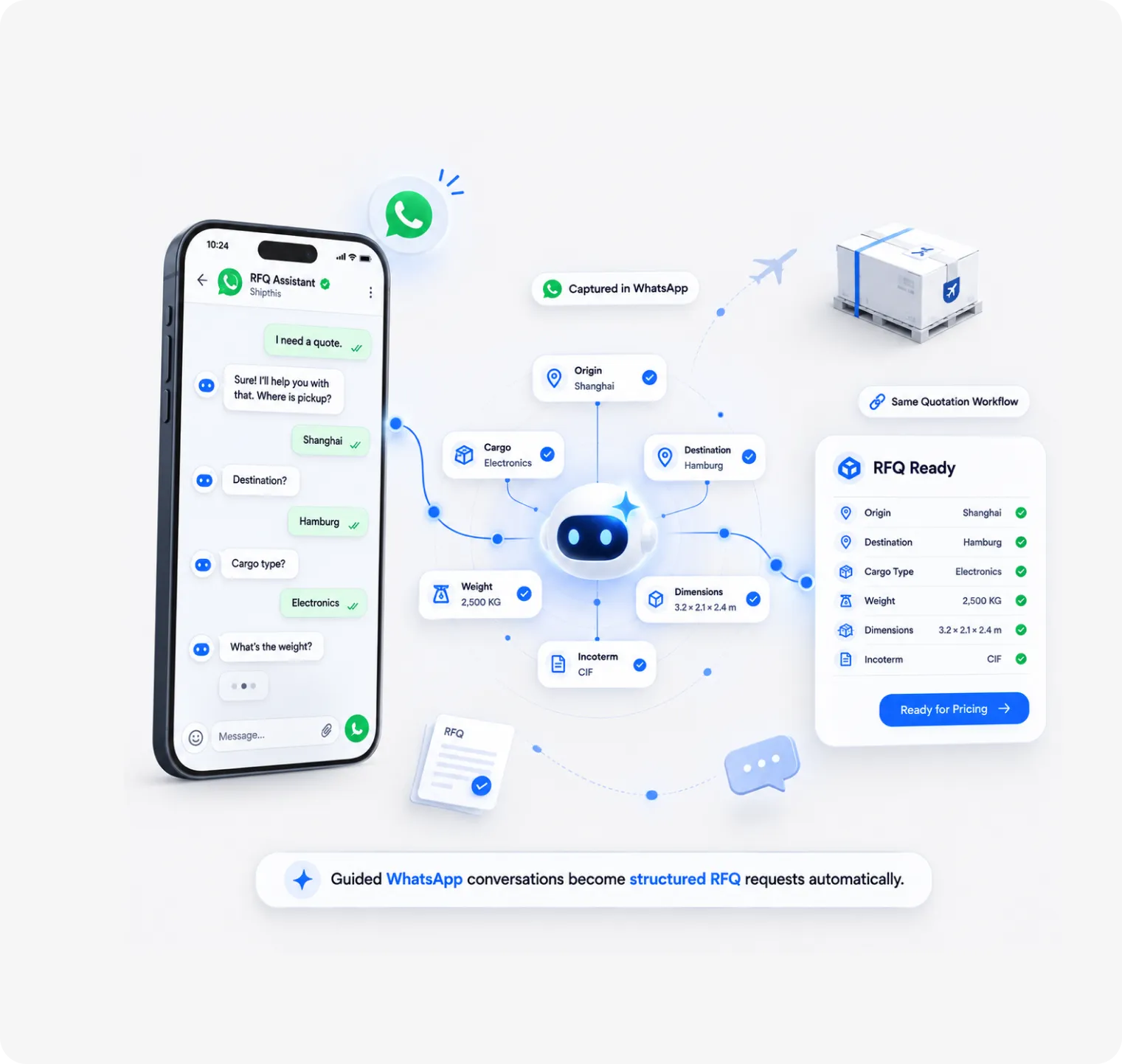
A guided chatbot walks customers through the details a quote needs, right inside WhatsApp, no separate app, no lost thread.
For customers who default to WhatsApp over email, an automated chatbot guides them through submitting an RFQ directly in the conversation they're already having, capturing and validating the same shipment details a quote needs, without asking them to switch to a different tool. The information feeds straight into the same quoting workflow as every other channel, so a WhatsApp RFQ gets the same structured treatment as one that arrived by email
Self-Service Requests on Your Website, Straight Into the ERP
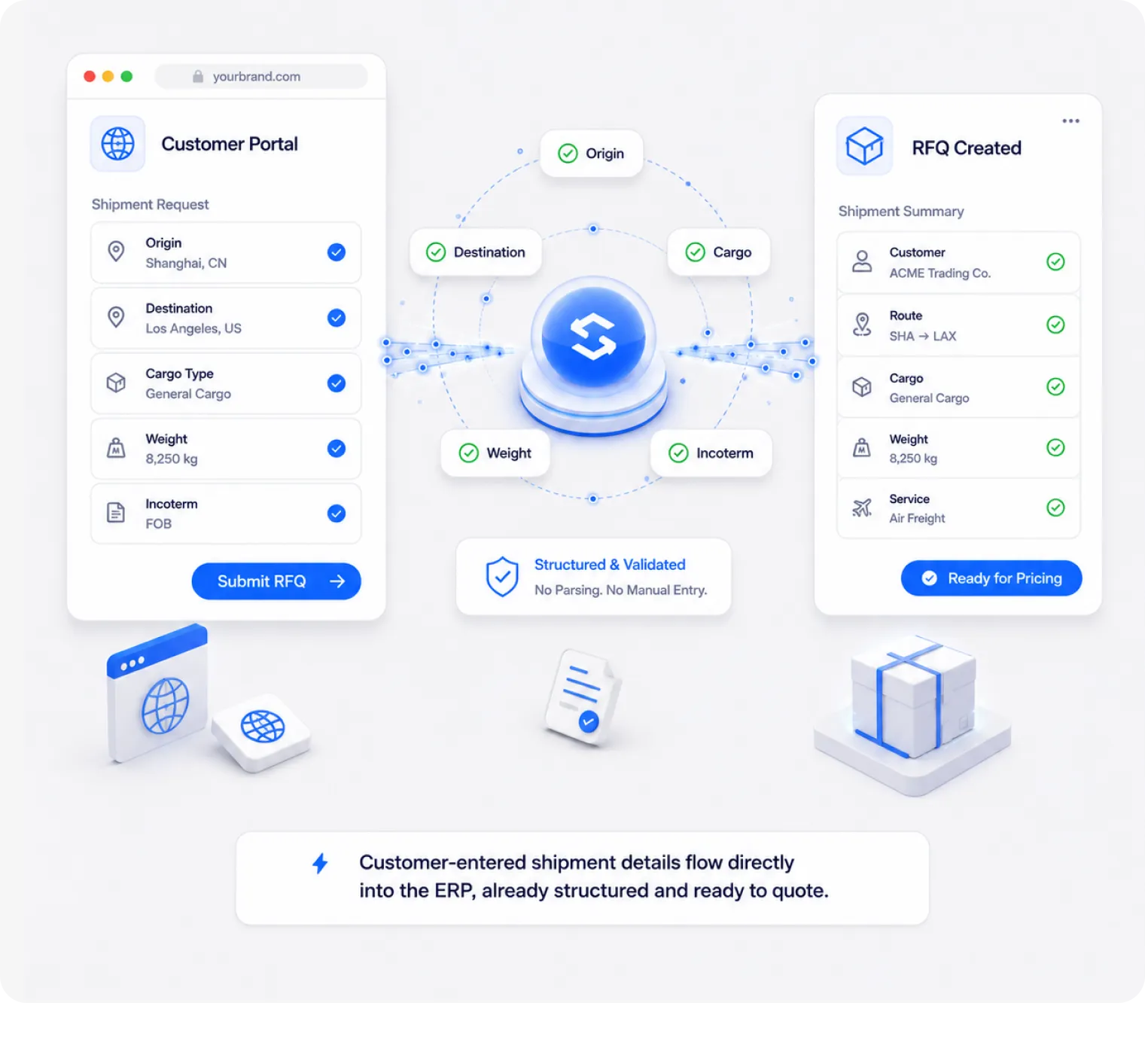
A dedicated web form and a branded customer portal let customers submit shipment details directly, structured from the start.
Some customers would rather fill in a form than write an email, and that's the cleanest RFQ channel there is, the shipment details go straight into the backend system exactly as the customer entered them, with nothing to extract or transcribe. Shipthis supports both a direct web-based request form and a branded customer portal where clients can submit RFQs, track shipments, and view invoices, reinforcing the same account relationship every time they come back.
Not Every RFQ Is Digital, That Don't Have to Mean Sticky Notes
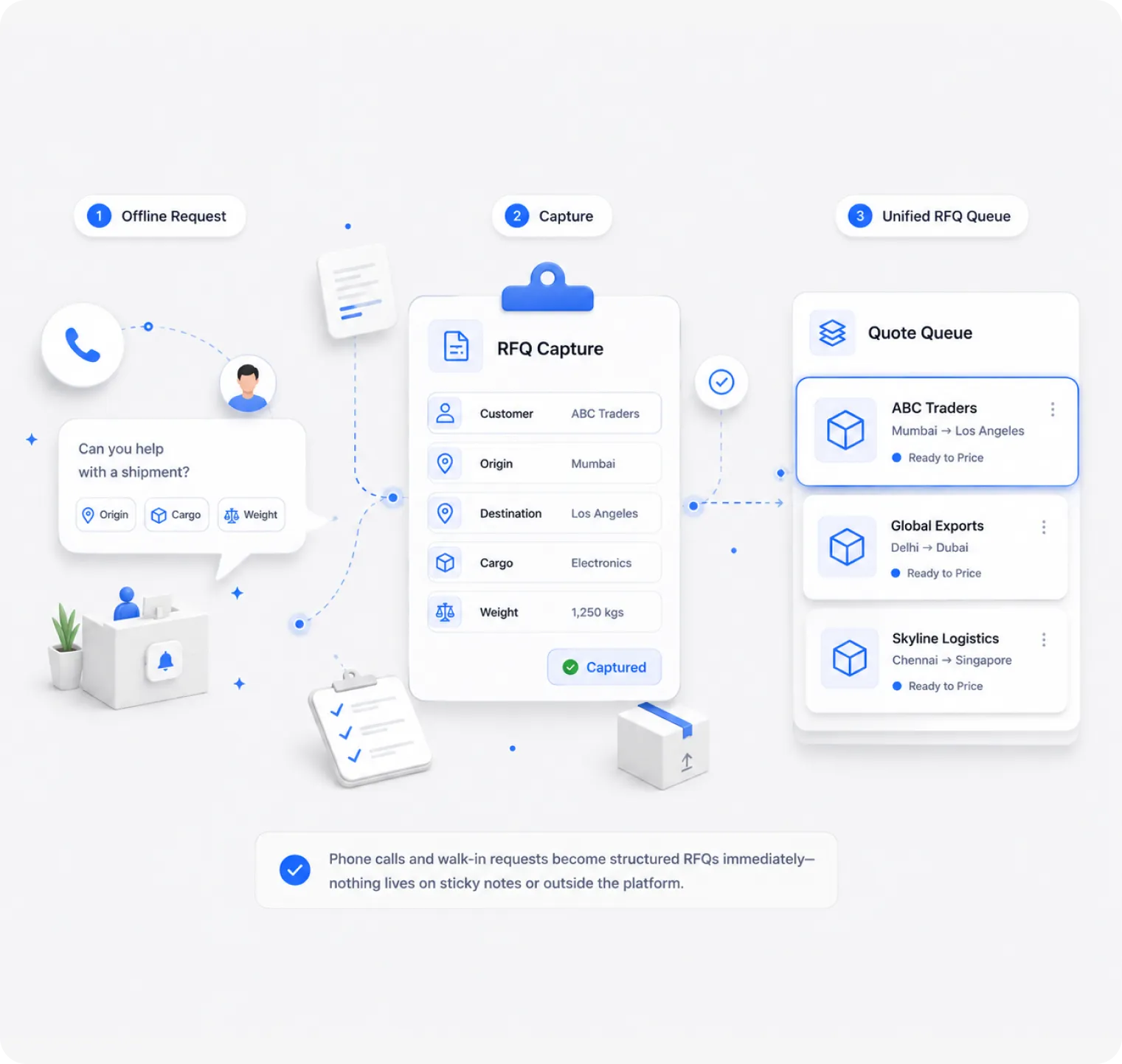
A simple, intuitive manual capture screen for the RFQs that arrive by phone or in person, so nothing has to live outside the platform.
Not every RFQ arrives digitally, a phone call or an in-person conversation still happens, and it shouldn't mean that request lives on a sticky note instead of in the system. Shipthis includes a straightforward manual capture screen for exactly this case, so a request taken by phone gets entered once, cleanly, and joins the same quote queue as every other channel.
Five Channels In. One Dashboard to Manage All of It.
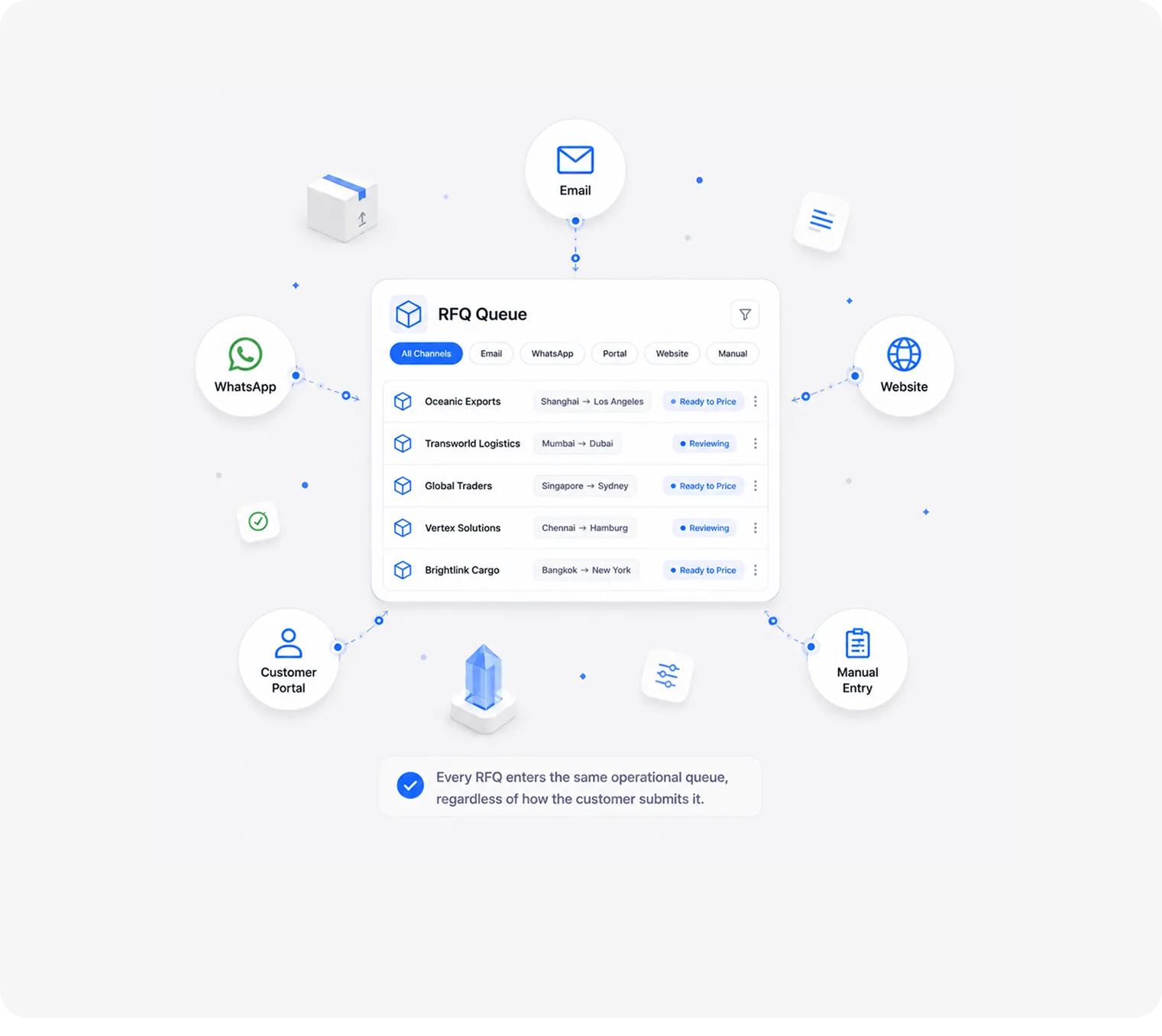
Every RFQ, regardless of channel, lands in one centralized dashboard, filterable, sortable, and tracked from request to response.
Capturing RFQs from five different channels only helps if they all end up somewhere your pricing team can actually manage them together. Shipthis brings every RFQ, email, WhatsApp, website, portal, or manual entry, into one centralized dashboard, filterable by customer, origin, destination, mode, or status, so your team has a single, real-time view of every outstanding request instead of checking an inbox, a WhatsApp thread, and a portal queue separately.


Everything the Quote Needs After the RFQ Lands
Capture is the start. These capabilities carry the request through pricing, approval, and delivery to the customer.
Quote Response, Multiple Rate Sources
Contracted rates, live spot rates, pre-negotiated customer rates, or a direct query to a vendor, pulled into the same quote.
Approval Workflow
Quotes above a set amount or below a margin threshold route to a manager automatically before going to the customer.
Quote Publishing & Sharing
Send a quote directly from the module, or publish it to the customer portal for review and acceptance.
Multi-Currency Quoting
Generate a quote in the customer's own currency, no manual conversion required.
Charges Templates
Reusable line-item templates, so a recurring quote structure doesn't get rebuilt from scratch every time.
AI-Powered Pricing Recommendation
Recommends pricing based on historical margin and win/loss patterns for that customer or lane.
Hazardous Cargo Detail Capture
Hazard class, UN number, packing group, and emergency contact captured directly in the quote itself.
Full Audit History
Every change to a quote logged with a date and timestamp.
Every Channel Covered. One of Them Solved Properly.
Most RFQ tools claim to capture every channel. Shipthis actually removes the manual work behind the busiest one, email, with AI parsing that's built for this specific job.
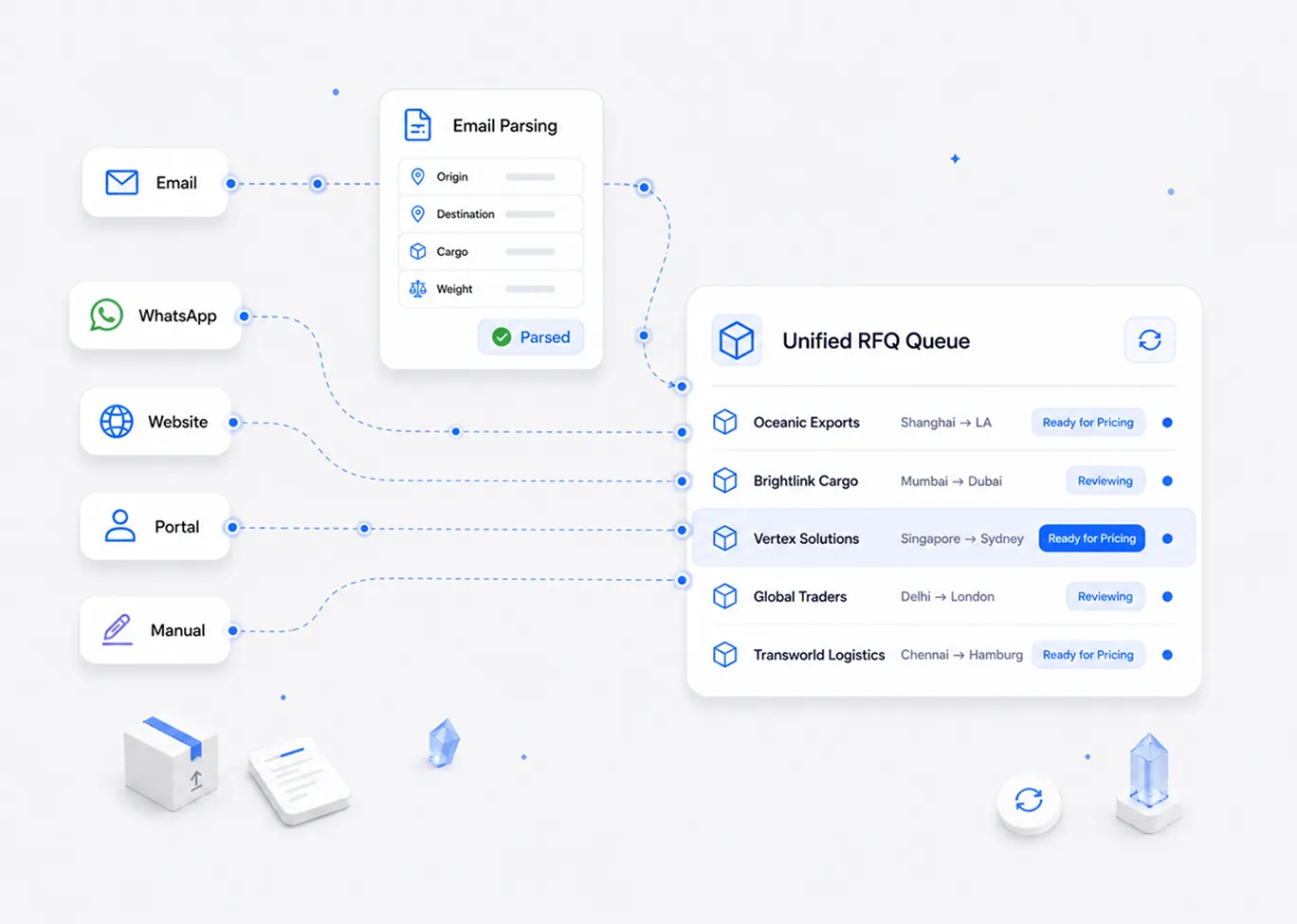
Covering every RFQ channel is table stakes at this point, most quoting platforms claim it. What separates Shipthis is that the highest-volume channel, email, isn't just captured, it's parsed automatically into a structured quote request, removing the specific manual step that actually slows a pricing team down. Combined with WhatsApp, portal, website, and manual capture all feeding the same centralized dashboard, RFQ management here isn't five separate features, it's one pipeline, with the slowest part of it actually fixed.

Sign-Up to Live RFQ Capture, in 9 Weeks
A dedicated implementation team migrates open RFQs and customer data, and gets your AI email parsing tuned to how your customers actually write.
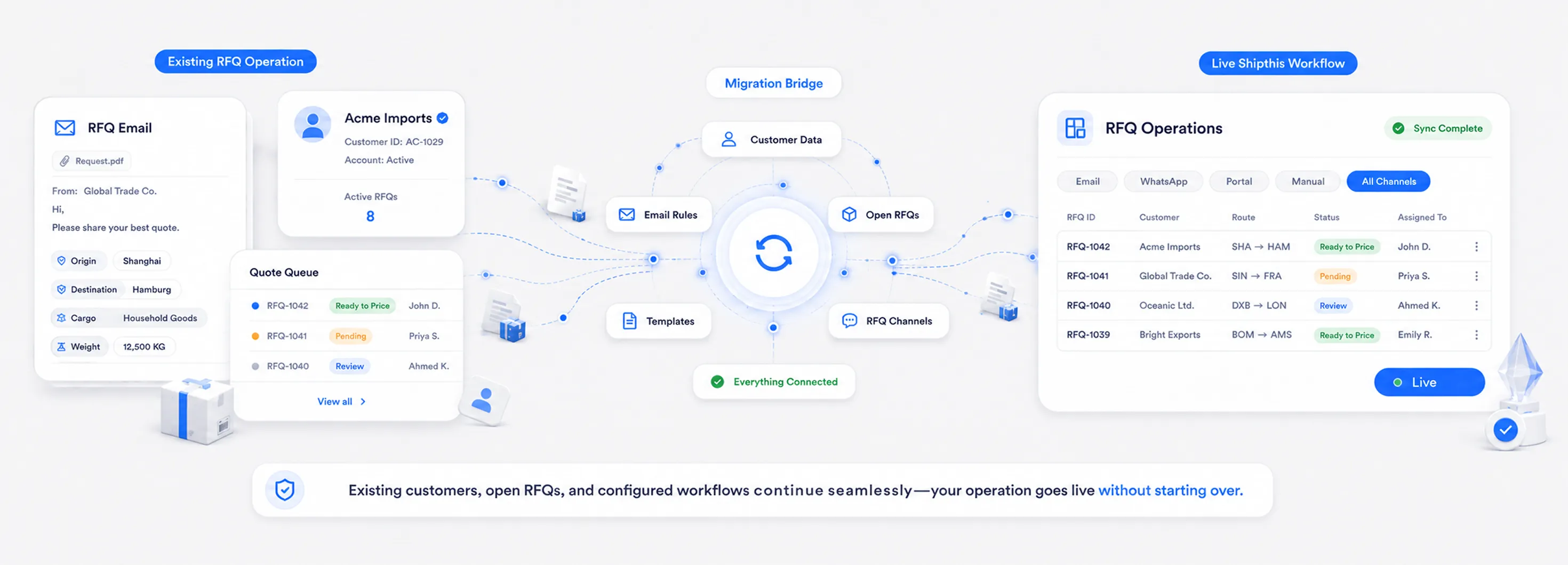
Switching how RFQs are captured doesn't mean pausing the pipeline you already have in flight. Shipthis onboarding is built around that reality. Existing open RFQs and customer data are migrated for you, and your team is trained on the channels they'll actually use, including tuning AI email parsing to the format and language your specific customers tend to write in. Most customers are fully operational within 9 weeks.


Forward Us an RFQ Email. We'll Show You the Quote It Becomes.
Book a walkthrough with your own RFQ channels and email formats, or start a free trial and try AI parsing yourself.
A demo can walk through your own RFQ mix, the channels your customers actually use, and what your typical RFQ emails look like, not a generic script. Prefer to explore first? A free trial gives your team hands-on access with no commitment.

Book a demo or start your 30-day free trial — and talk to a real freight specialist, not a sales script.
RFQ Management Questions, Answered
The AI extracts key shipment details, origin, destination, cargo type, weight, dimensions, and shipper or consignee information, directly from RFQ email content, including attachments in common formats, feeding them into a structured quote request your pricing team can act on immediately.
Yes. A guided chatbot captures RFQ details directly within WhatsApp, validating inputs as the customer provides them, and feeds the same structured data into the quoting workflow.
No. Customers can submit RFQs through a direct website form, the customer portal, email, WhatsApp, or have a request manually entered by your team, whichever channel they prefer.
They're entered through a simple manual capture screen, joining the same centralized dashboard as RFQs from any other channel.
Yes. Every RFQ, whatever channel it arrived through, appears in one centralized dashboard, filterable by customer, route, mode, or status.
Yes. Existing open RFQs and customer data are migrated as part of onboarding, so nothing in flight gets lost in the transition.