Thank you! We will get back to you soon
Oops! Something went wrong while submitting the form.
Freight forwarding relies heavily on repetitive data entry across documents like rate sheets, bookings, and invoices.
AI streamlines this by extracting data, parsing emails, and automating workflows.
This article covers how forwarders use AI for document automation, quoting, reconciliation, visibility, and along with key challenges and how to get started.


AI in freight forwarding uses machine learning, predictive analytics, and automation to handle tasks like document processing, routing, and delay prediction—reducing manual work and improving decision-making.
In 2026, the focus is on “human-in-the-loop” AI, where systems suggest actions but humans make the final call, combining automation speed with real-world expertise:
Wondering how AI automates documentation?
Let’s find out.
Freight forwarding relies on heavy documentation, like bills of lading, invoices, and customs forms. AI-powered OCR extracts and inputs this data automatically, eliminating manual entry and saving time:
AI reads Master Bills of Lading (MBLs), House Bills of Lading (HBLs), and vendor invoices, then maps the extracted fields directly into your system. The error rate drops compared to manual entry because the same data flows through once rather than being re-keyed at each stage.
Forwarders receive rate sheets in every format imaginable. PDFs, Excel files, email attachments, sometimes even screenshots. AI converts these unstructured inputs into clean, structured tariff data that feeds directly into quoting systems. Shipthis AI's document intelligence handles this conversion automatically, so rate updates don't pile up in someone's inbox.
Before submission, AI validates customs documentation against regulatory requirements and flags errors early. This applies to workflows like eAWB (electronic Air Waybill) submission, where accuracy determines whether carriers accept the shipment data or reject it for corrections.
Email is a major bottleneck in freight forwarding, filled with unstructured requests and updates. AI streamlines inbox management by extracting data and turning emails into automated workflows, reducing manual effort and response time.
The inbox is often the bottleneck. Booking requests, rate inquiries, status update requests, and exception notifications all arrive as unstructured email. AI parses these messages and converts them into operational actions:
AI reads incoming RFQ (Request for Quote) emails and extracts shipment details: origin, destination, cargo type, dates, special requirements. From there, it creates quote records automatically. No more manual transcription from email to system.
Beyond extraction, AI converts email content into shipment workflows—task assignments, milestone updates, and document requests. The message becomes the action. A customer asking for a status update triggers the system to pull tracking data and respond, rather than waiting for someone to read and forward the email.
Teams handle higher volumes without proportional staff increases. Shipthis AI's email parsing demonstrates how this works in practice. Messages become structured data, and structured data drives execution.
With quoting streamlined, the next step is optimizing how costs are managed and reconciled across operations.
Slow quote cycles cost business. When a customer requests a quote, the clock starts. AI enables faster, more accurate quotes by searching centralized rate databases and applying business rules automatically.
AI searches all contracted and spot rates across ocean, air, and inland transport to find the best options instantly. What once took hours of spreadsheet work now happens in seconds. The system pulls from a single rate database rather than scattered Excel files.
AI-driven margin analysis evaluates each quote against target profitability. Some platforms, including Shipthis AI pricing intelligence, predict win probability based on historical quote performance. This helps teams prioritize opportunities worth pursuing.
Quotes can be delivered automatically via email or customer portal, complete with itemized charges and alternate options. The entire cycle from request to response compresses from hours to minutes.
Once quotes are secured, the focus shifts to ensuring financial accuracy and control across every shipment.
Billing errors and cost variances create friction between operations and freight accounting. AI automates the match between expected costs and actual vendor bills, catching discrepancies before they become disputes.
AI compares vendor invoices against job estimates and flags discrepancies in real time. This happens before the job closes, not weeks later during reconciliation when the details are harder to trace.
AI automates exchange rate handling, GST, ZATCA, e-invoicing, and other localized tax mandates. For forwarders operating across multiple entities and currencies, this removes a significant administrative burden that otherwise requires manual calculation and verification.
Dashboards show margins, accruals, and cash flow by job, branch, or customer. Shipthis's integrated finance engine provides this visibility as part of the operational flow rather than as a separate reporting exercise.
AI enables proactive exception management through real-time shipment visibility. It answers "Where is my cargo?" before customers ask by predicting delays and triggering alerts automatically based on carrier data and external sources.
AI analyzes weather, port congestion, and carrier performance to forecast accurate arrival times. Automated milestone notifications keep stakeholders informed without manual updates. When conditions change, the ETA adjusts and alerts go out.
AI identifies potential disruptions early: vessel delays, customs holds, capacity issues. This enables proactive decision-making rather than reactive firefighting. You see the problem developing, not after it has already caused a cascade of delays.
Self-service tracking portals allow customers to see real-time status without calling or emailing. The Shipthis Customer Portal provides this capability under the forwarder's own brand, so customers get answers instantly.
Next, let’s explore how AI can help you in route planning and carrier selection.
AI analyzes traffic, weather, geopolitical factors, and carrier reliability to recommend optimal routes and carriers. Dynamic capacity matching algorithms match empty cargo space with available shipments, minimizing empty runs.
Beyond route planning, AI also plays a critical role in identifying and mitigating risks across freight operations.
AI applies risk management intelligence by monitoring external factors like port strikes, weather events, and regulatory changes alongside internal data like carrier performance and payment history. The system flags risks before they become problems.
But none of it would matter much if AI didn’t optimize customer experience.
Rising customer expectations demand digital, always-on service. AI delivers this without adding customer service headcount.
But these are just part of what freight forwarders expect today:
Here’s how digital and AI-driven workflows reduce logistics costs:
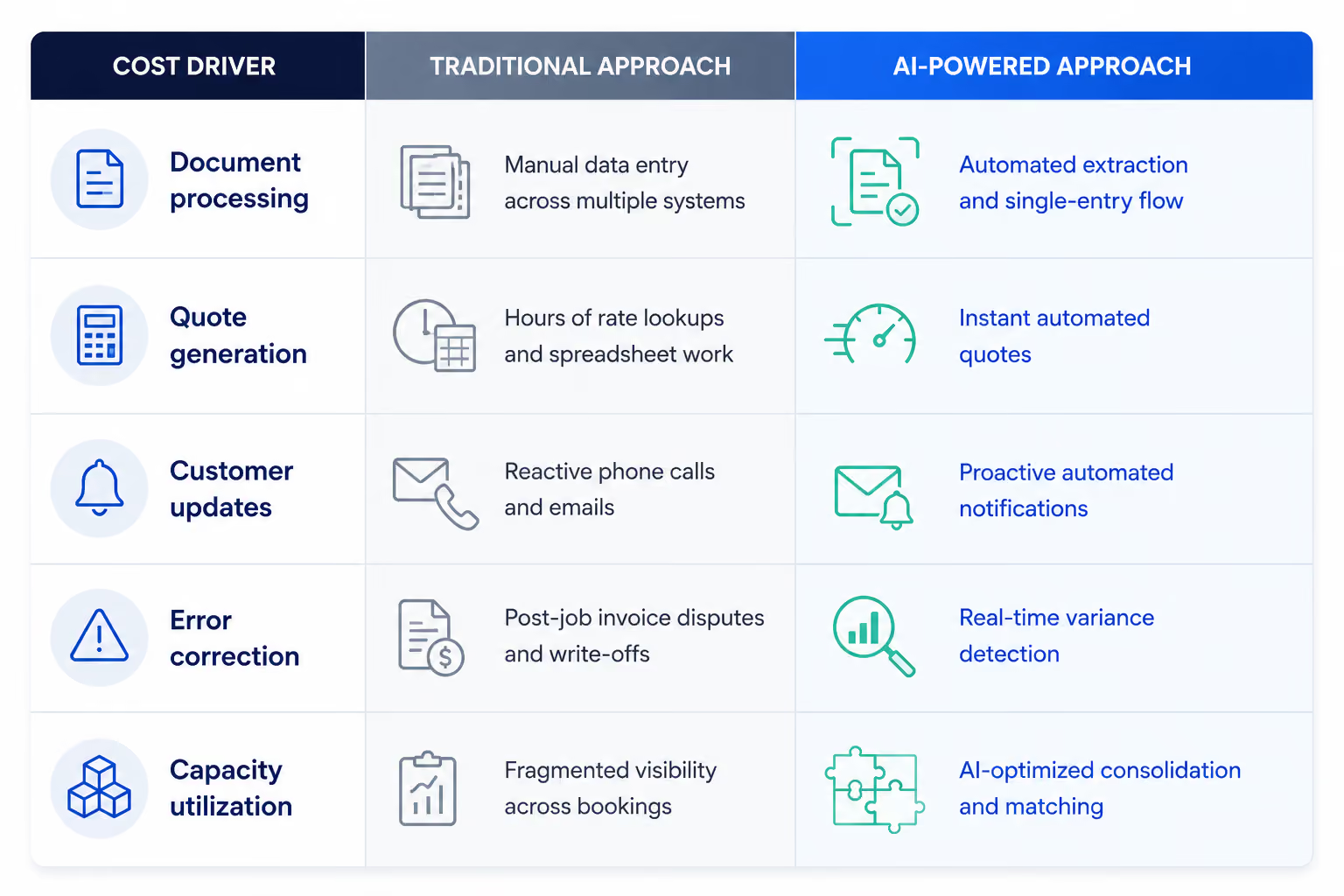
That said, freight forwarding AI does have its own set of cons you should be aware of:
Some of the aspects you should consider are:
AI requires clean, structured data. Many forwarders work with fragmented systems and inconsistent records. Platforms that bridge legacy software, like Shipthis's connectivity hub approach, allow modernization at the forwarder's own pace rather than requiring a complete system overhaul.
Staff resistance, training requirements, and the cultural shift from data entry to exception management roles all factor into successful implementation. The technology works, but people adapt at different speeds.
When evaluating AI solutions, consider whether they're freight-specific versus generic, their integration capabilities, and the implementation support offered. A platform built for forwarding understands the document types, workflows, and terminology that generic tools miss.
But you don’t have to worry about these issues if you use AI the right way for your freight forwarding tasks.
Let’s check out you can use AI for freight forwarding operations effectively:
Keep reading if you still have doubts about AI powered freight forwarding operations.
Here are answers to some common questions about incorporating AI in freight forwarding operations:
AI augments freight professionals rather than replacing them. It automates repetitive tasks while humans handle relationship management, complex negotiations, and exception decisions. The industry is moving toward "human-in-the-loop" AI where technology recommends actions and people approve them.
Start with high-volume, repetitive tasks like document processing, email parsing, or quote generation. These deliver the fastest ROI and easiest adoption.
Most forwarders see measurable time savings within weeks of deploying AI for document processing or quote automation. Full ROI depends on implementation scope, data quality, and team adoption.
Modern AI platforms connect to existing ERPs, TMS systems, and carrier networks through APIs and EDI, allowing forwarders to modernize incrementally. The key is selecting a platform designed as a connectivity hub rather than a closed system.
Basic OCR extracts text from images but requires manual field mapping and error correction. AI document intelligence understands freight document structures, validates data against business rules, and routes information directly into operational workflows.
AI is transforming freight forwarding by reducing manual work, improving accuracy, and speeding up operations.
Forwarders that adopt AI can scale faster, cut operational costs, and deliver better customer experiences, while empowering teams to focus on higher-value work.
And if you’re looking for the best software to help you out — look no further than Shipthis. We offer AI-powered freight forwarding software with document intelligence, automated email parsing, and quote generation built into a unified platform.
Book a demo now to explore Shipthis AI works.
