Thank you! We will get back to you soon
Oops! Something went wrong while submitting the form.
Last updated: 3 September 2026.


Surcharge season doesn’t announce itself politely. Between mid-August and mid-September 2026 alone, four major carriers — CMA CGM, MSC, Hapag-Lloyd, and ONE — have layered Panama Canal-related fees onto their published rates on staggered and only partly overlapping timelines, while the Panama Canal Authority has cut vessel draft to 48.0 ft (in force since 2 September) and, as of today, reduced daily transit slots.
The wave is still spreading: on 2 September, Seaboard Marine — a carrier not among the usual four — issued its own Panama Canal surcharge notice for South America trades.
None of this is exotic or unprecedented. But every cycle, the same handful of process failures turn a manageable rate change into a margin hit or a client dispute. Here are seven of the costliest, with figures from the current cycle attached to each.
This Article Covers
The mistake: pricing a shipment from a rate sheet that was accurate when it was built but hasn’t been touched since a carrier published a new surcharge.
CMA CGM’s Panama Canal Adjustment Factor rises to $500/TEU on 10 September 2026 — up from a prior rate that carrier notices and trade press have reported inconsistently as either roughly $320/TEU or $100/TEU (the two figures have never been reconciled, so treat both as unconfirmed). Take the more conservative gap: a rate sheet still showing $320/TEU underquotes a 40ft container by at least $180 once the container-vs-TEU basis is applied, and by roughly double that if the fee is charged twice per 40ft box rather than once — an ambiguity several carriers’ own notices don’t resolve (see the carrier fee comparison for the full breakdown). On 50 containers a month, that’s somewhere between $9,000 and $18,000 either quoted away as margin or, worse, discovered on the carrier invoice after the client has already been billed the old number.
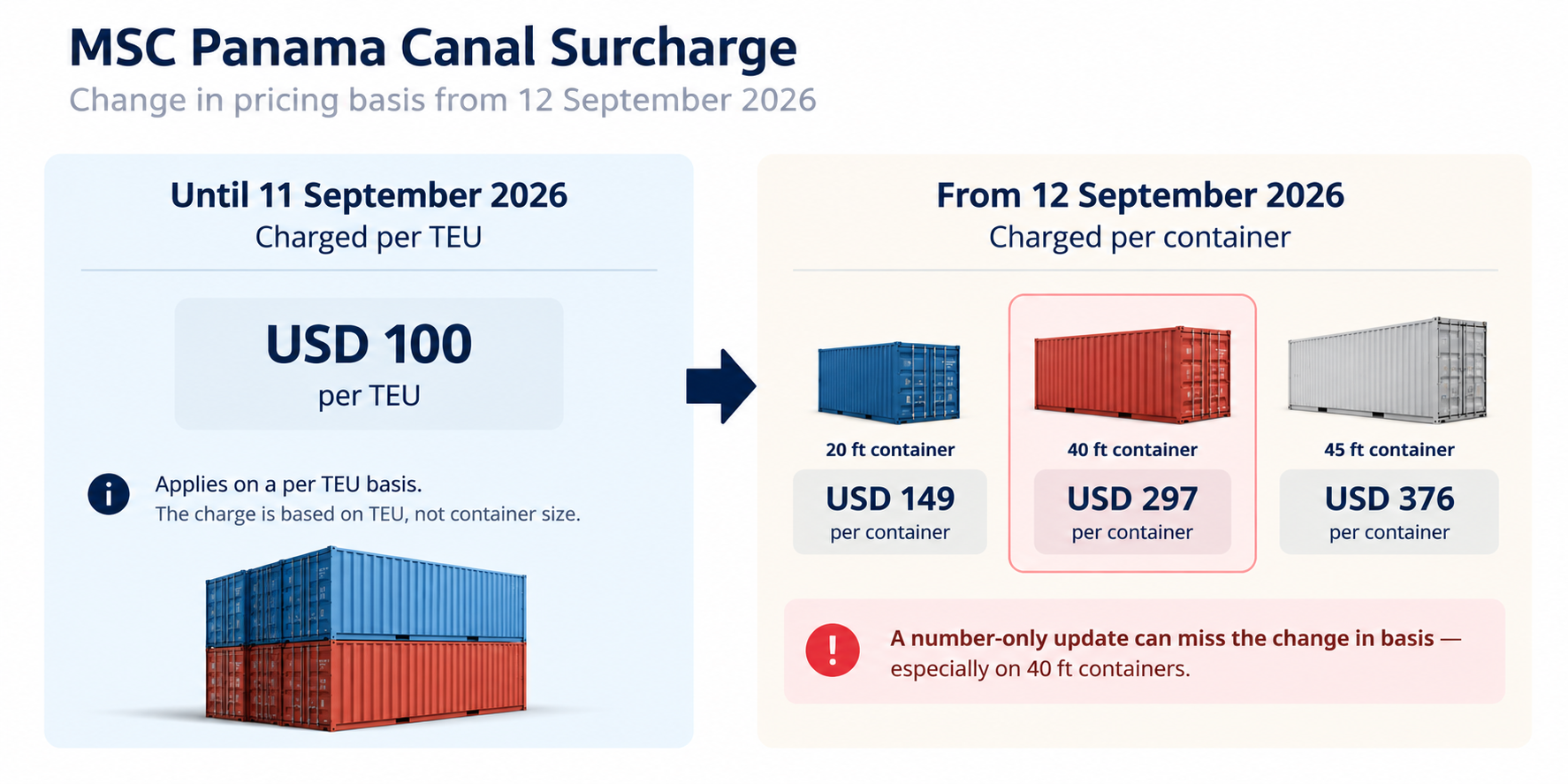
MSC makes the sharper point, because on 12 September the basis changes, not just the number. Until 11 September, MSC charges $100 per TEU. From 12 September, it charges per container: $149 for a 20ft, $297 for a 40ft, $376 for a 45ft. A forwarder who updates the figure but leaves the per-TEU logic in place still gets a 40ft box wrong — out somewhere between $97 and $197, depending on how the old per-TEU rate was being applied to that box. This is the failure mode a rate sheet is worst at catching, because the field that changed isn’t the one anyone thinks to check.
The fix isn’t a better spreadsheet cadence — it’s removing the gap between “carrier publishes” and “your rate sheet reflects it.” During a stretch where four carriers are moving in the same six weeks, and one of them is changing the unit of measure, weekly review is already too slow.
The mistake: applying a surcharge — or failing to apply one — without checking whether the specific lane or account qualifies for a published exemption.
The current cycle has real exclusions written into carrier notices. CMA CGM’s Panama Canal Adjustment Factor exempts Bangladesh–USEC cargo. ONE’s $150/TEU Panama Canal Transit Fee excludes Puerto Rico and applies only to its EC1, EC2, and EC4 services. MSC and Hapag-Lloyd, by contrast, have published no lane, cargo, or equipment exclusions for their current Panama surcharges — checked directly against both carriers’ own notices, not assumed from silence. That’s worth recording as a checked finding rather than treating it as unknown, though an absence of a published carve-out is not a guarantee one won’t be added later.
Getting this wrong runs in both directions: charge an exempt client the fee and you’ve manufactured a billing dispute and a trust problem for no reason; miss an exclusion that should apply to your own routing and you’ve quietly absorbed a fee you didn’t have to pay. On a lane doing meaningful volume, a missed exclusion on a $150/TEU fee across even a handful of containers a month adds up to real, recoverable money left on the table.
Carve-outs don’t show up in a carrier’s headline rate announcement — they’re in the fine print of the actual notice. Reading past the number to the conditions attached to it is the only way to catch these.
The mistake: treating vessel space as a given right up until a booking gets rolled, rather than pricing in the elevated risk during a capacity squeeze.
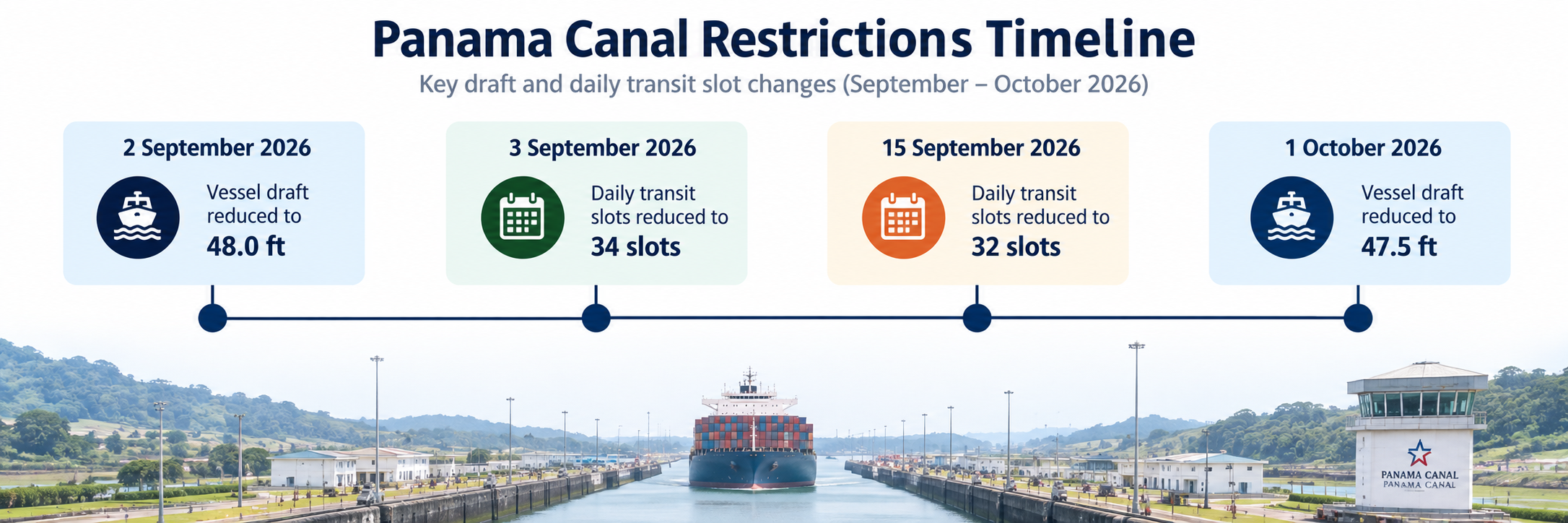
As of today, 3 September 2026, the ACP has cut daily transit slots from 36 to 34 (nine Neopanamax, twenty-five Panamax), with a further cut to 32 slots scheduled for 15 September. Running alongside it, maximum authorized draft dropped to 48.0 ft on 2 September, with 47.5 ft due on 1 October.
The two constraints together matter more than either alone. Analyst Jonathan Roach, quoted by The Loadstar on 28 August, put it plainly: “This time the issue is not simply fewer transit slots. It is fewer slots and less cargo per ship.” The same piece estimates that roughly 45% of Neopanamax transits could be affected by the draft restrictions, covering about 55% of nominal TEU capacity through those locks. Priority access is pricing accordingly: auction slot prices have been reported at over $1 million in recent weeks, with a record $5.3 million bid on 25 August — up from an earlier record of $4.6 million just two weeks before that.
There’s no single, verified industry-wide figure for what a rolled container costs a forwarder — it depends on the extra dwell and demurrage, re-trucking, and whatever penalty or goodwill credit the client relationship absorbs, and estimates from forwarders who’ve been burned by it range from a few hundred to several thousand dollars per box. What is verifiable is the mechanism: fewer slots and lighter loadings against unchanged booking behavior raise the probability of a roll, and that probability is highest right now, not in some hypothetical future squeeze. Building in a buffer — earlier cutoffs, a standing shortlist of alternate sailings — costs little and is worth more the tighter the canal gets.
The mistake: letting the client’s first contact with a new surcharge be a line item on an invoice.
This one is cheap to fix and expensive to get wrong, because the cost isn’t the fee — it’s the relationship. A customer who learns about a surcharge two days before their cargo ships reads it as “you didn’t tell me,” even when the fee is entirely outside your control; the same customer, told three weeks out with a one-line reason attached, reads it as “you’re on top of this.”
The runway varies more than most forwarders expect. CMA CGM gave the market four weeks between announcing its $500/TEU rate (12 August) and its 10 September effective date. ONE gave eleven days — notice on 30 July, effective 10 August. Seaboard Marine’s Panama Canal surcharge notice, issued 2 September for a 4 October effective date, gives about a month. You don’t control which end of that range a carrier picks, which is precisely why catching the notice on the day it publishes matters more than any downstream process.
The financial exposure here scales with the client relationship, not the fee — a client who churns over a surprise invoice costs you their full remaining lifetime value, not the few hundred dollars of surcharge that triggered the dispute. The full timing framework and email templates are covered in how to pass surcharges through without losing trust.
The mistake: defaulting to the carrier or routing you always use, without checking whether the current surcharge landscape has made an alternative meaningfully cheaper.
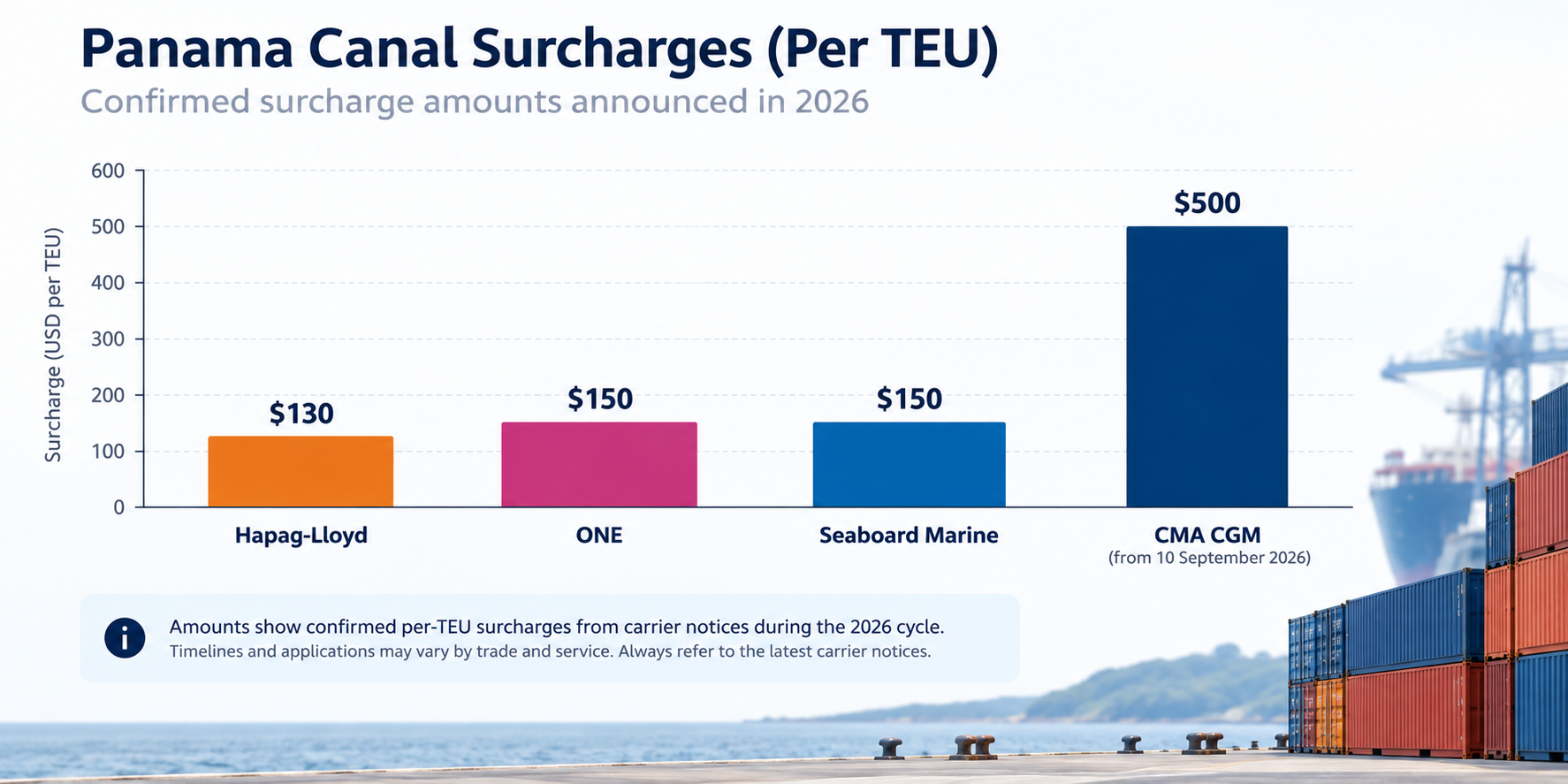
The spread between carriers is wide enough to matter. Hapag-Lloyd’s confirmed Panama Canal surcharge is $130/TEU (effective 15 August, all equipment types). ONE is at $150/TEU. CMA CGM rises to $500/TEU on 10 September — from that date, the gap against Hapag-Lloyd is $370/TEU, though today it’s smaller and rests on a prior CMA CGM rate that remains unconfirmed. Carriers aren’t fully interchangeable on transit time, service frequency, or contract terms, and the per-TEU-vs-per-container ambiguity noted above affects the absolute numbers (though not each carrier’s relative ranking; see the full comparison for the ranking math). Even accounting for real switching constraints, a gap that size is worth running the numbers on before defaulting to habit, especially on lanes with genuine multi-carrier options.
The same logic applies to routing, not just carrier: an East Coast/Gulf routing absorbing Panama Canal fees directly is sometimes beatable by a West Coast-plus-rail alternative on total landed cost — and a full diversion around the Cape of Good Hope adds meaningfully to transit time on top of that, often by weeks rather than days, so it only makes sense on shipments where that time difference genuinely doesn’t matter to the client. On those shipments, though, it’s worth modelling rather than assuming.
The mistake: a quoting process slow enough that by the time a number reaches the client, either the carrier has moved the rate again or a competitor has already quoted faster.
During a stretch where four carriers are adjusting rates within weeks of each other — and one of them is changing the unit those rates are quoted in — a quote built by manually checking each carrier’s latest notice, cross-referencing exclusions, and re-keying the result into a proposal is working against a moving target. The cost here isn’t a single calculable dollar figure the way a missed exclusion is — it’s the compounding risk of sending a number that was already stale when it left, and of losing bookings to whoever quoted same-day instead of two days later. When rates move this often, speed and accuracy stop being separate goals; a slow quote and a wrong quote fail the client the same way.
The mistake: relying on carrier emails, sales rep calls, or trade press to catch a rate change — all of which are inconsistent and easy to miss.
This is the root cause behind most of the other six. A missed CMA CGM notice means a stale rate sheet (#1). A missed exclusion clause buried in a notice means a wrongly applied fee (#2). A notice caught late means a client finding out from an invoice instead of an email (#4).
The current cycle produced an example in the last week that a forwarder tracking only the four headline carriers would have missed entirely: on 2 September, Seaboard Marine — a carrier that rarely makes trade-press headlines — published a Panama Canal surcharge of $150/TEU, effective 4 October, on cargo moving from Chile, Ecuador, and Peru to the United States, Canada, Central America, and the Caribbean. It changes what a correct quote looks like on those lanes starting in October, whether or not it ever gets covered anywhere else.
With notice windows in this cycle running from eleven days to about a month, and now including a carrier outside the usual four, a forwarder without a standing process for catching every carrier notice on publication day is, by construction, operating on whichever end of that range — and whichever carrier — happens to move next.
1. What’s the single most expensive mistake on this list?
It depends on volume and lane, but quoting off a stale rate sheet (#1) tends to be the most consistently expensive, because it repeats on every shipment quoted before the sheet is corrected — a single missed update can compound across dozens of bookings before anyone notices.
2. How much notice do carriers typically give before a Panama Canal surcharge takes effect?
It varies significantly. In the 2026 cycle, CMA CGM gave about four weeks (12 August notice for a 10 September effective date), ONE gave eleven days (30 July notice for a 10 August effective date), and Seaboard Marine gave about a month (2 September notice for a 4 October effective date). Don’t assume a long runway — build your process around catching notices on the day they publish.
3. Is the cost of a rolled container something I can budget for precisely?
Not with a single reliable figure — there’s no verified industry-wide average, since the real cost depends on your specific contract terms, dwell and demurrage exposure, and client relationship. What you can do is recognize that the probability of a roll rises when transit slots and vessel loadings are both cut, as they have been this cycle, and price in a buffer accordingly rather than assuming space is guaranteed.
4. Do carve-outs and exclusions change often enough to be worth tracking closely?
Yes — they’re specific to each carrier’s notice and can shift with each rate update. CMA CGM’s Bangladesh–USEC exemption and ONE’s Puerto Rico exclusion are both current examples; treating exclusions as a one-time thing to learn rather than something to re-check on every new notice is how forwarders end up over- or under-charging clients.
5. Where should I start if I’m only fixing one of these seven mistakes right now?
Start with #7 — a reliable system for catching carrier notices the day they’re published, from every carrier you route through, not only the ones already making headlines. Five of the other six mistakes on this list are downstream of missing or catching a notice late; fixing the monitoring gap makes the rest easier to fix in turn.
See also: Panama Canal Surcharges 2026: Full Carrier Guide, CMA CGM vs MSC vs Hapag-Lloyd: Panama Canal Fee Comparison, and How to Pass Carrier Surcharges to Customers Without Losing Trust for the underlying rate data and carve-out details referenced above.
Six of the seven mistakes above share a root cause: the rate changed in one place, and the people who needed to act on it — pricing, quoting, the client-facing team — were working somewhere else. That gap is where stale rate sheets, missed carve-outs, and late client notices come from.
Shipthis is a single unified platform for freight forwarding operations, bringing tariff and rate management, quotation, CRM, documentation, and accounting into one system instead of spreading them across spreadsheets and disconnected tools. When a carrier publishes a new surcharge, the rate you update and the clients and quotes it touches sit in the same place.
Want to see how it fits your workflow?
Book a demo, or start with a 30-day free trial. Shipthis runs on a single plan covering all modules for end-to-end freight operations, with add-ons billed only as you use them — see pricing for details.
Related reading:
· Panama Canal Surcharges 2026: Full Carrier Guide
· CMA CGM vs MSC vs Hapag-Lloyd: Panama Canal Fee Comparison
· How to Pass Carrier Surcharges to Customers Without Losing Trust
