How to Pass Carrier Surcharges to Customers Without Losing Trust

Last updated: 25 August 2026 (revision 2)

Last verified: 25 August 2026.

Why This Is a Trust Problem, Not Just a Pricing Problem

The fee itself is rarely what costs you the client. What costs you the client is a surprise — a surcharge that shows up on an invoice with no warning, no explanation, and no sense that you saw it coming and had their back. Right now, with CMA CGM, MSC, Hapag-Lloyd, and ONE all charging Panama Canal-related fees on overlapping but not identical timelines — and two of them raising in September — forwarders are having this conversation with clients constantly. This guide gives you the timing, the templates, and the framing to have it well.

This Article Covers
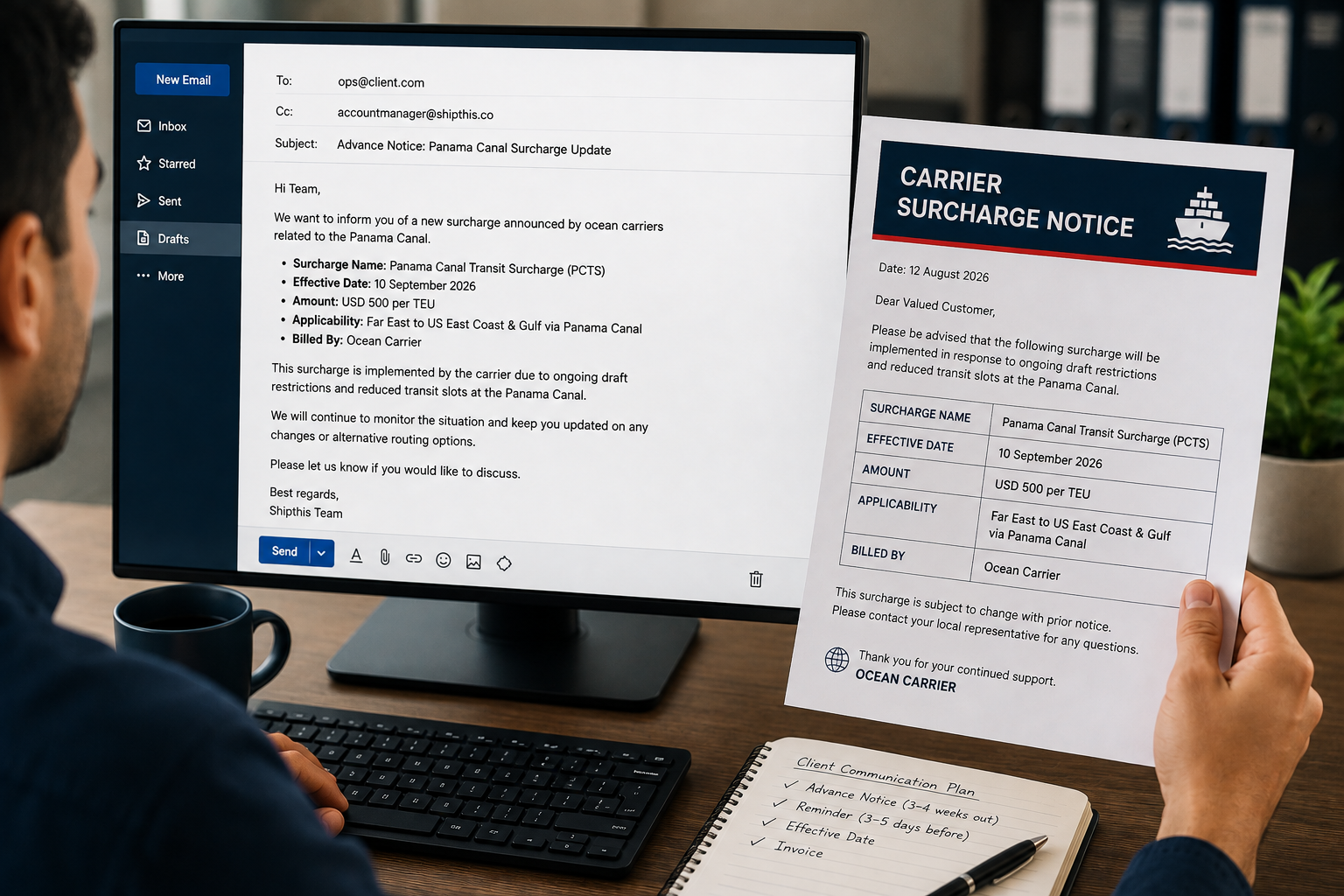
Freight forwarder preparing a client email about a Panama Canal carrier surcharge beside a generic carrier surcharge notice.


A customer who gets a surcharge notice two days before their cargo ships reads it as "you didn’t tell me" — even if the underlying fee is entirely outside your control. A customer who gets the same notice three weeks in advance, with a one-line reason attached, reads it as "you’re on top of this." Same fee, same amount, completely different relationship outcome.

The goal of every template and framing choice below is the same: make it obvious that the surcharge originated with the carrier and the Panama Canal Authority, not with you, and that you told them as early as you credibly could.

Before You Send Anything: Check What Your Contract Allows

Whether you can pass a surcharge through at all depends on the rate agreement you have with that client. A fixed all-in rate for a defined period may not permit a mid-term pass-through; a floating or index-linked arrangement usually does, and many contracts name specific surcharge categories that are passable and others that are not.

This question sits upstream of every template in this guide. Sending a well-crafted notice about a charge you have no contractual right to pass on is worse than sending nothing — it invites a dispute you will lose. Check the clause first, and where it is ambiguous, raise it as a conversation rather than an invoice line.
Timing the Notice
  • Segment by exposure before you send. Not every client ships on every lane. A blanket "surcharges are increasing" email to your entire book reads as noise to clients it does not affect, and dilutes the message for the ones it does. Filter first (see the CRM section below), then send.
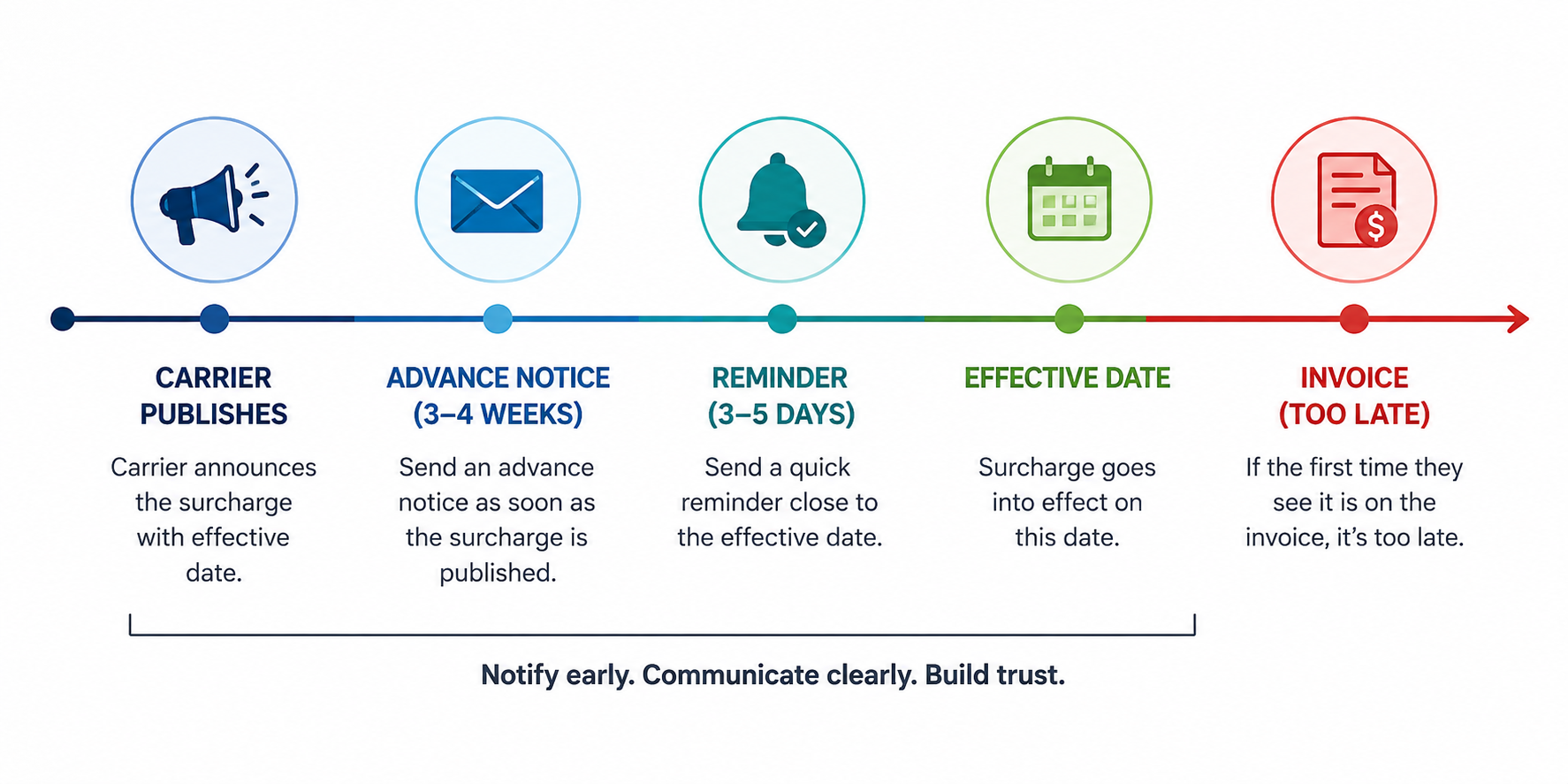
  • Give a second notice close to the effective date. One email three weeks out and then silence until the invoice is not enough — memory fades. A short reminder three to five days before the change keeps it from feeling like it happened suddenly, particularly for clients who ship infrequently and may not have absorbed the first notice.
  • Never let the invoice be the first time they see the number. If a client’s first contact with a new surcharge is a line item on an invoice, you have lost the trust argument regardless of how justified the fee is.
When to notify clients about a carrier surcharge, from carrier announcement to invoice.
"When to notify clients about a carrier surcharge, from carrier announcement to invoice"


Sample Email Templates

These are starting points — adjust tone and specifics to your house style and the client relationship. Each is deliberately short; a surcharge notice that reads like a legal disclaimer gets skimmed, not trusted.

Template 1: Advance Notice (3–4 weeks out)

Template 1: Advance Notice3–4 WEEKS OUT

Subject: Panama Canal surcharge update for your [lane] shipments — effective [date]

Hi [Name],

Wanted to flag this early so it doesn't catch you off guard: [Carrier] has announced a Panama Canal surcharge of [amount] effective [date], affecting [lane/trade]. This is a carrier-wide charge tied to the draft and transit restrictions at the canal — not something specific to your account or our pricing.

If any of your upcoming shipments gate in on or after [date], this will apply. Happy to walk through the numbers on a specific booking, or to talk through whether a different routing makes sense for anything time-flexible.

[Your name]


Template 2: Close-to-Effective-Date Reminder (3–5 days out)

Template 2: Close-to-Effective-Date Reminder3–5 DAYS OUT

Subject: Reminder — [Carrier] surcharge takes effect [date]

Hi [Name],

Quick reminder that the [Carrier] Panama Canal surcharge we flagged on [original notice date] takes effect this [day]. If you have anything gating in after [date], the new rate will apply. Let me know if you'd like me to re-run numbers on anything currently in motion.

[Your name]


Template 3: Offering a Routing Alternative

Template 3: Offering a Routing AlternativeGOODWILL

Subject: An option worth considering for your [lane] shipment

Hi [Name],

Given the current Panama Canal surcharges on the East Coast/Gulf routing, I ran the numbers on an alternative: [West Coast plus rail/trucking option]. [Brief cost and transit-time comparison.] It won't make sense for every shipment, but for anything less time-sensitive it's worth a look.

No pressure either way — happy to keep you on the direct routing if that's simpler. Just wanted you to have the option.

[Your name]


Template 4: When a Client Pushes Back

Template 4: When a Client Pushes BackRESPONSE

Subject: Re: Panama Canal surcharge

Hi [Name],

Totally understand the frustration — nobody likes an unplanned cost. To be clear: this isn't a markup on our end. [Carrier] set this rate in response to the Panama Canal Authority restricting vessel draft and, from September, cutting the number of daily transit slots, which reduces how much cargo can move through the canal. We're passing it through at cost, not adding to it.

Happy to send you the carrier's own notice if it's useful for your records, and to look at whether an alternative routing makes sense for future shipments if this lane keeps seeing pressure.

[Your name]

Explaining the "Why" With Data

Vague language ("carrier costs are rising") reads as evasive. Specific, sourced language reads as credible. A few ways to make the explanation concrete without turning the email into a white paper:
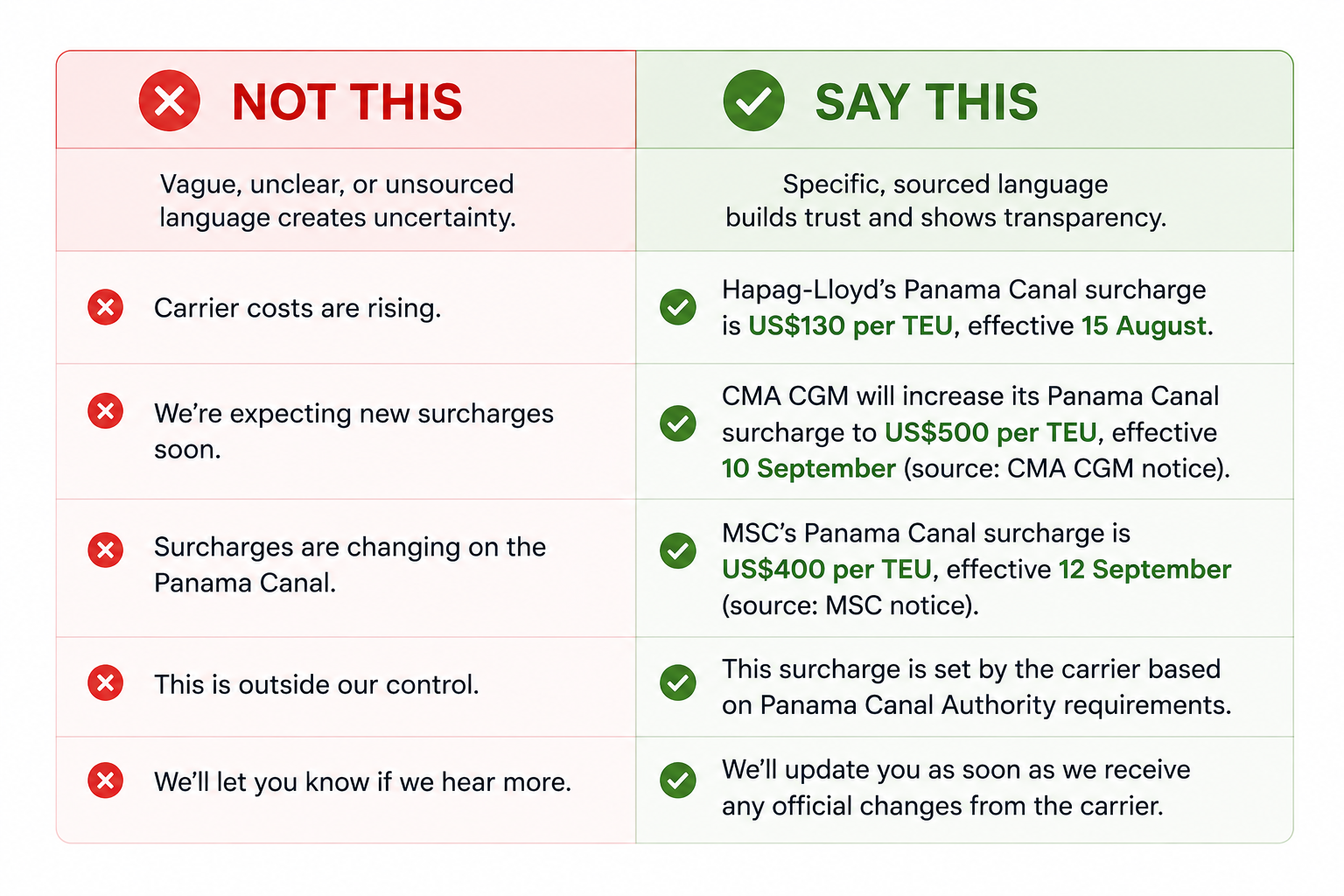
  • Cite the carrier’s own notice, not your interpretation of it. If a client questions the fee, forwarding the carrier’s published surcharge notice is more persuasive than restating it in your own words — it shows the charge originated upstream.
  • Avoid overstating certainty you don’t have. Carrier explanations can be ambiguous — whether a "per TEU" rate applies once or twice to a 40ft container often isn’t specified in the carrier’s own notice, and prior rates for the same fee have been reported differently by different outlets. Don’t promise a client a number you haven’t confirmed with your rep; say "we’re confirming this with the carrier" rather than guessing and having to walk it back.
Vague versus sourced language when explaining a freight surcharge to a client
"Vague versus sourced language when explaining a freight surcharge to a client"
Offering Routing Alternatives as Goodwill

Even when a client can’t or won’t switch routings, offering to look is itself a trust-building move — it signals you are actively managing their cost, not passively passing fees through.

  • Be honest about the trade-offs. West Coast plus rail can beat a surcharge-laden East Coast routing on cost, but often loses on transit time or adds transload risk. Presenting only the upside erodes trust faster than the surcharge would have.
  • Reserve this for clients where it’s genuinely viable. Offering a routing change to a client whose cargo has no realistic alternative reads as filler, not help. Segment before you offer.

Using CRM Tools to Segment Affected Clients

Sending the right message to the right client at the right moment depends on being able to filter your book quickly. A few practical filters worth setting up before the next surcharge lands, rather than during it:
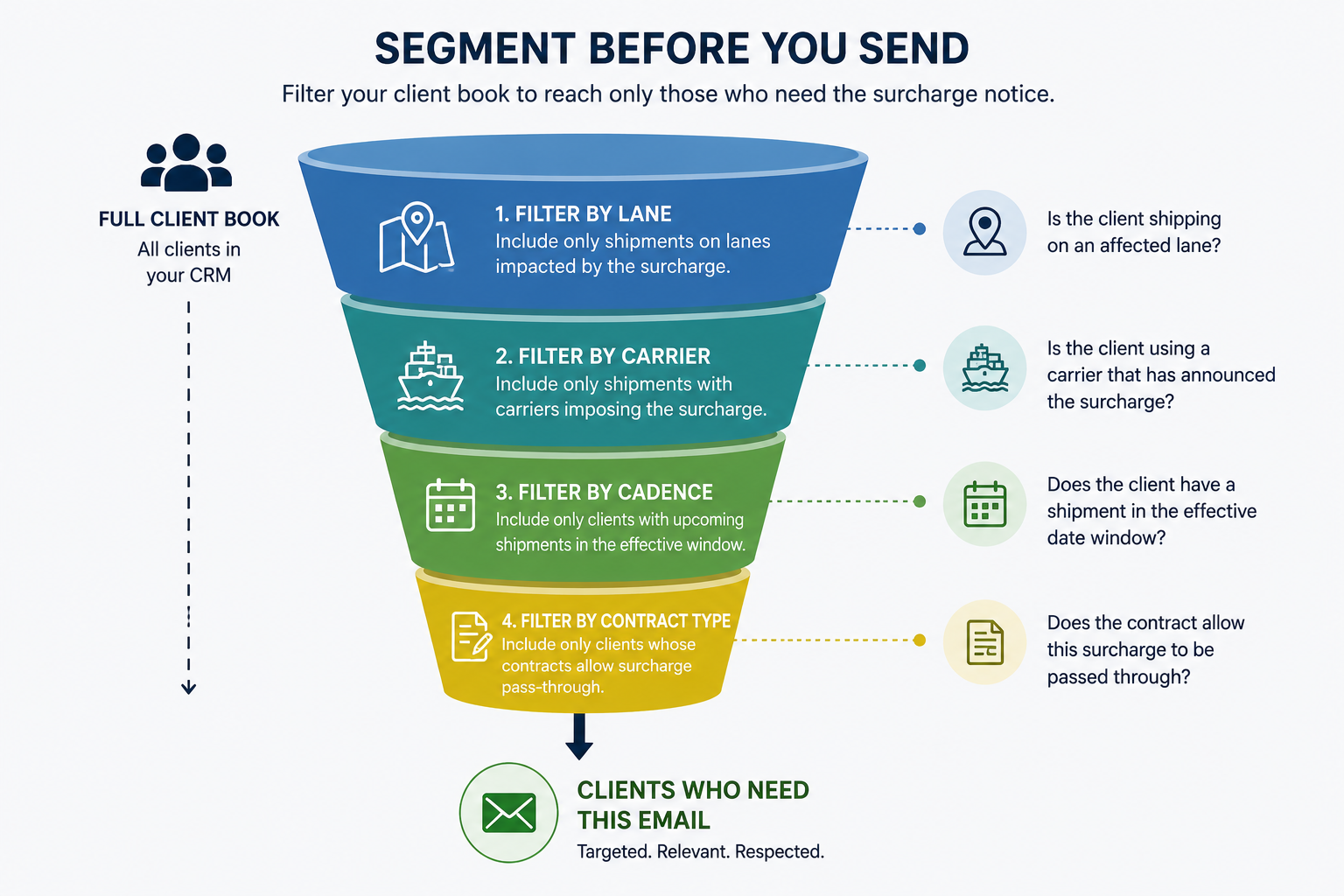
  • By trade lane. Tag accounts by primary origin–destination pairs so an Asia–USEC/Gulf notice goes only to clients actually exposed to it.
  • By carrier. If you book predominantly with one or two carriers per client, tag accordingly — a Hapag-Lloyd rate change shouldn’t reach clients you route exclusively via MSC.
  • By shipment cadence. A client shipping weekly needs the close-to-date reminder more than a client shipping quarterly, who may only ever see the advance notice.
  • By exclusion eligibility. Some surcharges carry carve-outs — CMA CGM’s Bangladesh–USEC exemption, for example. Flag accounts that qualify so they aren’t sent an alarming notice about a fee that doesn’t apply to them.
  • By contract type. Separate clients whose agreements permit a mid-term pass-through from those on fixed all-in rates. These are two different emails, and sending the wrong one starts a dispute.
  • Automate the trigger, not just the send. The gap between "carrier publishes a rate" and "client is told" is a workflow problem, not a diligence problem — forwarders miss it because the rate update and the client list live in different systems, and closing the gap depends on someone remembering. Where rate management and CRM sit in the same system, the notice can be triggered off the rate update itself.
Segmenting a client book by lane, carrier, cadence and contract type before sending a surcharge notice
"Segmenting a client book by lane, carrier, cadence and contract type before sending a surcharge notice".
What Forwarders Should Do Now
  • Check the pass-through language in each affected client’s rate agreement before sending any of the templates above. A fixed all-in rate may not permit it.
  • Draft your advance-notice and reminder templates now, so sending one is a five-minute task rather than a from-scratch email under time pressure.
  • Keep a running log of which carrier notices you forwarded to which clients, so a pushback conversation can be backed with a paper trail ("we flagged this on 12 August").
  • Review which of your active lanes have a viable alternative routing worth modelling, so the goodwill offer in Template 3 is ready rather than improvised.
FAQ

1- Can I always pass a carrier surcharge through to my client?

No — it depends on your rate agreement. A fixed all-in rate for a defined period may not permit a mid-term pass-through, while floating or index-linked arrangements generally do, and some contracts name which surcharge categories are passable. Check the clause before you send a notice; a charge you have no contractual right to pass on is a dispute waiting to happen, not a communication problem.

2- How far in advance should I tell clients about a carrier surcharge?

As soon as the carrier publishes it — typically several weeks before the effective date. CMA CGM, for example, announced its US$500/TEU Panama Canal rate on 12 August for a 10 September effective date. Passing that notice along immediately, rather than waiting, is what turns a surprise fee into a planned one.

3- What if a client asks why the surcharge is so high?

Explain the mechanism briefly and specifically: the Panama Canal Authority has reduced the maximum vessel draft and, from September, is also cutting daily transit slots, so less cargo moves through per sailing and the cost per container rises — which the carrier passes through as a surcharge. Where possible, offer to share the carrier’s own published notice rather than only your summary of it.


4- Should I absorb part of the surcharge to keep a client happy?

That’s a business decision specific to your margins and the relationship, not something with a universal right answer. What is worth avoiding regardless is presenting an absorbed cost as if it were the full carrier fee — if you are softening the number, say so, since a client who later sees the full carrier rate elsewhere will feel misled.


5- How do I handle a surcharge whose exact basis (per TEU vs per container) is unclear?

Say so plainly rather than guessing. Several carriers’ 2026 Panama Canal surcharge notices don’t specify whether a 40ft container is charged once or twice under a "per TEU" rate. Tell the client you’re confirming with the carrier rather than quoting a number you might have to revise.

6- Is it worth offering an alternative routing even if the client probably won’t switch?

Yes, if it’s genuinely relevant to their lane — the offer itself signals active account management even when declined. It is not worth it for a client whose cargo has no realistic alternative, where the offer reads as filler rather than help.

Sources
Close the Gap Between Rate and Notice

Every template on this page assumes you already know which clients are affected and when the rate changed. That is the part that actually breaks. When the rate lives in one system and the client list in another, the notice depends on someone remembering — and on a busy week, nobody does. Shipthis keeps rate management and CRM in the same platform, so the client list you need is one filter away from the rate that changed.

Want to see it on your own book? Book a demo and ask to see a mid-month surcharge change alongside the list of accounts exposed to it. Or start with the numbers — Shipthis pricing is $89 per user per month, every module included.

Related reading: Panama Canal Surcharges 2026: Full Carrier Guide · Why Panama Canal Draft Restrictions Raise Freight Costs · CMA CGM vs MSC vs Hapag-Lloyd: Panama Canal Fee Comparison

More Questions?
or Let’s just connect!

Thank you! We will get back to you soon
Oops! Something went wrong while submitting the form.

Hear from
our Experts