Thank you! We will get back to you soon
Oops! Something went wrong while submitting the form.
Last updated: August 21, 2026.
Reviewed by: Sartaj Beary, Shipthis.
Status as of 21 August 2026 — In force: maximum authorized draft 48.5 ft (since 15 August).
Announced, not yet in force: draft cuts to 48.0 ft (2 September, postponed from 26 August) and 47.5 ft (1 October, postponed from 3 September); daily transit-slot reductions in early September (see below).


You’ve seen the surcharge line on the invoice. A client asks why, and “the canal has draft restrictions” doesn’t actually answer the question — it just adds a new piece of jargon on top of the fee they’re already annoyed about.
Here’s the plain version: a “draft restriction” is a limit on how deep in the water a ship is allowed to sit while passing through the canal. When the Panama Canal Authority (ACP) lowers that limit, ships have to carry less weight, which means fewer containers per sailing, which means the cost of running that sailing gets divided across a smaller number of boxes. Your surcharge is that division problem, itemized. As of August 2026, the ACP has also cut the number of daily transits — a second, separate squeeze on capacity that compounds the first.
This article walks through both mechanisms one link at a time, so the next time a client — or a junior ops hire — asks “why,” you have a two-minute answer instead of a canal authority press release.
See the full carrier-by-carrier surcharge table in our pillar guide, Panama Canal Surcharges 2026: Full Carrier Guide.
This Article Covers
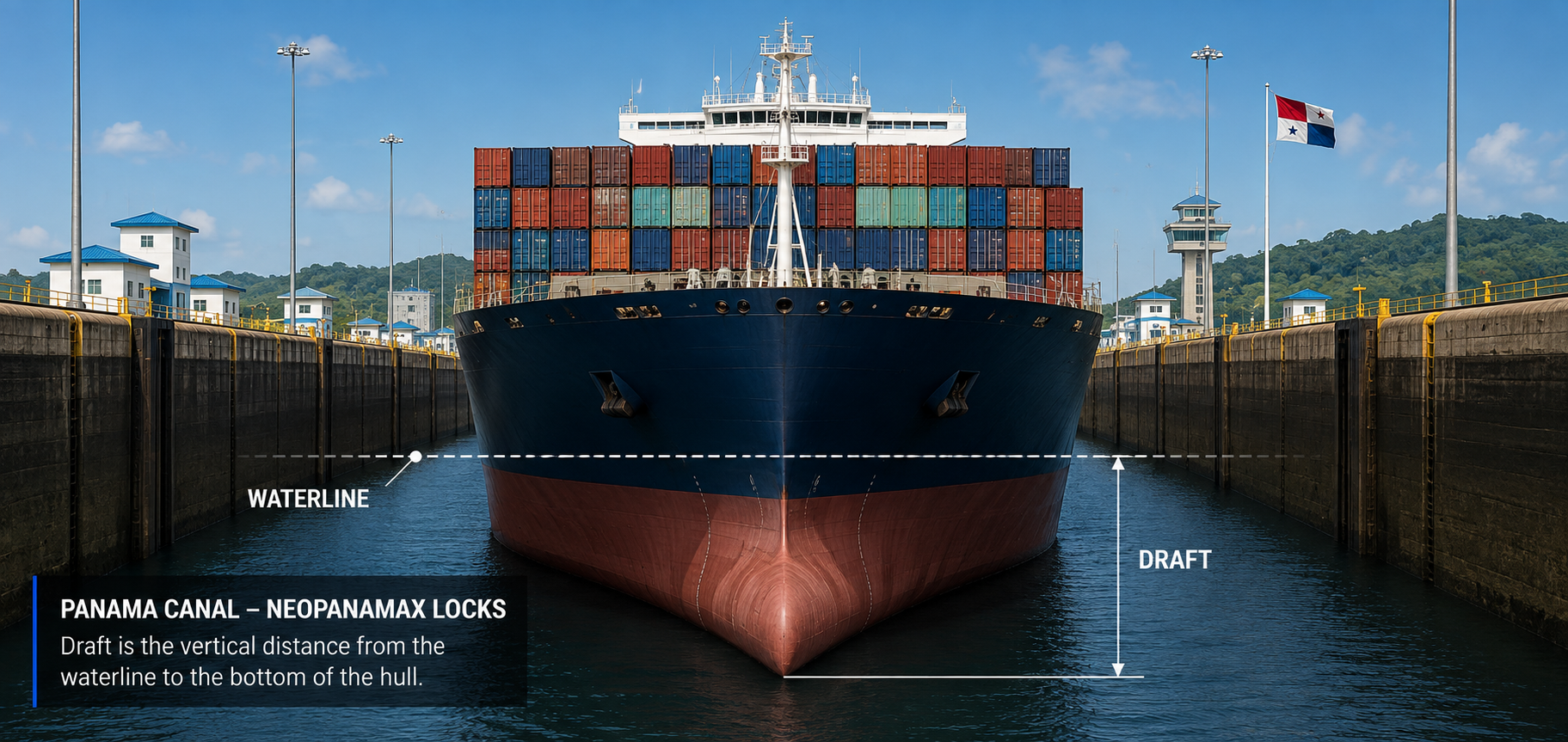
Draft is simply how much of a ship sits below the waterline — the vertical distance from the waterline to the bottom of the hull. A fully loaded container ship rides low in the water because of its own weight and its cargo; an empty one rides higher.
The Panama Canal’s Neopanamax locks have a maximum authorized draft — a hard ceiling on how low a ship is allowed to sit while transiting. That ceiling exists because the canal’s operation depends on fresh water from Gatun Lake to fill and empty the locks with every transit.
When the lake’s water level drops, the canal has less depth to work with, and the ACP lowers the maximum authorized draft to keep vessels from grounding or damaging the lock infrastructure.
This is not a pricing decision. It’s a hydraulic engineering constraint — the ACP doesn’t set draft limits to raise revenue; it sets them because physics leaves no other option when the lake runs low.
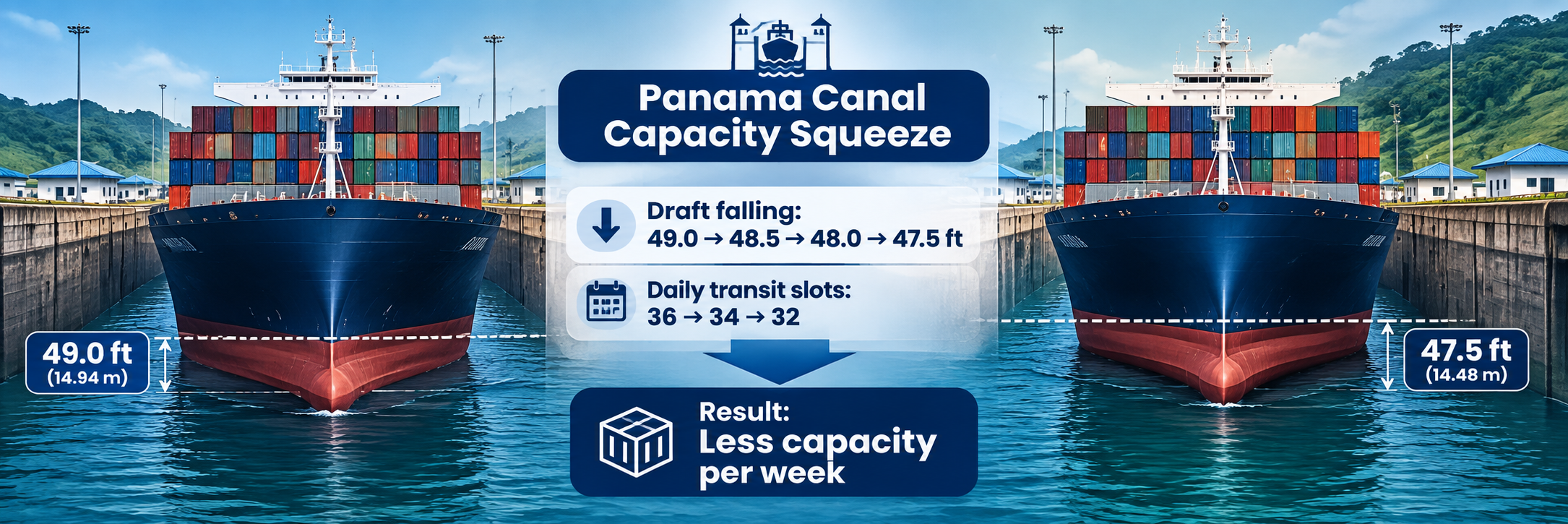
2026 has seen a steady, stepwise decline rather than one isolated cut. Per ACP Advisory A-22-2026 (issued July 1, 2026) and subsequent notices, the sequence runs:
That’s four cuts announced across six weeks, two of them now in force — a total drop of 1.5 ft. The 2 September and 1 October cuts will be the fourth and fifth draft adjustments the ACP has made since it began its water-conservation program in December 2025. Both were postponed from their original 26 August and 3 September dates in the ACP’s 20 August advisory.
The driver behind all of it is low water levels in Gatun Lake, linked to an El Niño-influenced dry pattern. May–August 2026 rainfall came in roughly 34% below the historical average, with water contributions to the basin about 44% below average.
For weeks, the ACP’s position was that these draft cuts affected vessel weight only, not the number of ships transiting per day. That changed on August 20, 2026: the ACP announced it is also cutting the number of daily transit slots — to 34 effective September 4, 2026, and to 32 effective September 15, 2026 — citing the same rainfall and basin-inflow shortfall behind the draft cuts.
This matters for how you explain the surcharge to a client. It’s no longer accurate to say only vessel weight is constrained — canal capacity is now being squeezed on two axes at once:
Both pressures push in the same direction: less containerized capacity moving through the canal, at a time when demand hasn’t dropped to match. That’s a stronger — and more current — explanation for why surcharges are compounding rather than leveling off.
Separately from the draft and slot cuts above, you may have seen headlines about carriers and shippers paying enormous sums to jump the queue for canal transit. According to Splash247 (May 12, 2026), average premiums for priority slots climbed from a pre-crisis baseline of roughly $135,000–$140,000 to $385,000–$425,000 in April–May 2026.
Bloomberg later reported a shipper paid roughly $4 million for priority transit (Aug 11, 2026), and days after that, a $4.6 million payment (Aug 14, 2026) — the highest figure reported to date at time of writing.
It’s tempting to fold this into the same story as the TEU surcharges above, but they’re not quite the same mechanism, and it’s worth keeping them separate when you’re explaining this to a client:
Both the auction premiums and the carrier surcharges are Panama Canal cost pressures happening at the same time, but conflating them overstates the case. If a client asks whether their $500/TEU surcharge is “because of the auction,” the accurate answer is no — it’s because of the draft and slot cuts, which are a separate (if related) squeeze on canal capacity.
Strip away the jargon and it’s a chain with two parallel pressure points:
That’s the whole mechanism. No auction, no discretionary carrier pricing decision at the root of it — just a water level problem that gets converted, through two compounding capacity cuts, into a line item.
1. What Does "Draft Restriction" Mean at the Panama Canal?
It means the Panama Canal Authority has set a lower maximum limit on how deep a vessel is allowed to sit in the water while transiting the Neopanamax locks. It’s driven by how much water is available in Gatun Lake to operate the lock system, not by carrier or canal pricing decisions.
2. How Many Times Has the Panama Canal Adjusted Draft Limits in 2026?
As announced through 20 August 2026, the ACP has cut the maximum authorized draft four times — 49.0 ft (Jul 24), 48.5 ft (Aug 15), 48.0 ft (Sept 2) and 47.5 ft (Oct 1), the last two postponed from their original 26 August and 3 September dates — with the last two representing the fourth and fifth adjustments since its water-conservation program began in December 2025.
3. Has the Number of Daily Panama Canal Transits Also Been Cut, or Just Vessel Weight?
Both. Through mid-August 2026, only vessel draft (weight) was restricted, with daily transit counts unaffected. That changed on August 20, 2026, when the ACP announced daily transit slots would fall to 34 from September 4 and to 32 from September 15 — a second, separate capacity cut layered on top of the draft restrictions.
4. Are Panama Canal Surcharges the Same as the "Slot Auction" Fees I’ve Read About?
No. Slot auction premiums — which have reportedly reached as high as $4.6 million for a single priority transit (Bloomberg, Aug 14, 2026) — are primarily driven by tanker and dry-bulk vessels competing for transit priority amid Strait of Hormuz-related rerouting. Container-line TEU/container surcharges are a separate response to draft and transit-slot restrictions. Both add cost pressure at the canal, but they’re not the same mechanism.
5. Why Can’t Carriers Just Absorb the Extra Cost Instead of Passing It On?
Vessel operating costs — fuel, crew, canal transit fees — stay roughly fixed regardless of how many containers are on board or how many vessels transit per day. When draft and slot limits reduce the number of containers moving through the canal, those fixed costs get divided across a smaller total, raising the cost per container. Carriers pass that increase through as a surcharge rather than absorbing a margin hit on every affected sailing.
6. Will These Restrictions Ease if It Rains More?
Possibly, since the root cause is Gatun Lake water levels. But there’s no confirmed timeline for reversal, and the ACP has cut both draft limits and daily transit slots multiple times within a six-week span in 2026. Forwarders should plan around the current restrictions persisting through at least early October rather than assuming a quick recovery.
Once you can explain the mechanism in two minutes, the harder problem is the one behind it: every one of these announcements lands mid-quarter, and every open quote carrying an old number has to be found and re-dated by hand. Centralised rate and surcharge management turns that from a manual sweep into one update that flows into every live quotation.
Want to see it on your own lanes? Book a demo and ask to see a mid-month surcharge change propagate into open quotes without anyone re-keying a rate sheet.
Or start with the numbers — Shipthis pricing is $89 per user per month, every module included.
Related reading:
