Thank you! We will get back to you soon
Oops! Something went wrong while submitting the form.


3PL software is built around inventory that sits still: multiple clients’ stock in a warehouse, received, stored, picked, packed, and billed. Freight forwarding software is built around cargo that moves: shipments, bills of lading, customs documentation, and carrier milestones.
That is the distinction in one line.
The more useful observation is that many operators asking this question already do both. The real decision is therefore rarely which category to buy. It is whether to run one system or two — and what breaks where they meet.
Note: This article compares software categories, not service providers. If you are deciding whether to hire a 3PL or a freight forwarder, that is a different question.
This Article Covers
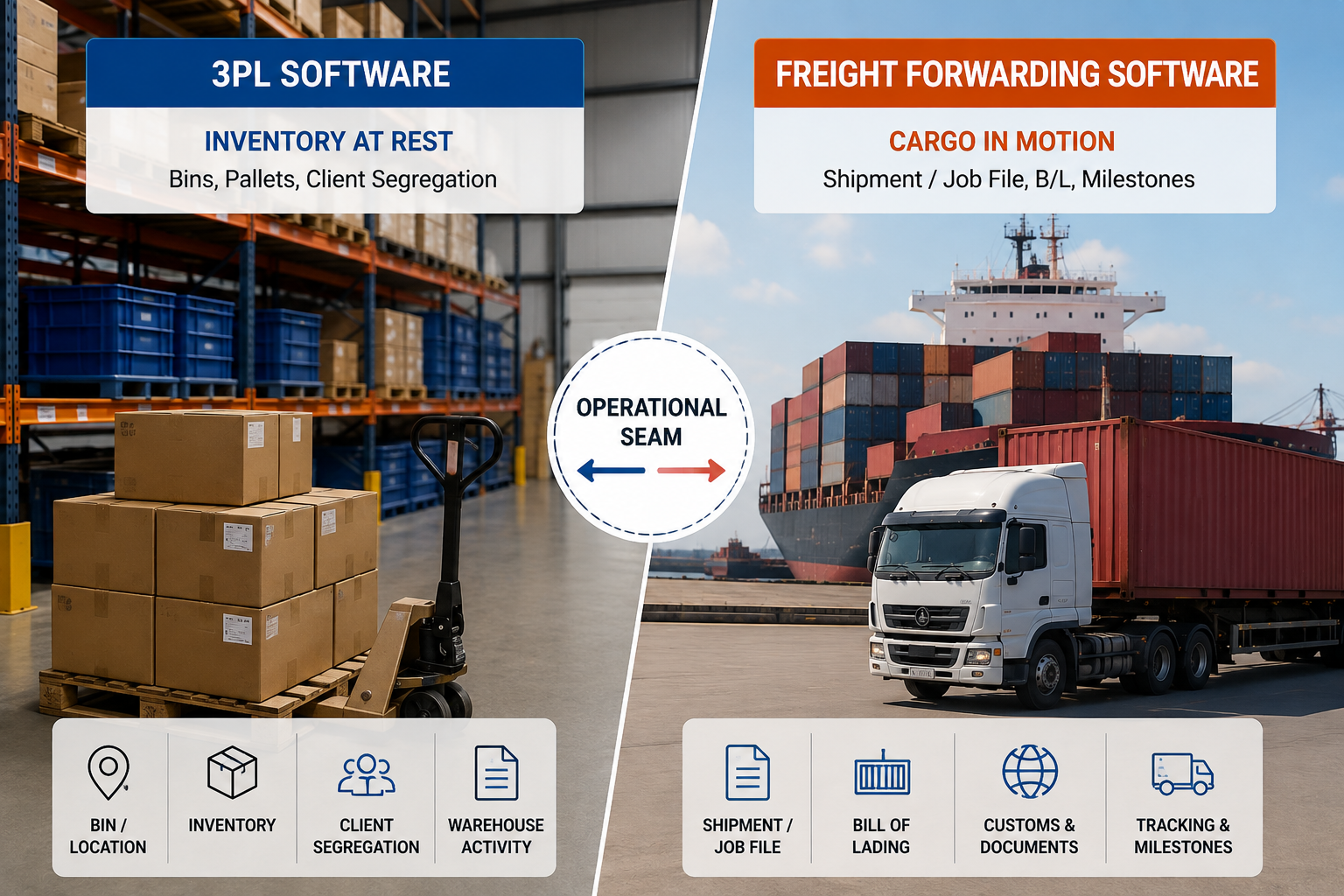
3PL software is designed around multi-client warehousing and fulfillment. The defining requirement is not simply storage. It is the ability to manage inventory and operations for multiple customers while keeping each customer's stock, activity, billing, and reporting separate.
The functional core is physical: goods receipt, put-away to bin and rack locations, inventory control, picking, packing, dispatch, and returns. Around that sit client contracts and SLAs, activity-based costing, billing, reporting, and customer visibility.
The billing model also reflects the nature of the business. Revenue may come from storage by pallet, cubic metre, or period, together with receiving, handling, picking, packing, and other warehouse activities. For operators serving direct-to-consumer brands, ecommerce and order-channel integrations can also be important.
Current software-market guidance from SoftwareConnect describes 3PL/WMS systems around inventory control, fulfillment, warehouse operations, and multi-client requirements.
Shipthis's warehouse management solution is positioned for 3PLs, freight forwarders, NVOCCs, and logistics providers, with capabilities including inventory visibility, receiving, outbound operations, warehouse documents, and warehouse billing.
Freight Forwarding Software is built around the shipment or job file.
A job may begin when a customer requests a rate and continue through quoting, booking, documentation, transportation, tracking, invoicing, and settlement.
The functional core is documentary and commercial: quoting from tariffs, booking with carriers, master and house documentation, customs and manifest workflows, carrier milestone tracking, shipment profitability, and agent or vendor settlement.
Freight forwarding systems are also designed to handle the complexity that comes with international transportation: multiple parties, transport modes, currencies, entities, branches, documents, regulatory requirements, and carrier relationships.
The practical consequence is straightforward: a forwarding system is optimized around the shipment, while a warehouse system is optimized around inventory, locations, and warehouse activity.
Neither is inherently better. They are designed around different operational objects.
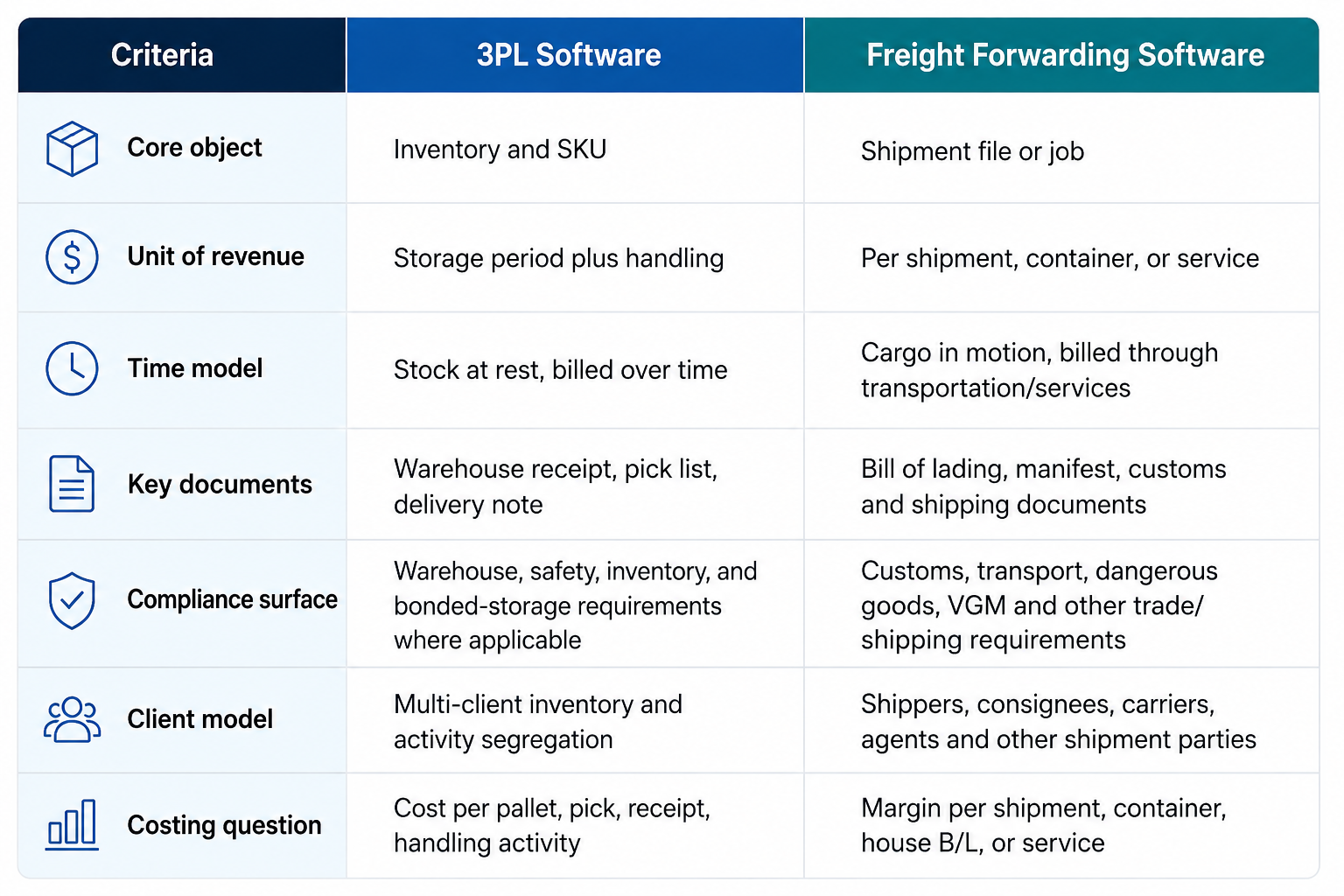
The deepest difference is not the feature list. It is the data model.
A warehouse system is organized around a location, quantity, inventory owner, and warehouse activity: how much stock is in which location and what happened to it.
A forwarding system is organized around a job, shipment parties, transport legs, and documents: who is shipping what, where it is going, how it is moving, and what documents govern that movement.
That distinction explains why integrations between warehouse and forwarding systems can become difficult. The systems aren't simply moving identical data structures between each other; they are translating between two different operational views of the same cargo.
There is real overlap.
Both categories can involve customer records, billing, reporting, shipment or inventory visibility, integrations, and customer portals. Some modern platforms also combine warehouse and freight capabilities.
The important question is what happens between the two operational worlds.
Two events commonly cross the boundary in a combined operation:
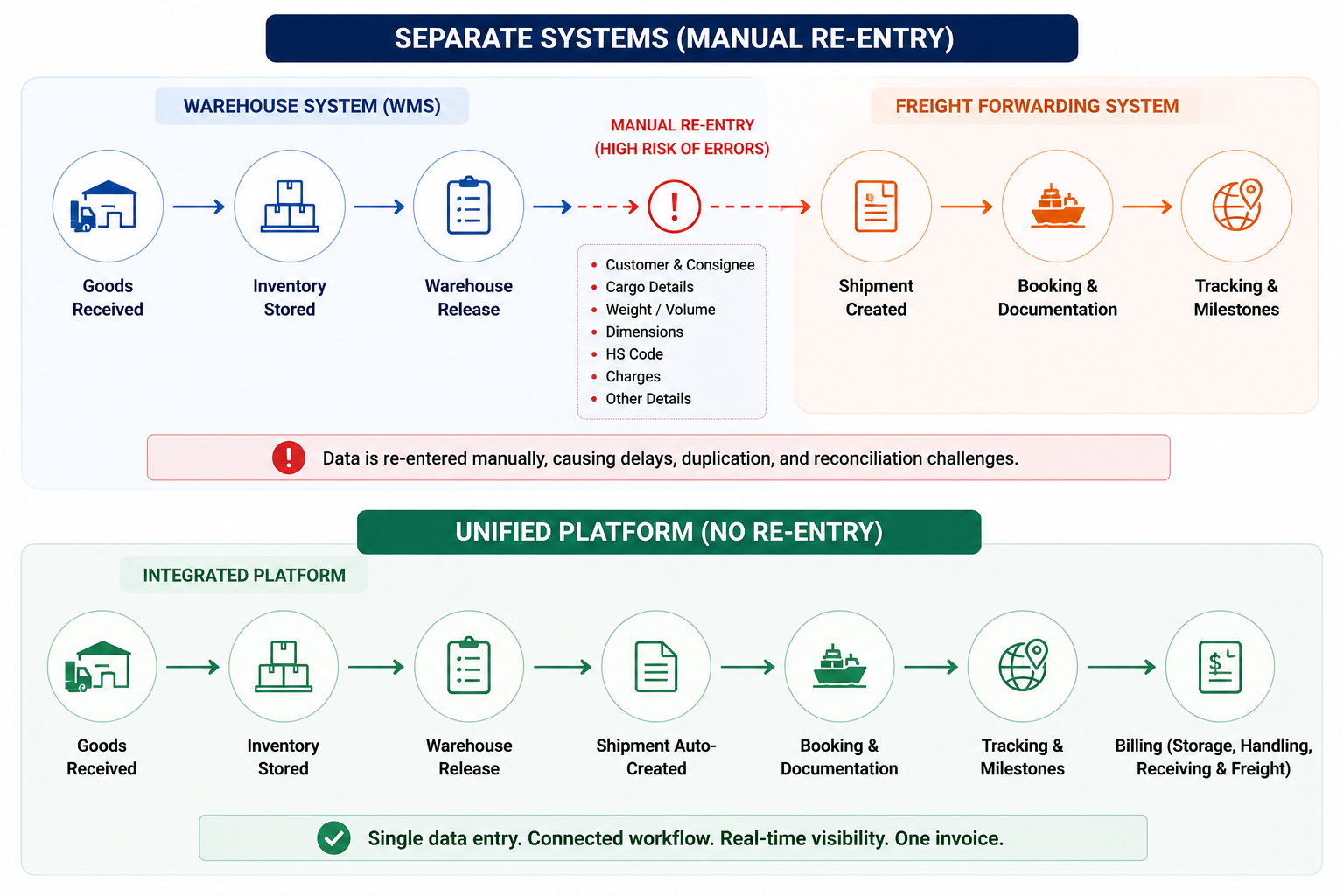
When those events live in separate systems, a person or integration has to bridge them.
That can create practical problems:
The problem is not necessarily that either system is bad. Each system may be performing its own function correctly.
The potential loss happens at the seam between them.
That is why combined margin reporting can be a more useful evaluation question than simply asking which system has more warehouse features.
Buy forwarding software.
If you don't operate a warehouse, paying for a full warehouse-management capability may add unnecessary implementation, training, and licensing complexity.
Focus the evaluation instead on documentation, consolidation, carrier connectivity, tracking, compliance, accounting, and agent settlement.
For ocean-focused operators, see the NVOCC software evaluation guide for a deeper look at the capabilities that matter.
Buy 3PL/WMS software.
If your business only stores, picks, packs, and distributes goods domestically, freight-forwarding functionality may add complexity without solving a core operational requirement.
One important caveat: if your customers are DTC ecommerce brands, a specialist fulfillment platform may be stronger for storefront integrations, parcel carrier rate shopping, and returns.
The right system depends on the operation you actually run.
This is the profile where a unified platform can make the most operational sense.
Your shipments and warehouse inventory describe the same physical cargo. Your customers may buy both warehousing and freight services. And the warehouse-to-shipment handoff sits directly in the middle of the workflow.
In this situation, two systems create an integration boundary that has to be maintained.
A unified platform can instead keep warehouse and freight activity connected within the same operational environment.
Shipthis currently positions its platform as a unified system with shipment management and warehouse management on one platform and one data model.
Keep the WMS if it is deeply configured and carries years of operational knowledge.
Replacing a mature warehouse system simply to gain a unified data model may create significant migration risk.
Instead, focus on integration quality.
Check whether the forwarding platform supports modern APIs, EDI, webhooks, and event-based data exchange rather than relying on manual exports or basic file transfers.
For example, Shipthis documents API and EDI capabilities for connecting shipment, warehouse, inventory, and status data with other business applications.
Neither category has one universal pricing model.
3PL and warehouse software can be priced according to warehouse count, users, order volume, inventory volume, features, and deployment model.
SoftwareConnect's current 2026 3PL pricing guide gives the following indicative ranges:
SoftwareConnect notes that actual costs vary by warehouse count, size, order volumes, employees, and feature complexity.
Freight-forwarding software can instead be priced per user, per module, or through other commercial models.
For Shipthis, the current published pricing is $89 per user per month, with the platform stating that every module is included. The current site also gives an example of a 25-user team at $2,225/month.
The more useful comparison is therefore not simply:
3PL software price vs freight software price.
It is:
One platform vs. two platforms
When evaluating two systems, count:
That is the real cost of operating across the seam.
Yes. But “warehouse management” can mean anything from a full multi-client WMS to basic inventory fields or a third-party integration.
Three questions help separate a real capability from a feature-list claim:
The simplest test is to ask the vendor to convert a warehouse release into a shipment live and see whether anyone has to re-enter the data.
Shipthis integrates warehouse and freight workflows on one platform. Its warehouse management is included in the per-seat price, warehouse releases can convert into shipments without re-entry, and storage, handling, and receiving charges can flow into the billing workflow
Much of the confusion comes from adjacent software categories that overlap in features but are designed around different operating models.
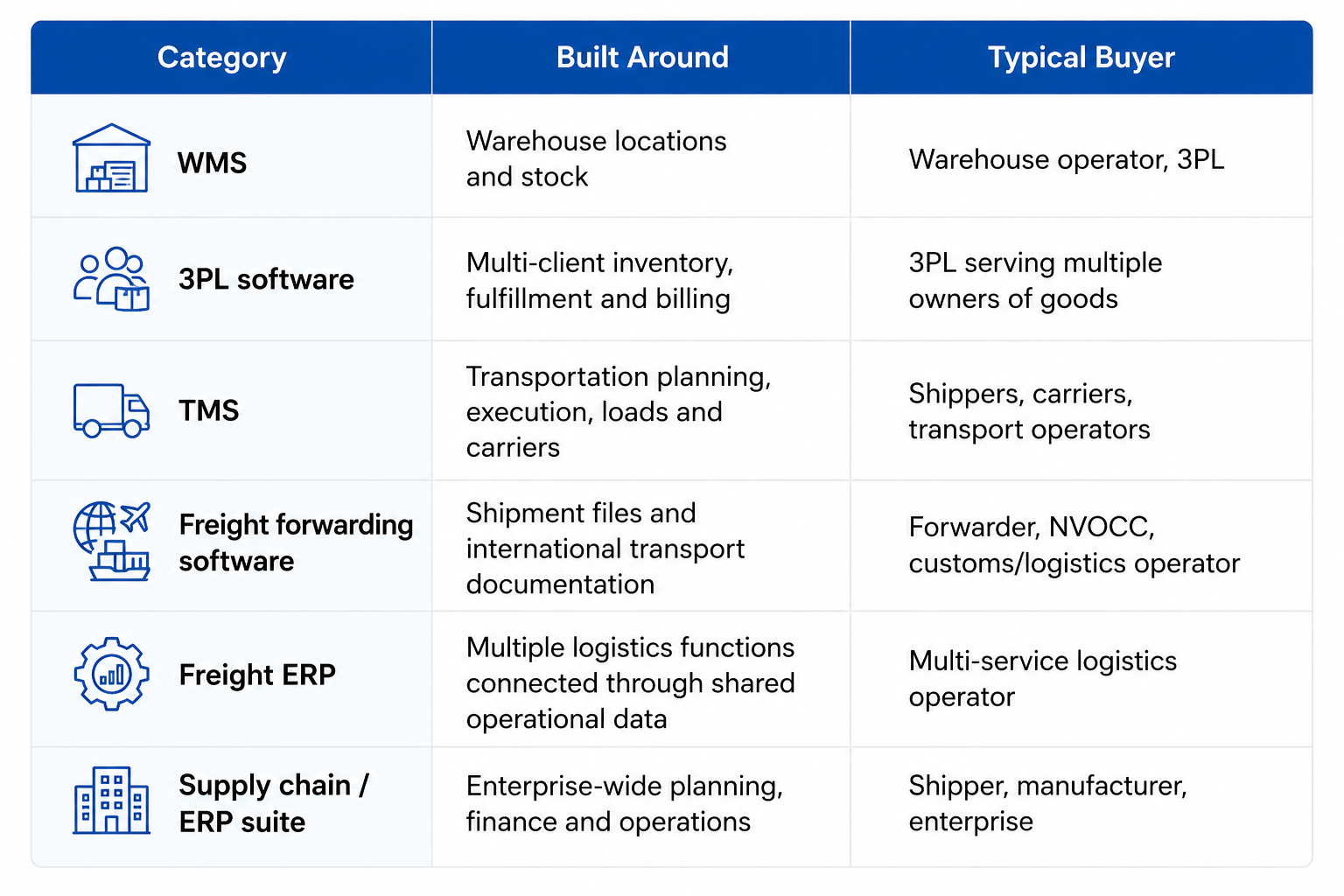
One important distinction: TMS and freight-forwarding software are not interchangeable categories.
A TMS generally focuses on transportation planning and execution, such as loads, routes, carriers, and transportation orders. Freight-forwarding software goes deeper into the shipment file, international documentation, customs workflows, carrier relationships, and forwarding-specific commercial processes.
In the U.S., the underlying legal definitions for freight forwarders and other transportation roles are separately defined under federal law.
49 U.S.C. § 13102 — Definitions
And a 4PL is not a software category. It is a logistics service model in which one provider coordinates other logistics providers.
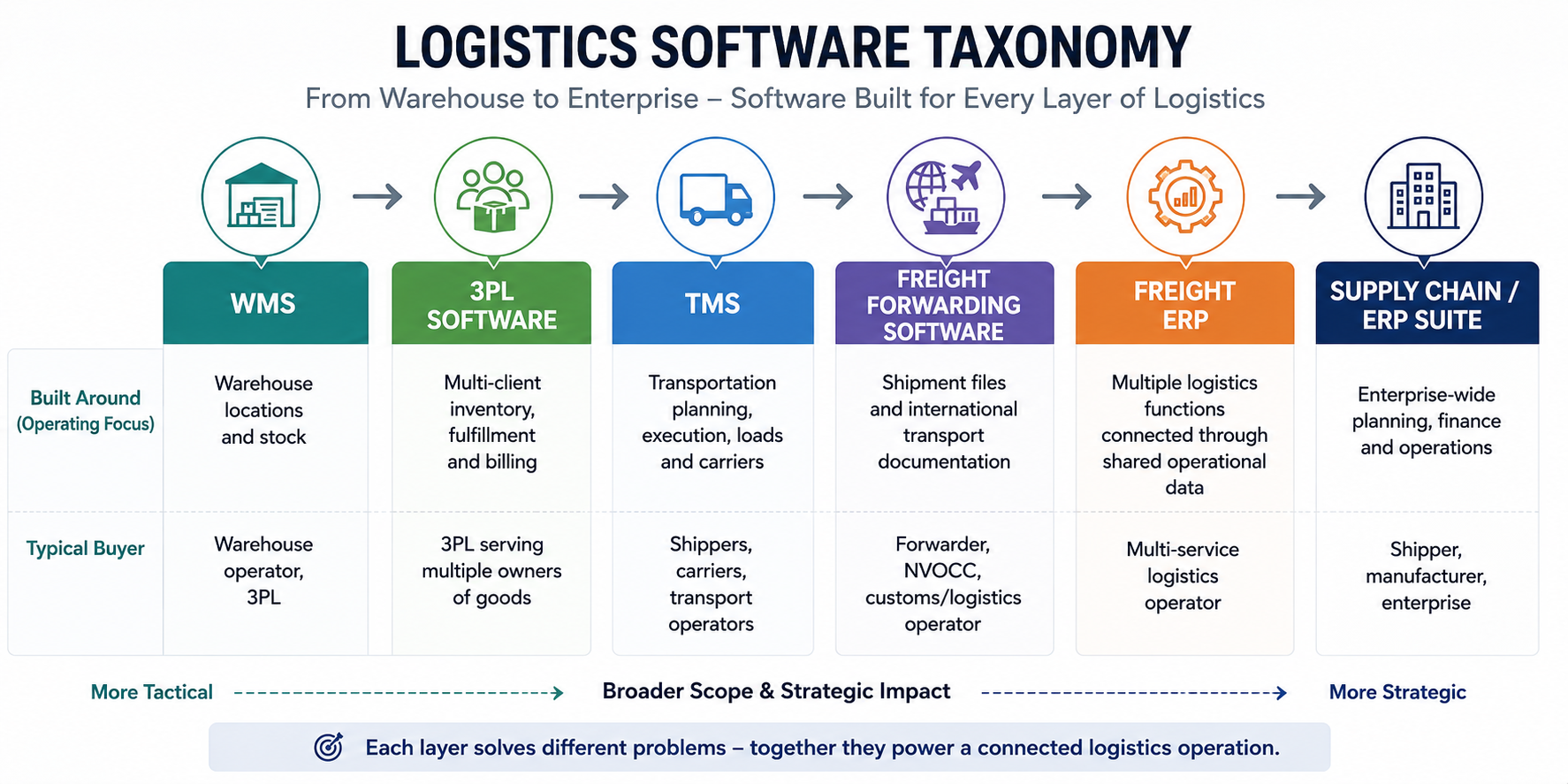
3PL software is centered on multi-client warehouse inventory, receiving, storage, picking, packing, fulfillment, and client billing.
Freight forwarding software is centered on shipments, quoting, booking, bills of lading, customs and shipping documentation, carrier tracking, and shipment profitability.
One is organized around stock at rest; the other around cargo in motion.
Some freight-forwarding platforms include warehouse management as an integrated capability.
The important distinction is whether the warehouse functionality supports real warehouse operations — receiving, inventory, locations, releases, billing, and operational workflows — rather than simply storing stock information.
A practical test is whether a warehouse release can become a shipment without someone re-entering the data.
Not necessarily.
A 3PL that only stores and distributes goods domestically may have no need for freight-forwarding functionality.
A 3PL that also arranges international transportation, manages shipping documentation, or performs forwarding activities may benefit from forwarding capabilities alongside its warehouse system.
Not quite.
A WMS manages warehouse locations, inventory, movements, and warehouse labor.
3PL software adds the multi-client business layer: inventory segregation by customer, client-specific contracts and SLAs, activity-based billing, and customer-facing visibility.
The two categories overlap, but 3PL software is designed specifically around operating warehousing as a service for multiple customers.
A TMS generally focuses on transportation planning and execution — loads, routes, carriers, transportation orders, and related workflows.
Freight-forwarding software is centered on the international shipment file, including quoting, booking, bills of lading, customs and shipping documentation, carrier milestones, and forwarding-specific financial workflows.
There can be significant overlap, but the operating model and primary data object are different.
Pricing varies substantially by warehouse count, users, transaction volume, features, deployment model, and implementation requirements.
SoftwareConnect's 2026 guide places small 3PL operations at roughly $6,000–$25,000 per year, mid-tier operations at $25,000–$100,000, and high-tier systems at approximately $100,000–$300,000 per year. Enterprise systems can start above $200,000 annually.
These are market benchmarks, not universal prices.
Yes.
Some logistics platforms combine warehouse management and freight operations within one platform.
The important question is whether the two capabilities actually share operational data and workflows.
Ask the vendor to demonstrate a warehouse release becoming a shipment without manual re-entry, then verify how warehouse billing, freight billing, inventory, and customer reporting are connected.
Replace both when neither system is deeply embedded and the warehouse-to-shipment handoff is a daily operational workflow.
Integrate when one system is heavily configured, carries years of process knowledge, or would be expensive and risky to replace.
The deciding factor is not simply software cost.
It is:
migration risk vs. the ongoing cost of the operational seam.
The category label matters far less than one question: do your systems meet at the point where a warehouse release becomes a shipment? Everything expensive about running both services happens at that junction.
So make it the centre of every demo. Ask each vendor to convert a warehouse release into a shipment while you watch, and count how many fields a human types. For a wider view of the market, see 9 best freight forwarding software in 2026.
Ready to test it properly? Book a demo and ask to see a warehouse release become a shipment with zero re-entry.
Or read the whitepaper first — How to Choose the Right Freight Forwarding Software
