
Drop the Tariff Sheet In. Get a Structured Rate Table Out.
Carrier tariff sheets arrive however the carrier sends them, a PDF, an Excel file, an email attachment, formatted however that carrier happens to format it. Shipthis's AI rate parser reads it directly, identifying lanes, charge names, currencies, weight and volume breaks, and validity periods, and converts all of it into a structured, ready-to-use rate table, no manual cleaning, no re-typing a single line.
No credit card required. Go live in 9 weeks. Implementation team included.
.png)


.avif)
A new tariff sheet is only useful once it's in the system, and manual entry means a gap where quotes still go out on the old rate.
.webp)
A carrier sends an updated tariff sheet, and it sits in an inbox until someone has time to manually clean it up and enter it, sometimes hours, sometimes days. During that gap, quotes keep going out based on the previous rate, and nobody notices until a booking comes in at a cost that doesn't match what was quoted. Shipthis removes that gap. The AI parses the sheet the moment it arrives, so the new rate is structured and available to quote against almost as soon as the carrier sent it, not whenever someone finally gets to the data entry.


However the Carrier Sends It, the AI Reads It
PDF tariff sheets, Excel files with inconsistent layouts, or rates embedded directly in an email, all parsed the same way.
Carrier tariff sheets don't arrive in one standard format, one carrier sends a PDF, another an Excel file with their own column layout, another just types the rates into an email body. Shipthis's AI parser handles all three, reading the actual content regardless of how it's packaged, so your team doesn't need a different process depending on which carrier the sheet came from
.webp)
.webp)
Not Just a Number. The Full Structure Behind It.
Lanes, charge names, currencies, weight and volume breaks, and validity periods, identified and structured, not just extracted as raw text
A tariff rate isn't just a number, it's a lane, a charge name, a currency, a weight or volume break, and a validity period, all of which have to be identified correctly for the rate to actually be usable in a quote. Shipthis's AI parser identifies each of these specifically, structuring the output so it's immediately queryable in the rate library, not a dump of extracted text that still needs someone to figure out what each value actually refers to.
Parsed Today. Searchable and Quotable Today.
Structured rates land directly in the same rate library your pricing team already searches, no separate export, no manual transfer.
A parsed rate that lands in a separate file still requires someone to move it into the system your pricing team actually uses, which reintroduces the same manual step this feature is meant to remove. Shipthis feeds parsed rates directly into the same rate library covered by Tariff & Rate Management, so a rate that was parsed from a PDF this morning is searchable and quotable in the same system by this afternoon, with no export or manual transfer step in between.
.webp)
.png)
.png)
Parsing a Document Is Easy. Producing a Usable Rate Is the Actual Work.
Any format, correctly identified fields, and immediate availability in your rate library, not just a document reader with an AI label on it.
.webp)
Reading a PDF isn't the hard part of this feature, plenty of tools can extract text from a document. What's actually difficult, and what makes this feature worth having, is correctly identifying which extracted value is a lane versus a charge name versus a validity date, across however inconsistently each carrier formats their sheet, and landing the result somewhere it's immediately usable. Shipthis is built around that full chain, not just the document-reading step at the front of it.
Trust It Gradually, With Your Own Carrier Sheets as Proof
Implementation includes testing the parser against your actual carrier tariff sheets, so your team sees exactly how it performs before relying on it fully.
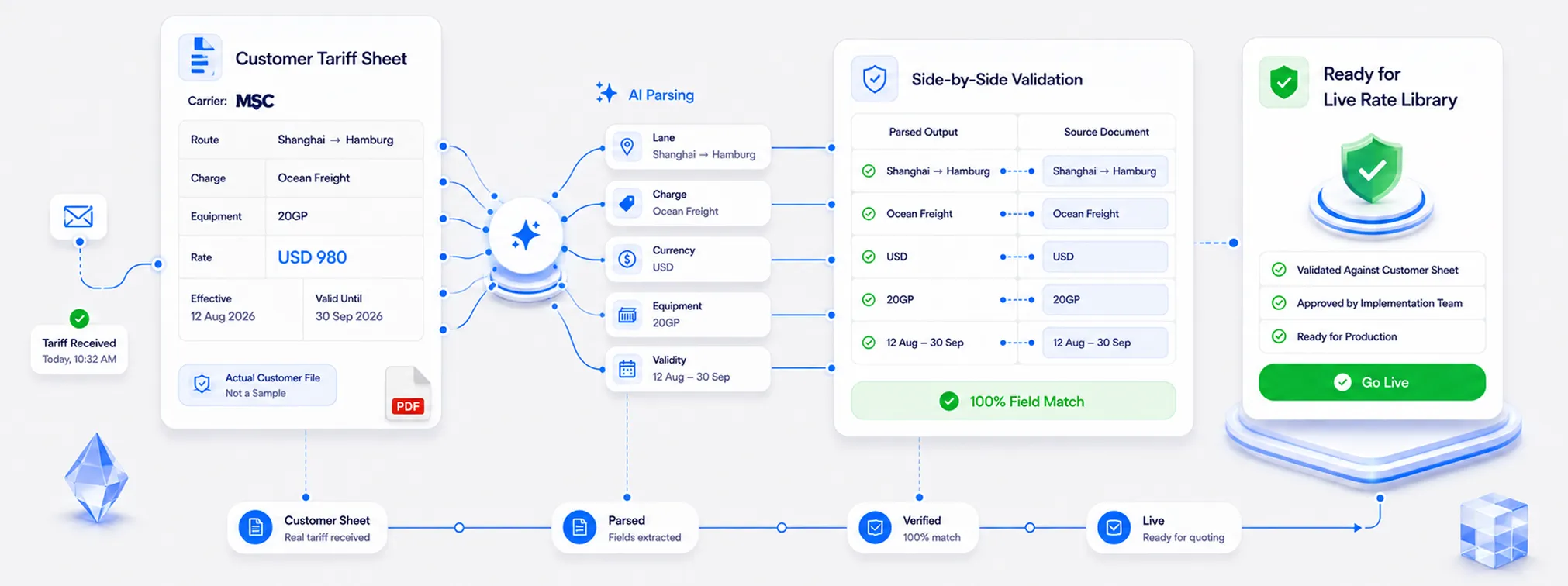
A new automated process handling something as sensitive as pricing data deserves a cautious rollout, not blind trust from day one. Shipthis implementation includes testing the AI parser against your own carriers' actual tariff sheet formats, so your pricing team can verify accuracy directly before it becomes the default workflow, rather than being asked to trust it based on a demo with someone else's sample file. Most customers are fully operational within weeks, with support continuing well past go-live.

Send Us a Real Tariff Sheet. We'll Show You What Comes Out.
Book a walkthrough with your own carrier's tariff sheet, or start a free trial and try the parser yourself.
A demo can walk through an actual tariff sheet from one of your carriers — not a clean sample file. Prefer to explore first? A free trial gives your team hands-on access with no commitment.

Book a demo or start your 30-day free trial — and talk to a real freight specialist, not a sales script.
AI Tariff Sheet Upload Questions, Answered
PDF tariff sheets, Excel files, and rates embedded directly in email, regardless of the specific layout or format each carrier uses.
Lanes, charge names, currencies, weight and volume breaks, and validity periods, identified individually and structured, not extracted as raw text.
Directly into the same searchable rate library covered by Tariff & Rate Management, no export step or manual transfer required.
Yes. Implementation includes testing the parser against your own carriers' actual tariff sheets, so your team can confirm accuracy before it becomes the default workflow.
For most tariff sheets, yes, though manual entry remains available for any rate that doesn't arrive as a document, such as a rate agreed verbally or by a format the system hasn't encountered before.
The rates this AI parser extracts are your buy-side cost. The Margin Rules Engine applies your configured markup rules on top of that cost, fixed, percentage-based, tiered, or conditional, to calculate the sell price automatically.